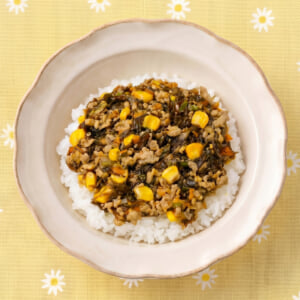
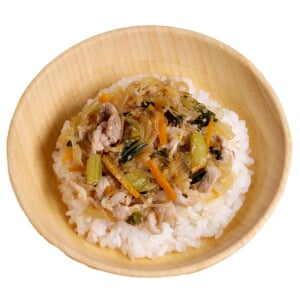
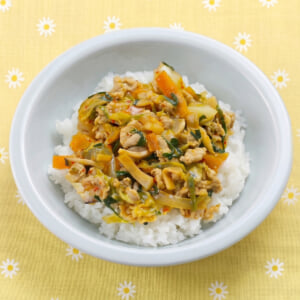
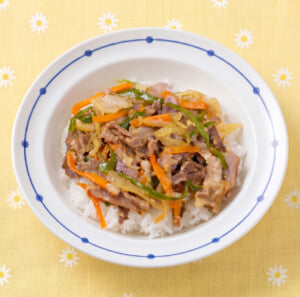
Chukadon (Chinese-Style Stir-Fry Rice Bowl)
中華丼 · Chukadon
 By Aoi, licensed nutritionist · From a Japanese preschool lunch menu
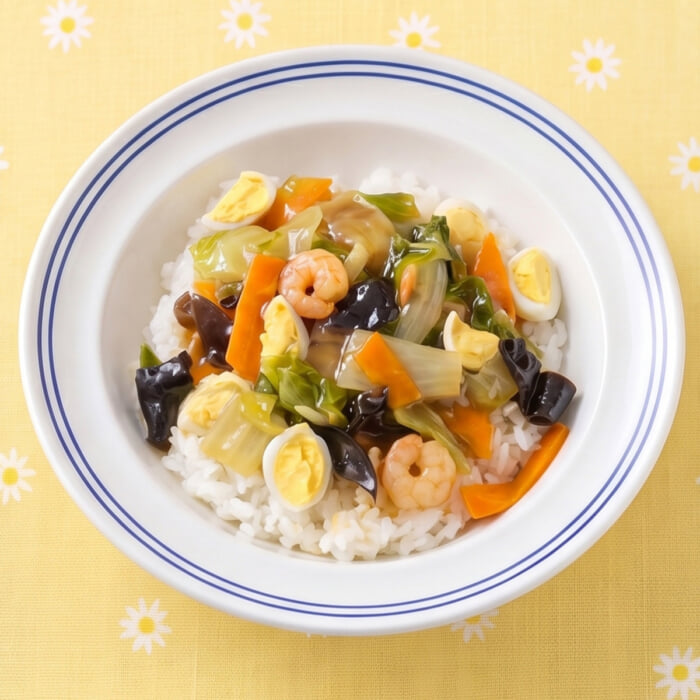
Chukadon is one of Japan's homegrown "Chinese" dishes: a stir-fry of pork, shrimp, napa cabbage, and other vegetables simmered in a light soy-and-chicken-stock sauce, thickened with potato starch, and ladled over rice. It is essentially happosai (Japanese-style eight-treasure stir-fry) served as a rice bowl, and you will find it everywhere from neighborhood Chinese restaurants to school lunch trays. Children love how the silky sauce coats every grain of rice, and it quietly gets a good amount of vegetables into them along the way. The little quail eggs tucked in are always the first thing to disappear from the bowl.
Toddlers to adults. Portion out the children's share before the final seasoning, then season the rest for adults.
Wheat-free, but uses soy sauce (made with wheat). Japanese school-lunch allergy menus usually allow it, so check with your doctor. How to read the labels
Added. Open the recipe helper (bottom right) → ☰ Menu → 🛒 Shopping list to see the ingredients for your family size.
Printing uses the number of adults and children set under Ingredients, so set those first.
Ingredients
Amounts for 1 child (1 serving). An adult counts as 2 servings.
One serving here is 1.5× the portion served to a child in a Japanese preschool, sized for Western appetites. An adult counts as two servings. Tap an ingredient to check it off.
Ingredients
- 0.6 gdried wood ear mushroomsDried black wood ear (kikurage) mushrooms that are soaked before use; mild flavor with a pleasantly crunchy texture. Substitute: Dried shiitake mushrooms, or omit.
- 15 gcarrot
- 24 gonion
- 36 gnapa cabbage
- 45 gthinly sliced pork (komagire)Small, thin offcuts of pork sold in Japan for quick stir-fries and simmered dishes. Substitute: Thinly sliced pork shoulder or loin cut into bite-size pieces.
- 18 gfrozen peeled shrimp
- 18 gboiled quail eggs (canned)Ready-boiled quail eggs sold in cans or pouches at Asian grocers. Substitute: Fresh quail eggs, boiled and peeled, or quartered hard-boiled chicken eggs.
- 2.4 gsesame oil
- 84 mlwater
Seasonings (A)
- 0.2 gchicken stock powder (Chinese-style)Japanese granulated chicken bone soup base used for Chinese-style soups and stir-fries. Substitute: Chicken bouillon granules or powder.
- 6.6 gsoy sauce
- 1.8 gsugar
- 1.2 gginger paste (tube)Grated ginger sold ready to use in a squeeze tube, a staple in Japanese kitchens. Japanese school lunch kitchens grate fresh ginger for its aroma, but for cooking at home Aoi says the tube works just fine. Tube pastes often contain added salt, oil and other ingredients, so check the label. Substitute: Use freshly grated ginger in the same amount. 1 teaspoon of paste is about 5 g.
- 1.2 ggarlic paste (tube)Grated garlic sold ready to use in a squeeze tube, a staple in Japanese kitchens. Japanese school lunch kitchens grate fresh garlic for its aroma, but for cooking at home Aoi says the tube works just fine. Tube pastes often contain added salt, oil and other ingredients, so check the label. Substitute: Use freshly grated garlic in the same amount. 1 teaspoon of paste is about 5 g.
Starch Slurry
- 2.4 gpotato starch (katakuriko)Japanese potato starch used for thickening sauces and coating fried foods. Substitute: Cornstarch: start with the same amount and add a little more if it is still thin. It thickens a little less than potato starch and needs a couple of minutes at a gentle bubble to reach full thickness.
- 4.5 gwater (for the potato starch slurry)
To Finish
- 0.9 cup (rice bowl)warm cooked rice
About the Japanese ingredients in this recipe
- dried wood ear mushrooms (乾燥きくらげ)
- Dried black wood ear (kikurage) mushrooms that are soaked before use; mild flavor with a pleasantly crunchy texture. Substitute: Dried shiitake mushrooms, or omit.
- thinly sliced pork (komagire) (豚こま切れ肉)
- Small, thin offcuts of pork sold in Japan for quick stir-fries and simmered dishes. Substitute: Thinly sliced pork shoulder or loin cut into bite-size pieces.
- boiled quail eggs (canned) (うずらの卵(水煮))
- Ready-boiled quail eggs sold in cans or pouches at Asian grocers. Substitute: Fresh quail eggs, boiled and peeled, or quartered hard-boiled chicken eggs.
- chicken stock powder (Chinese-style) (鶏ガラスープの素)
- Japanese granulated chicken bone soup base used for Chinese-style soups and stir-fries. Substitute: Chicken bouillon granules or powder.
- ginger paste (tube) (しょうがチューブ)
- Grated ginger sold ready to use in a squeeze tube, a staple in Japanese kitchens. Japanese school lunch kitchens grate fresh ginger for its aroma, but for cooking at home Aoi says the tube works just fine. Tube pastes often contain added salt, oil and other ingredients, so check the label. Substitute: Use freshly grated ginger in the same amount. 1 teaspoon of paste is about 5 g.
- garlic paste (tube) (にんにくチューブ)
- Grated garlic sold ready to use in a squeeze tube, a staple in Japanese kitchens. Japanese school lunch kitchens grate fresh garlic for its aroma, but for cooking at home Aoi says the tube works just fine. Tube pastes often contain added salt, oil and other ingredients, so check the label. Substitute: Use freshly grated garlic in the same amount. 1 teaspoon of paste is about 5 g.
- potato starch (katakuriko) (かたくり粉)
- Japanese potato starch used for thickening sauces and coating fried foods. Substitute: Cornstarch: start with the same amount and add a little more if it is still thin. It thickens a little less than potato starch and needs a couple of minutes at a gentle bubble to reach full thickness. Read the guide: Katakuriko (Japanese Potato Starch) and What to Use Instead → Guide: japanese-school-lunch.com/articles/katakuriko-potato-starch/
Directions
Video is in Japanese — the steps below are synced to it, so tap ▶ on a step to jump to that moment.
- 1
Soak the wood ear mushrooms in water for about 15 minutes to rehydrate them (cutting the vegetables while they soak saves time!). Rinse and roughly chop. Cut the carrot into thin rectangles, thinly slice the onion, and cut the napa cabbage into rough bite-size pieces. Cut the pork into 2 cm strips. Thaw the frozen shrimp under running water.
- 2
Heat the sesame oil in a frying pan and stir-fry the carrot and onion over medium heat for about 3 minutes.
- 3
Add the pork and stir-fry until it changes color, then add the shrimp, wood ear mushrooms, and napa cabbage and stir-fry until wilted.
- 4
Add the water. Once it comes to a boil, add the quail eggs and Seasonings (A) and simmer over low heat for about 10 minutes. Note: If you are also making a toddler version, add only about 70% of the combined Seasonings (A) here and proceed the same way.
- 5
When the liquid has reduced so that about one-third of the ingredients are submerged, turn off the heat and add the potato starch slurry. Cook over low heat, stirring, until the sauce thickens. Note: Once thickened, set aside the toddler portion (leave out the wood ear mushrooms and cut the shrimp into small pieces). For elementary-school age and up, add the remaining Seasonings (A) to taste and heat through.
- 6
Spoon over the rice. When serving to children, cut the quail eggs into quarters or smaller.
Tips for Best Results
- How much water evaporates depends on the size of your frying pan. If the liquid runs low while simmering, add a little water to adjust.
- If you are worried about the quail eggs, you can swap them for whole-kernel corn.
Freezing
Put rice and the Chinese-style topping (without the quail eggs) in a microwave-safe container, cover with a lid, and freeze. To eat, reheat in the microwave right in the container.
Keeps for about 2 weeks (best eaten as soon as possible).
Nutrition
| Per | 1 serving | 1 adult serving | Your total |
|---|---|---|---|
| Energy | 172.5 kcal | 345 kcal | 172.5 kcal |
| Protein | 15.1 g | 30.2 g | 15.1 g |
| Fat | 9 g | 18 g | 9 g |
| Carbohydrates | 9.7 g | 19.4 g | 9.7 g |
| Fiber | 1.6 g | 3.2 g | 1.6 g |
| Salt equivalent | 1 g | 2.1 g | 1 g |
| Calcium | 48.8 mg | 97.5 mg | 48.8 mg |
| Iron | 1.6 mg | 3.2 mg | 1.6 mg |
| Potassium | 388.5 mg | 777 mg | 388.5 mg |
| Phosphorus | 184.5 mg | 369 mg | 184.5 mg |
| Energy | Protein | Fat | Carbs | Fiber | Salt equiv. | Calcium | Iron | Potassium | Phosphorus | |
|---|---|---|---|---|---|---|---|---|---|---|
| 1 serving | 172.5 kcal | 15.1 g | 9 g | 9.7 g | 1.6 g | 1 g | 48.8 mg | 1.6 mg | 388.5 mg | 184.5 mg |
| 1 adult serving | 345 kcal | 30.2 g | 18 g | 19.4 g | 3.2 g | 2.1 g | 97.5 mg | 3.2 mg | 777 mg | 369 mg |
Values are per serving (1.5× the Japanese preschool portion); an adult serving is double. They were calculated by a licensed Japanese nutritionist using the Standard Tables of Food Composition in Japan. "Salt equivalent" is sodium × 2.54, the standard Japanese measure. Allergen flags cover egg, milk and wheat only and come from the nutritionist's records. Soy sauce and miso are made with wheat but are usually allowed on Japanese wheat-free school menus, so check with your doctor.