Chijimi (Korean-Style Savory Pancake) (Wheat-Free)
チヂミ(小麦なし) · Chijimi
 By Aoi, licensed nutritionist · From a Japanese preschool lunch menu
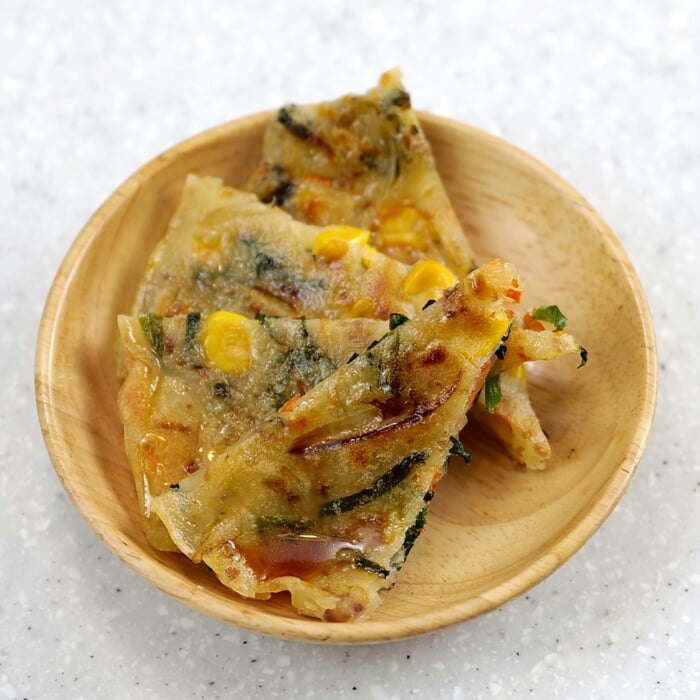
Chijimi is the Japanese name for the Korean savory pancake (buchimgae or jeon) - a thin, chewy pancake studded with vegetables and pan-fried in sesame oil. This version uses rice flour and potato starch instead of wheat flour. The vegetables and ground pork are stir-fried before they go into the batter so they cook through even in a thin pancake, and sweet corn plus a light brush of sweet soy sauce make it an easy sell to little ones. In preschool kitchens we serve it as an afternoon snack, cut into small pieces that fit neatly in a child's hand.
Wheat-free, but uses soy sauce (made with wheat). Japanese school-lunch allergy menus usually allow it, so check with your doctor. How to read the labels
Added. Open the recipe helper (bottom right) → ☰ Menu → 🛒 Shopping list to see the ingredients for your family size.
Printing uses the number of adults and children set under Ingredients, so set those first.
Ingredients
Amounts for 1 child (1 serving). An adult counts as 2 servings.
One serving here is 1.5× the portion served to a child in a Japanese preschool, sized for Western appetites. An adult counts as two servings. Tap an ingredient to check it off.
Ingredients
- 8.3 gground pork
- 7.5 gcarrot
- 7.5 gonion
- 7.5 ggarlic chives (nira)Flat-leaved chives with a mild garlic flavor, sold in bunches at Asian markets. Substitute: Scallion greens with a little minced garlic.
- 15 grice flour
- 12 gpotato starch (katakuriko)Japanese potato starch used for thickening sauces and coating fried foods. Substitute: Cornstarch: start with the same amount and add a little more if it is still thin. It thickens a little less than potato starch and needs a couple of minutes at a gentle bubble to reach full thickness.
- 10.5 gwhole kernel corn (canned or frozen)
Seasonings
- 1.5 gvegetable oil
- 30 gwater
- 0.3 gchicken stock powder (Chinese-style)Japanese granulated chicken bone soup base used for Chinese-style soups and stir-fries. Substitute: Chicken bouillon granules or powder.
- 0.3 gsoy sauce (for the mixture)
- 1.5 gsesame oil
- 1.2 gsoy sauce (for the sauce)
- 0.6 gsugar
About the Japanese ingredients in this recipe
- garlic chives (nira) (にら)
- Flat-leaved chives with a mild garlic flavor, sold in bunches at Asian markets. Substitute: Scallion greens with a little minced garlic.
- potato starch (katakuriko) (かたくり粉)
- Japanese potato starch used for thickening sauces and coating fried foods. Substitute: Cornstarch: start with the same amount and add a little more if it is still thin. It thickens a little less than potato starch and needs a couple of minutes at a gentle bubble to reach full thickness. Read the guide: Katakuriko (Japanese Potato Starch) and What to Use Instead → Guide: japanese-school-lunch.com/articles/katakuriko-potato-starch/
- chicken stock powder (Chinese-style) (鶏ガラスープの素)
- Japanese granulated chicken bone soup base used for Chinese-style soups and stir-fries. Substitute: Chicken bouillon granules or powder.
Directions
- 1
Cut the carrot into short matchsticks, slice the onion thinly and cut the slices in half, and cut the garlic chives into 2 cm lengths.
- 2
Heat the vegetable oil in a frying pan and stir-fry the vegetables from step 1. Add the ground pork and stir-fry until cooked through.
- 3
In a bowl, whisk together the rice flour, potato starch, water, chicken stock powder and soy sauce (for the mixture). Add the pork and vegetables from step 2 and the corn, and mix with cooking chopsticks.
- 4
Heat the sesame oil in a frying pan, pour in the batter in a thin layer and cook until both sides are lightly browned.
- 5
Put the soy sauce (for the sauce) and sugar in a small pan and heat briefly. Brush a thin layer over the cooked pancake from step 4, then cut into pieces.
Nutrition
| Per | 1 serving | 1 adult serving | Your total |
|---|---|---|---|
| Energy | 157.5 kcal | 315 kcal | 157.5 kcal |
| Protein | 3.2 g | 6.3 g | 3.2 g |
| Fat | 4.5 g | 9 g | 4.5 g |
| Carbohydrates | 26.3 g | 52.5 g | 26.3 g |
| Fiber | 0.9 g | 1.8 g | 0.9 g |
| Salt equivalent | 0.2 g | 0.3 g | 0.2 g |
| Calcium | 9 mg | 18 mg | 9 mg |
| Iron | 0.2 mg | 0.3 mg | 0.2 mg |
| Potassium | 129 mg | 258 mg | 129 mg |
| Energy | Protein | Fat | Carbs | Fiber | Salt equiv. | Calcium | Iron | Potassium | |
|---|---|---|---|---|---|---|---|---|---|
| 1 serving | 157.5 kcal | 3.2 g | 4.5 g | 26.3 g | 0.9 g | 0.2 g | 9 mg | 0.2 mg | 129 mg |
| 1 adult serving | 315 kcal | 6.3 g | 9 g | 52.5 g | 1.8 g | 0.3 g | 18 mg | 0.3 mg | 258 mg |
Values are per serving (1.5× the Japanese preschool portion); an adult serving is double. They were calculated by a licensed Japanese nutritionist using the Standard Tables of Food Composition in Japan. "Salt equivalent" is sodium × 2.54, the standard Japanese measure. Allergen flags cover egg, milk and wheat only and come from the nutritionist's records. Soy sauce and miso are made with wheat but are usually allowed on Japanese wheat-free school menus, so check with your doctor.