
About kyushoku & this site
The short version: these are the real recipes served to children in Japanese preschools and elementary schools, developed by a licensed nutritionist and translated for home cooks everywhere.
What is kyushoku?
Kyushoku (給食) is the school lunch program that feeds nearly every child in Japan from preschool through junior high. It is not a cafeteria with choices: the whole class eats the same balanced tray, planned by a nutritionist, cooked fresh that morning, and served by the children themselves. A typical tray has a staple (rice, bread or noodles), a main dish, a vegetable side, a soup and milk — with seasonal ingredients, low salt, and a quiet but relentless focus on getting kids to enjoy vegetables, fish, beans and seaweed.
Preschools (hoikuen) also serve an afternoon snack, oyatsu, which is often something lightly sweet and homemade — steamed cakes, rice-flour dumplings, roasted sweet potato.
Who is Aoi?
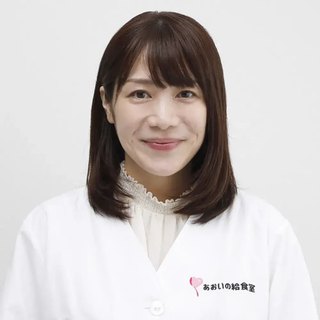
Aoi is a kanri eiyoshi (管理栄養士) — Japan's national license for registered dietitians — and spent ten years as the nutritionist in Japanese preschool kitchens, planning the menus and cooking lunch for a building full of one-to-five-year-olds every day. In 2018 Aoi founded a company that now plans school lunch menus for preschools across Japan, and has published two best-selling Japanese cookbooks of kid-friendly family meals.
Every recipe here comes from Aoi's Japanese site あおいの給食室 ("Aoi's Kyushoku Kitchen"). You can also watch Aoi cook many of them on the YouTube channel (narrated in Japanese).
How Aoi cooks for kids
A few principles run through every recipe on this site — the same ones a Japanese preschool kitchen works by:
- Easy to chew comes first. Vegetables are cut to fit on a small spoon, root vegetables start in cold water so they cook through, and slippery or chewy foods are cut so a small child can't choke on them.
- Preschool food-safety habits, translated for home. Japanese preschools heat almost everything — even cucumber and ham are blanched. The recipes tell you when that matters and when you can relax at home.
- An allergy-friendly option is never an afterthought. Egg-free "mayo", tofu standing in for egg, dairy-free snacks: swaps are built into the recipes rather than tacked on.
- The goal is a clean plate. These recipes exist because they won over rooms of picky toddlers first. Nothing here needs special equipment or ingredients that only a professional kitchen would stock.
- Make ahead, freeze, repeat. Most recipes include tips for freezing and reheating, because that is how a busy family actually eats well on a Tuesday.
The Japanese site has over 1,000 recipes, video walk-throughs and a membership community; this English site currently carries 1,073 of those recipes, translated with care for cooks who don't have a Japanese pantry.
How to read a recipe
- Portions. One serving on this site is 1.5× the portion a Japanese preschool serves a child, sized for Western appetites. An adult counts as two servings. Use theAdults / Children counter on each recipe to scale everything — ingredients and the nutrition table together — to your own table.
- Elementary-school portions. Some recipes have a second version marked "Elementary School Portion" with larger quantities for children aged 6–12.
- Weights, with cups and spoons alongside. Japanese recipes weigh everything, so every ingredient is given by weight first. Under each amount you will find the nearest familiar measure — teaspoons, tablespoons, cups, or "about half an onion" — and the g / ml ⇄ oz switch converts the weights to ounces and pounds. A cheap kitchen scale is still the single best upgrade for cooking these recipes accurately.
- Microwave power. Japanese recipes assume a 600W microwave, while full-size microwaves elsewhere are often rated around 1,000 to 1,200W. The times on this site are already converted for 1200W. If your microwave is weaker, give it proportionally longer: about 1.1× the time at 1,100W, 1.2× at 1,000W and 1.5× at 800W. Check your microwave's output power, not the (higher) power it draws.
- Seasoning is mild on purpose. Salt is kept low for young children. Taste and adjust for adults — the "portion out before seasoning" tag tells you which recipes are designed to be split that way.
- Nutrition. Values are shown for one serving as defined above, scaled from the nutritionist's own figures for a Japanese preschool portion, which were calculated from the Standard Tables of Food Composition in Japan. "Salt equivalent" is the standard Japanese measure (sodium × 2.54).
About the allergen labels
Japanese school lunches must accommodate children with food allergies, and the three most common allergens in Japan — egg, milk and wheat — are tracked on every recipe. "Egg-free", "Milk-free" and "Wheat-free" follow Japanese labeling conventions:
- Soy sauce and miso may still appear in "wheat-free" recipes. They are made with wheat and are labeled as containing it in Japan, but Japanese school-lunch allergy guidelines usually do not require removing them, because most of the wheat protein breaks down during brewing. This means "wheat-free" is not the same as gluten-free. Follow your own doctor's advice.
- Only egg, milk and wheat are tracked. Soy, sesame, fish, shellfish, peanuts and tree nuts are not flagged — soy in particular appears in most recipes as soy sauce, miso or tofu.
- Products differ by country. A Japanese consommé cube may contain milk; a Western one may not. Always read the label on what you actually buy.
This information is a guide for home cooking, not medical advice. If your child has a diagnosed allergy, please follow your allergist's guidance.
Videos
Some recipes include a video from Aoi's Japanese YouTube channel. The narration is in Japanese. On some of them, the steps on the page are synced to the video, so you can tap ▶ on a step to jump to that moment and watch the technique. Other videos may show a different version of the dish, so always follow the ingredients and steps on the page.
Contact
Found a translation that reads oddly, or an ingredient that needs a better substitute? We'd love to hear it. Reach the Japanese site through あおいの給食室.