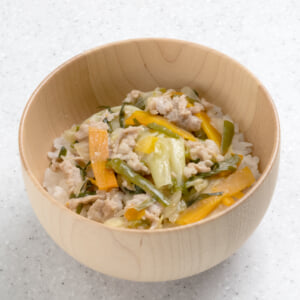
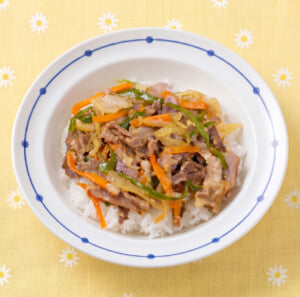
Pork Kimchi Rice Bowl (Buta Kimchi Don)
豚キムチ丼 · Buta Kimchi Don
 By Aoi, licensed nutritionist · From a Japanese preschool lunch menu
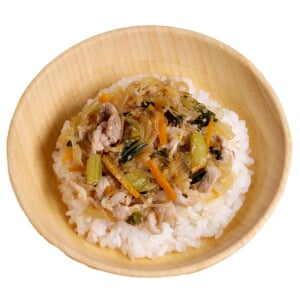
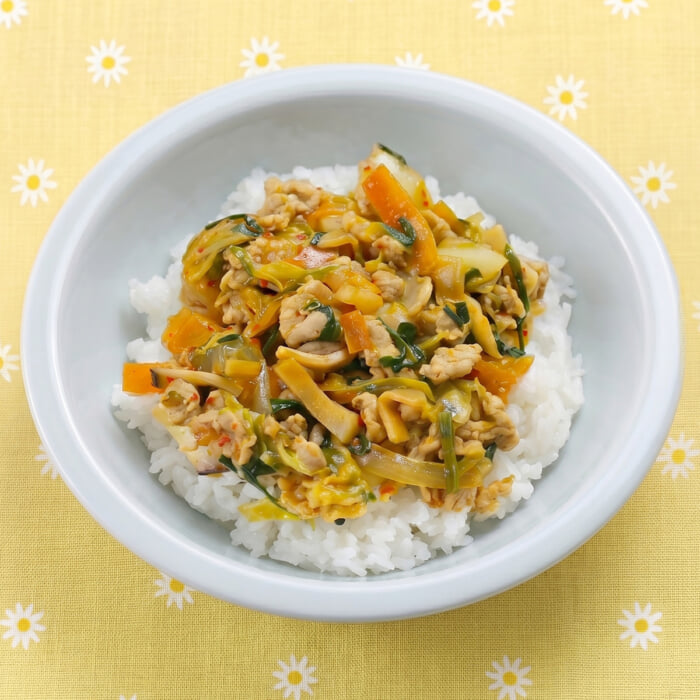
Buta kimchi (pork and kimchi stir-fry) is a weeknight favorite in Japan, and here it becomes a hearty rice bowl loaded with vegetables: onion, carrot, cabbage, king oyster mushrooms and garlic chives all cook down alongside the pork. Cooking the kimchi thoroughly softens its sourness, and a light potato-starch thickening pulls everything together so the sauce clings to the rice instead of running off. Because kimchi is fairly spicy and salty, this one is for elementary-school kids and grown-ups rather than toddlers - simply adjust the amount of kimchi to suit your family's taste.
School-age & up. Best for elementary-school-age children and older.
Wheat-free, but uses soy sauce (made with wheat). Japanese school-lunch allergy menus usually allow it, so check with your doctor. How to read the labels
Added. Open the recipe helper (bottom right) → ☰ Menu → 🛒 Shopping list to see the ingredients for your family size.
Printing uses the number of adults and children set under Ingredients, so set those first.
Ingredients
Amounts for 1 child (1 serving). An adult counts as 2 servings.
One serving here is 1.5× the portion served to a child in a Japanese preschool, sized for Western appetites. An adult counts as two servings. Tap an ingredient to check it off.
Ingredients
- 48 gthinly sliced pork (komagire)Small, thin offcuts of pork sold in Japan for quick stir-fries and simmered dishes. Substitute: Thinly sliced pork shoulder or loin cut into bite-size pieces.
- 2.4 gvegetable oil
- 36 gonion
- 18 gcarrot
- 30 gcabbage
- 18 gking oyster mushrooms
- 12 ggarlic chives (nira)Flat-leaved chives with a mild garlic flavor, sold in bunches at Asian markets. Substitute: Scallion greens with a little minced garlic.
- 2.4 gsesame oil
- 1.2 ggarlic paste (tube)Grated garlic sold ready to use in a squeeze tube, a staple in Japanese kitchens. Japanese school lunch kitchens grate fresh garlic for its aroma, but for cooking at home Aoi says the tube works just fine. Tube pastes often contain added salt, oil and other ingredients, so check the label. Substitute: Use freshly grated garlic in the same amount. 1 teaspoon of paste is about 5 g.
Seasonings (A)
- 1.8 gsoy sauce (for marinade A)
- 1.8 gsakeSake (Japanese rice wine) is used in small amounts to soften the smell of fish and meat and add depth. Japanese "cooking sake" often contains added salt. Some alcohol can remain after short cooking. If you prefer no alcohol for children, use the substitute. Substitute: The same amount of water (the taste will be a little simpler), or dry white wine.
Seasonings (B)
- 24 gkimchi
- 1.8 gsugar
- 4.5 gsoy sauce (for stir-fry seasoning B)
Starch Slurry
- 1.2 gpotato starchJapanese katakuriko, a fine potato starch used for thickening sauces and coating food before frying. Substitute: Cornstarch: start with the same amount and add a little more if it is still thin. It thickens a little less than potato starch and needs a couple of minutes at a gentle bubble to reach full thickness.
- 3 gwater
To Finish
- 0.9 cup (rice bowl)warm cooked rice
About the Japanese ingredients in this recipe
- thinly sliced pork (komagire) (豚こま切れ肉)
- Small, thin offcuts of pork sold in Japan for quick stir-fries and simmered dishes. Substitute: Thinly sliced pork shoulder or loin cut into bite-size pieces.
- garlic chives (nira) (にら)
- Flat-leaved chives with a mild garlic flavor, sold in bunches at Asian markets. Substitute: Scallion greens with a little minced garlic.
- garlic paste (tube) (にんにくチューブ)
- Grated garlic sold ready to use in a squeeze tube, a staple in Japanese kitchens. Japanese school lunch kitchens grate fresh garlic for its aroma, but for cooking at home Aoi says the tube works just fine. Tube pastes often contain added salt, oil and other ingredients, so check the label. Substitute: Use freshly grated garlic in the same amount. 1 teaspoon of paste is about 5 g.
- sake (酒)
- Sake (Japanese rice wine) is used in small amounts to soften the smell of fish and meat and add depth. Japanese "cooking sake" often contains added salt. Some alcohol can remain after short cooking. If you prefer no alcohol for children, use the substitute. Substitute: The same amount of water (the taste will be a little simpler), or dry white wine.
- potato starch (片栗粉)
- Japanese katakuriko, a fine potato starch used for thickening sauces and coating food before frying. Substitute: Cornstarch: start with the same amount and add a little more if it is still thin. It thickens a little less than potato starch and needs a couple of minutes at a gentle bubble to reach full thickness. Read the guide: Katakuriko (Japanese Potato Starch) and What to Use Instead → Guide: japanese-school-lunch.com/articles/katakuriko-potato-starch/
Directions
Video is in Japanese — the steps below are synced to it, so tap ▶ on a step to jump to that moment.
- 1
Cut the pork into 2 cm strips and rub in the seasonings (A). Thinly slice the onion, cut the carrot into short thin rectangles, cut the cabbage into 2 cm squares, cut the king oyster mushrooms into short thin rectangles, and cut the garlic chives into 2 cm lengths. Roughly chop the kimchi.
- 2
Heat the sesame oil in a frying pan and stir-fry the onion and carrot over medium heat for 4 to 5 minutes. Add the pork and garlic paste and stir-fry until the pork changes color. Note: Adding a splash of water partway through and letting the vegetables steam as they fry brings out even more sweetness.
- 3
Add the cabbage, king oyster mushrooms and garlic chives and stir-fry. Once they start to wilt, add the seasonings (B) and stir-fry. Note: Cooking it thoroughly drives off the sourness for a milder flavor, while a quick stir-fry keeps more of the crunch and spiciness.
- 4
Add a small amount of water (not included in the ingredient amounts). Note: This water is only there to keep the potato starch from clumping in the next step. You are not making a thick sauce - everything just needs to come together - so a small amount is plenty. If the vegetables have already released a lot of liquid, you can skip it.
- 5
Turn off the heat, drizzle in the starch slurry, then return the pan to low heat and stir quickly until the sauce thickens. Spoon over the rice.
Tips for Best Results
- Kimchi is quite spicy and salty, so this recipe is not suited to toddler meals. Enjoy it for elementary-school kids through adults.
- You can adjust the heat with the amount of kimchi. Add more or less to suit your taste.
Freezing Instructions
Layer the rice and then the pork kimchi in a heat-safe container, cover with the lid, and freeze. To eat, microwave it right in the container.
Keeps for about 2 weeks (but eat it as soon as you reasonably can).
Nutrition
| Per | 1 serving | 1 adult serving | Your total |
|---|---|---|---|
| Energy | 160.5 kcal | 321 kcal | 160.5 kcal |
| Protein | 12.1 g | 24.3 g | 12.1 g |
| Fat | 7.4 g | 14.7 g | 7.4 g |
| Carbohydrates | 13.2 g | 26.4 g | 13.2 g |
| Fiber | 3.2 g | 6.3 g | 3.2 g |
| Salt equivalent | 1.5 g | 3 g | 1.5 g |
| Calcium | 43.5 mg | 87 mg | 43.5 mg |
| Iron | 1 mg | 2.1 mg | 1 mg |
| Potassium | 549 mg | 1098 mg | 549 mg |
| Phosphorus | 159 mg | 318 mg | 159 mg |
| Energy | Protein | Fat | Carbs | Fiber | Salt equiv. | Calcium | Iron | Potassium | Phosphorus | |
|---|---|---|---|---|---|---|---|---|---|---|
| 1 serving | 160.5 kcal | 12.1 g | 7.4 g | 13.2 g | 3.2 g | 1.5 g | 43.5 mg | 1 mg | 549 mg | 159 mg |
| 1 adult serving | 321 kcal | 24.3 g | 14.7 g | 26.4 g | 6.3 g | 3 g | 87 mg | 2.1 mg | 1098 mg | 318 mg |
Values are per serving (1.5× the Japanese preschool portion); an adult serving is double. They were calculated by a licensed Japanese nutritionist using the Standard Tables of Food Composition in Japan. "Salt equivalent" is sodium × 2.54, the standard Japanese measure. Allergen flags cover egg, milk and wheat only and come from the nutritionist's records. Soy sauce and miso are made with wheat but are usually allowed on Japanese wheat-free school menus, so check with your doctor.