Sukiyaki (Elementary School Portion)
すき焼き · Sukiyaki
 By Aoi, licensed nutritionist · From a Japanese elementary school lunch menu
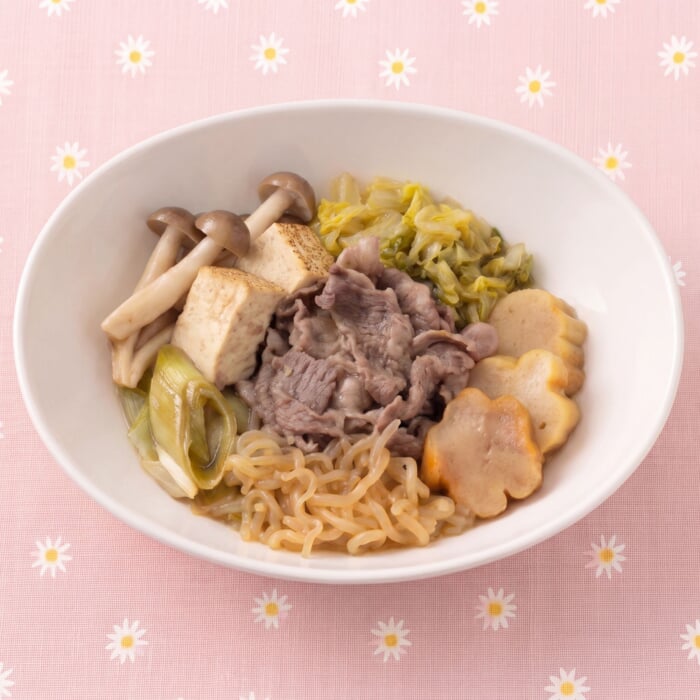
Sukiyaki is one of Japan's best-loved beef dishes: thin slices of beef, napa cabbage, long onion, tofu and shirataki simmered in a sweet soy-and-mirin broth. At home it is often cooked at the table in a shallow iron pan, but this school-lunch version simply simmers everything in one pot, with the seasoning kept gentle for small children. The sweet-savory broth is a flavor kids take to right away, and the flower-shaped fu soaks it all up, so every bite tastes good even with less salt. Made without egg or milk.
Toddlers to adults. Portion out the children's share before the final seasoning, then season the rest for adults.
Added. Open the recipe helper (bottom right) → ☰ Menu → 🛒 Shopping list to see the ingredients for your family size.
Printing uses the number of adults and children set under Ingredients, so set those first.
Ingredients
Amounts for 1 child (1 serving). An adult counts as 2 servings.
One serving here is 1.5× the portion served to a child in a Japanese elementary school, sized for Western appetites. An adult counts as two servings. Tap an ingredient to check it off.
Ingredients
- 4.5 ghana-fu (flower-shaped dried wheat gluten)Small, light, flower-shaped pieces of dried wheat gluten that soften in soup and add color for kids. Substitute: Small croutons, or simply omit.
- 15 gJapanese long onion (naga-negi)A long, thick scallion with a mild, sweet flavor when cooked, used in Japanese soups and stir-fries. Substitute: Leek (white and light green parts) or thick scallions.
- 60 gnapa cabbage
- 15 gshimeji mushroomsSmall brown-capped mushrooms sold in clusters, with a mild, nutty flavor. Substitute: Oyster or button mushrooms.
- 24 ggrilled tofu (yaki-dofu)Firm tofu that has been seared on the surface so it holds its shape when simmered. Substitute: Firm or extra-firm tofu, pressed to remove excess water.
- 36 gshirataki noodles (no-rinse type)Shirataki are translucent, chewy, nearly calorie-free noodles made from konjac yam; the no-rinse (aku-nuki fuyo) type is pre-treated so it does not need parboiling to remove its characteristic smell. Substitute: Use regular shirataki or konjac noodles (sold in water-filled pouches at Asian groceries and many supermarkets) and rinse or blanch them for about 1 minute before using; cooked glass noodles or thinly sliced konjac can also stand in.
- 60 gthinly sliced beefPaper-thin slices of beef, sold ready-cut at Japanese and Asian groceries for dishes like sukiyaki and shabu-shabu. Substitute: Ask your butcher to slice sirloin or chuck very thinly, or partially freeze a piece of beef and slice it as thinly as you can yourself.
- 114 mldashi stockJapanese soup stock, usually made from kombu (dried kelp) and/or bonito flakes; the base of most Japanese soups and simmered dishes. Substitute: Instant dashi granules dissolved in water, or a mild unsalted chicken or vegetable stock.
Sauce Mixture (A)
- 5.1 gsugar
- 9.6 gsoy sauce
- 1.5 gmirinMirin is a sweet Japanese rice seasoning that adds gentle sweetness and a glossy finish. Hon-mirin (true mirin) contains about 14% alcohol; "mirin-style seasoning" has little or no alcohol. Some alcohol can remain after short cooking. If you prefer no alcohol for children, use the substitute. Substitute: For each tablespoon of mirin, use 1 tablespoon water plus 1 to 2 teaspoons sugar.
About the Japanese ingredients in this recipe
- hana-fu (flower-shaped dried wheat gluten) (花麩)
- Small, light, flower-shaped pieces of dried wheat gluten that soften in soup and add color for kids. Substitute: Small croutons, or simply omit.
- Japanese long onion (naga-negi) (長ねぎ)
- A long, thick scallion with a mild, sweet flavor when cooked, used in Japanese soups and stir-fries. Substitute: Leek (white and light green parts) or thick scallions.
- shimeji mushrooms (しめじ)
- Small brown-capped mushrooms sold in clusters, with a mild, nutty flavor. Substitute: Oyster or button mushrooms.
- grilled tofu (yaki-dofu) (焼き豆腐)
- Firm tofu that has been seared on the surface so it holds its shape when simmered. Substitute: Firm or extra-firm tofu, pressed to remove excess water.
- shirataki noodles (no-rinse type) (しらたき(アク抜き不要タイプ))
- Shirataki are translucent, chewy, nearly calorie-free noodles made from konjac yam; the no-rinse (aku-nuki fuyo) type is pre-treated so it does not need parboiling to remove its characteristic smell. Substitute: Use regular shirataki or konjac noodles (sold in water-filled pouches at Asian groceries and many supermarkets) and rinse or blanch them for about 1 minute before using; cooked glass noodles or thinly sliced konjac can also stand in.
- thinly sliced beef (牛薄切り肉)
- Paper-thin slices of beef, sold ready-cut at Japanese and Asian groceries for dishes like sukiyaki and shabu-shabu. Substitute: Ask your butcher to slice sirloin or chuck very thinly, or partially freeze a piece of beef and slice it as thinly as you can yourself.
- dashi stock (だし汁)
- Japanese soup stock, usually made from kombu (dried kelp) and/or bonito flakes; the base of most Japanese soups and simmered dishes. Substitute: Instant dashi granules dissolved in water, or a mild unsalted chicken or vegetable stock.
- mirin (みりん)
- Mirin is a sweet Japanese rice seasoning that adds gentle sweetness and a glossy finish. Hon-mirin (true mirin) contains about 14% alcohol; "mirin-style seasoning" has little or no alcohol. Some alcohol can remain after short cooking. If you prefer no alcohol for children, use the substitute. Substitute: For each tablespoon of mirin, use 1 tablespoon water plus 1 to 2 teaspoons sugar.
Directions
Video is in Japanese — the steps below are synced to it, so tap ▶ on a step to jump to that moment.
- 1
Soak the fu in lukewarm water for about 10 minutes to rehydrate it, then squeeze out the water. (Fu soaks up the broth, so it tastes delicious even with mild seasoning.)
- 2
Cut the long onion diagonally and the napa cabbage into rough 4-5 cm pieces. Trim the base off the shimeji and separate them into small clusters, and cut the grilled tofu into bite-size pieces. Cut the shirataki into 3 cm lengths. If the beef slices are large, cut them into easy-to-eat pieces. (For small children, cut the shirataki and shimeji short.)
- 3
Put the dashi stock and (A) in a pot and bring to a boil. Add the napa cabbage, shimeji, long onion and shirataki, cover, and simmer over low heat for about 5 minutes. (If you are also making a toddler version, add only about 70% of (A) at this point.) (Adjust the amount of dashi stock according to how much liquid the vegetables release.)
- 4
Once the vegetables have wilted, add the grilled tofu and fu, cover, and simmer over low heat for another 5 minutes or so.
- 5
Add the beef, separating the slices as you go, cover, and cook briefly over medium heat just until the beef is cooked through. (Be careful not to overcook the beef, as it turns tough.) (For the toddler version, add just the toddlers' share of beef, cook it, and ladle out their portion together with the broth. For the elementary-school-and-up version, add the remaining (A) to taste, cover and simmer over low heat for about 5 minutes, then briefly cook the remaining beef.)
When making this at home, there is no need to arrange the ingredients neatly in the pot - just mix everything together and simmer, which is much easier. Serving is simple too: just scoop it straight out of the pot.
Grilled tofu holds its shape well during simmering, so I recommend it. If you can't find it, firm (momen) tofu works fine too.
In school lunches we sometimes make this with pork instead of beef.
Nutrition
| Per | 1 serving | 1 adult serving | Your total |
|---|---|---|---|
| Energy | 226.5 kcal | 453 kcal | 226.5 kcal |
| Protein | 15.6 g | 31.2 g | 15.6 g |
| Fat | 13.5 g | 27 g | 13.5 g |
| Carbohydrates | 14.9 g | 29.7 g | 14.9 g |
| Fiber | 3 g | 6 g | 3 g |
| Salt equivalent | 1.7 g | 3.3 g | 1.7 g |
| Calcium | 103.5 mg | 207 mg | 103.5 mg |
| Iron | 2.4 mg | 4.8 mg | 2.4 mg |
| Potassium | 531 mg | 1062 mg | 531 mg |
| Phosphorus | 199.5 mg | 399 mg | 199.5 mg |
| Energy | Protein | Fat | Carbs | Fiber | Salt equiv. | Calcium | Iron | Potassium | Phosphorus | |
|---|---|---|---|---|---|---|---|---|---|---|
| 1 serving | 226.5 kcal | 15.6 g | 13.5 g | 14.9 g | 3 g | 1.7 g | 103.5 mg | 2.4 mg | 531 mg | 199.5 mg |
| 1 adult serving | 453 kcal | 31.2 g | 27 g | 29.7 g | 6 g | 3.3 g | 207 mg | 4.8 mg | 1062 mg | 399 mg |
Values are per serving (1.5× the Japanese elementary-school portion); an adult serving is double. They were calculated by a licensed Japanese nutritionist using the Standard Tables of Food Composition in Japan. "Salt equivalent" is sodium × 2.54, the standard Japanese measure. Allergen flags cover egg, milk and wheat only and come from the nutritionist's records. Soy sauce and miso are made with wheat but are usually allowed on Japanese wheat-free school menus, so check with your doctor.