Shumai (Steamed Pork Dumplings)
シューマイ · Shumai
 By Aoi, licensed nutritionist · From a Japanese preschool lunch menu
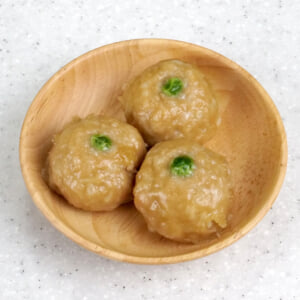
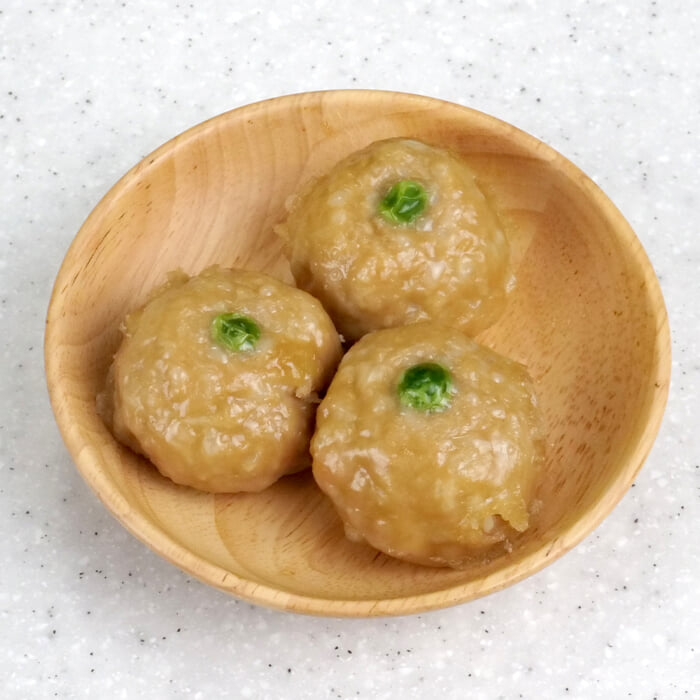
Shumai are the open-topped steamed pork dumplings that came to Japan from Chinese cooking and became a lunchbox and school-lunch favorite, complete with the single green pea pressed on top that Japanese shumai are known for. This preschool version skips the wrappers entirely: the dumplings are rolled in potato starch, which turns into a thin, glossy skin as they cool, so there is no fiddly folding. The onion is softened in the microwave first so it turns sweet and blends into the filling, giving a soft, juicy texture that even toddlers can manage with a spoon. Everything steams in an ordinary frying pan with a lid, so you don't need any special equipment.
Added. Open the recipe helper (bottom right) → ☰ Menu → 🛒 Shopping list to see the ingredients for your family size.
Printing uses the number of adults and children set under Ingredients, so set those first.
Ingredients
Amounts for 1 child (1 serving). An adult counts as 2 servings.
One serving here is 1.5× the portion served to a child in a Japanese preschool, sized for Western appetites. An adult counts as two servings. Tap an ingredient to check it off.
Ingredients
- 22.5 gonion
- 60 gground pork
- 8.6 gegg
- 1.7 gfrozen green peas
Seasonings
- 1.5 gvegetable oil
- 1.7 gsoy sauce
- 0.3 gsalt
- 0.3 gginger paste (tube)Grated ginger sold ready to use in a squeeze tube, a staple in Japanese kitchens. Japanese school lunch kitchens grate fresh ginger for its aroma, but for cooking at home Aoi says the tube works just fine. Tube pastes often contain added salt, oil and other ingredients, so check the label. Substitute: Use freshly grated ginger in the same amount. 1 teaspoon of paste is about 5 g.
- 4.5 gpotato starch (katakuriko)Japanese potato starch used for thickening sauces and coating fried foods. Substitute: Cornstarch: start with the same amount and add a little more if it is still thin. It thickens a little less than potato starch and needs a couple of minutes at a gentle bubble to reach full thickness.
- 9 gpotato starch (katakuriko)Japanese potato starch used for thickening sauces and coating fried foods. Substitute: Cornstarch: start with the same amount and add a little more if it is still thin. It thickens a little less than potato starch and needs a couple of minutes at a gentle bubble to reach full thickness.
About the Japanese ingredients in this recipe
- ginger paste (tube) (しょうがチューブ)
- Grated ginger sold ready to use in a squeeze tube, a staple in Japanese kitchens. Japanese school lunch kitchens grate fresh ginger for its aroma, but for cooking at home Aoi says the tube works just fine. Tube pastes often contain added salt, oil and other ingredients, so check the label. Substitute: Use freshly grated ginger in the same amount. 1 teaspoon of paste is about 5 g.
- potato starch (katakuriko) (かたくり粉)
- Japanese potato starch used for thickening sauces and coating fried foods. Substitute: Cornstarch: start with the same amount and add a little more if it is still thin. It thickens a little less than potato starch and needs a couple of minutes at a gentle bubble to reach full thickness. Read the guide: Katakuriko (Japanese Potato Starch) and What to Use Instead → Guide: japanese-school-lunch.com/articles/katakuriko-potato-starch/
Directions
- 1
Finely mince the onion. Place it in a microwave-safe bowl, add the vegetable oil and mix. Cover loosely with plastic wrap and microwave at 1200W for about 2 minutes 30 seconds (5 minutes at 600W).
- 2
In a bowl, combine the ground pork, the onion from step 1, soy sauce, salt, ginger paste, potato starch and beaten egg, and knead until the mixture becomes sticky. Roll into small balls and coat them in potato starch (the amount for 2 adults and 1 child divides into 15 pieces).
- 3
Cut a sheet of parchment paper into a circle larger than the bottom of your frying pan. Arrange the dumplings from step 2 on it and press a green pea into the top center of each one (push it in firmly—the dumplings puff up as they steam!).
- 4
Pour about 2 cm of water (not included in the ingredients) into the frying pan and bring it to a boil. Lower in the parchment with the dumplings from step 3, cover and steam over medium heat for about 10 minutes (a steamer works too!). As the dumplings cool, the potato starch coating melds into the meat and forms a skin.
Nutrition
| Per | 1 serving | 1 adult serving | Your total |
|---|---|---|---|
| Energy | 205.5 kcal | 411 kcal | 205.5 kcal |
| Protein | 12.1 g | 24.3 g | 12.1 g |
| Fat | 12.6 g | 25.2 g | 12.6 g |
| Carbohydrates | 11.9 g | 23.7 g | 11.9 g |
| Salt equivalent | 0.6 g | 1.2 g | 0.6 g |
| Calcium | 15 mg | 30 mg | 15 mg |
| Iron | 0.9 mg | 1.8 mg | 0.9 mg |
| Energy | Protein | Fat | Carbs | Salt equiv. | Calcium | Iron | |
|---|---|---|---|---|---|---|---|
| 1 serving | 205.5 kcal | 12.1 g | 12.6 g | 11.9 g | 0.6 g | 15 mg | 0.9 mg |
| 1 adult serving | 411 kcal | 24.3 g | 25.2 g | 23.7 g | 1.2 g | 30 mg | 1.8 mg |
Values are per serving (1.5× the Japanese preschool portion); an adult serving is double. They were calculated by a licensed Japanese nutritionist using the Standard Tables of Food Composition in Japan. "Salt equivalent" is sodium × 2.54, the standard Japanese measure. Allergen flags cover egg, milk and wheat only and come from the nutritionist's records. Soy sauce and miso are made with wheat but are usually allowed on Japanese wheat-free school menus, so check with your doctor.