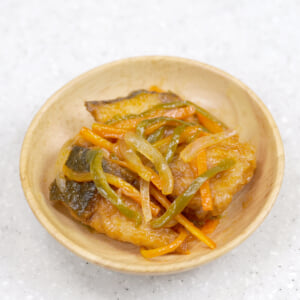
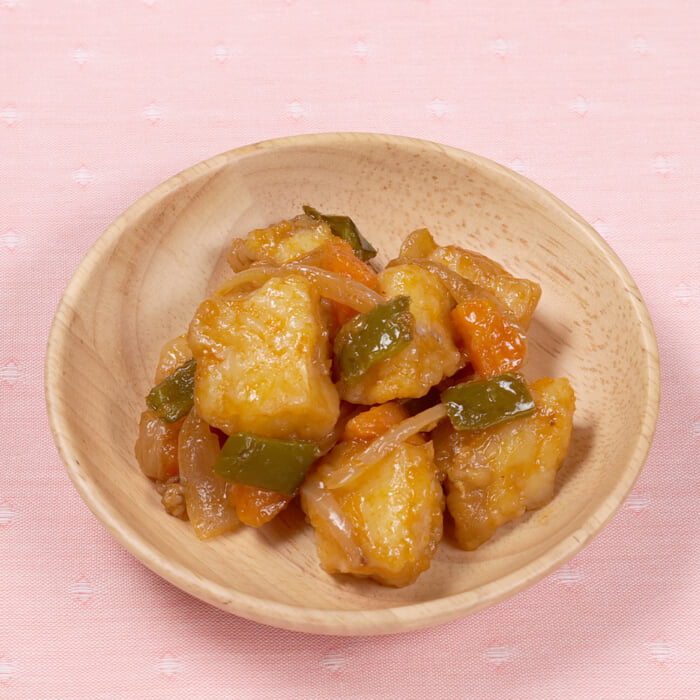
Sweet and Sour Swordfish (Subuta-Style)
メカジキの酢豚風 · Mekajiki no Subuta-fu
 By Aoi, licensed nutritionist · From a Japanese preschool lunch menu
Subuta, the Japanese take on Chinese sweet and sour pork, is a favorite on school lunch menus, and this version swaps the pork for swordfish. Swordfish is firm, meaty and free of small bones, so it holds its shape in the sauce and is easy for little ones to chew. Instead of deep-frying, the starch-coated fish is baked in the oven, which keeps things lighter and simpler in a busy kitchen. The ketchup-based sauce is gently sweet with just a touch of vinegar, so even children who are wary of sour flavors tend to clean their plates.
Added. Open the recipe helper (bottom right) → ☰ Menu → 🛒 Shopping list to see the ingredients for your family size.
Printing uses the number of adults and children set under Ingredients, so set those first.
Ingredients
Amounts for 1 child (1 serving). An adult counts as 2 servings.
One serving here is 1.5× the portion served to a child in a Japanese preschool, sized for Western appetites. An adult counts as two servings. Tap an ingredient to check it off.
Ingredients
- 67.5 gswordfish
- 0.3 gginger
- 21 gcarrot
- 36 gonion
- 12 ggreen bell pepper
Seasonings
- 1 gsoy sauce
- 0.9 gsakeSake (Japanese rice wine) is used in small amounts to soften the smell of fish and meat and add depth. Japanese "cooking sake" often contains added salt. Some alcohol can remain after short cooking. If you prefer no alcohol for children, use the substitute. Substitute: The same amount of water (the taste will be a little simpler), or dry white wine.
- 7.2 gpotato starchJapanese katakuriko, a fine potato starch used for thickening sauces and coating food before frying. Substitute: Cornstarch: start with the same amount and add a little more if it is still thin. It thickens a little less than potato starch and needs a couple of minutes at a gentle bubble to reach full thickness.
- 1.5 gvegetable oil
- 3 gvegetable oil
- 22.5 gwater
- 0.2 gconsommé bouillon (granules or cube)Japanese-style Western soup stock powder or cubes, similar to chicken or vegetable bouillon. Substitute: Chicken or vegetable bouillon granules or a bouillon cube.
- 1.4 gsugar
- 1.4 gsoy sauce
- 0.2 gsalt
- 2.1 gvinegar
- 2.6 gketchup
About the Japanese ingredients in this recipe
- sake (酒)
- Sake (Japanese rice wine) is used in small amounts to soften the smell of fish and meat and add depth. Japanese "cooking sake" often contains added salt. Some alcohol can remain after short cooking. If you prefer no alcohol for children, use the substitute. Substitute: The same amount of water (the taste will be a little simpler), or dry white wine.
- potato starch (片栗粉)
- Japanese katakuriko, a fine potato starch used for thickening sauces and coating food before frying. Substitute: Cornstarch: start with the same amount and add a little more if it is still thin. It thickens a little less than potato starch and needs a couple of minutes at a gentle bubble to reach full thickness. Read the guide: Katakuriko (Japanese Potato Starch) and What to Use Instead → Guide: japanese-school-lunch.com/articles/katakuriko-potato-starch/
- consommé bouillon (granules or cube) (コンソメ)
- Japanese-style Western soup stock powder or cubes, similar to chicken or vegetable bouillon. Substitute: Chicken or vegetable bouillon granules or a bouillon cube.
Directions
- 1
Cut the swordfish into 2 cm cubes and marinate in the soy sauce, sake and ginger juice. Line a baking sheet with parchment paper brushed with oil, toss the swordfish in potato starch and arrange the pieces on the sheet. Bake in a 180°C (350°F) oven for 10 minutes.
- 2
Cut the carrot into rangiri (irregular bite-size chunks) and parboil. Thinly slice the onion and cut the slices in half; cut the green bell pepper into 1.5 cm squares.
- 3
Heat the oil in a pot, add the vegetables from step 2 and sauté well.
- 4
Add the combined sauce ingredients and the swordfish from step 1, and stir-fry briefly until everything is coated and the liquid has cooked off.
Nutrition
| Per | 1 serving | 1 adult serving | Your total |
|---|---|---|---|
| Energy | 190.5 kcal | 381 kcal | 190.5 kcal |
| Protein | 13.8 g | 27.6 g | 13.8 g |
| Fat | 9.8 g | 19.5 g | 9.8 g |
| Carbohydrates | 13.4 g | 26.7 g | 13.4 g |
| Salt equivalent | 0.8 g | 1.5 g | 0.8 g |
| Calcium | 16.5 mg | 33 mg | 16.5 mg |
| Iron | 0.6 mg | 1.2 mg | 0.6 mg |
| Energy | Protein | Fat | Carbs | Salt equiv. | Calcium | Iron | |
|---|---|---|---|---|---|---|---|
| 1 serving | 190.5 kcal | 13.8 g | 9.8 g | 13.4 g | 0.8 g | 16.5 mg | 0.6 mg |
| 1 adult serving | 381 kcal | 27.6 g | 19.5 g | 26.7 g | 1.5 g | 33 mg | 1.2 mg |
Values are per serving (1.5× the Japanese preschool portion); an adult serving is double. They were calculated by a licensed Japanese nutritionist using the Standard Tables of Food Composition in Japan. "Salt equivalent" is sodium × 2.54, the standard Japanese measure. Allergen flags cover egg, milk and wheat only and come from the nutritionist's records. Soy sauce and miso are made with wheat but are usually allowed on Japanese wheat-free school menus, so check with your doctor.