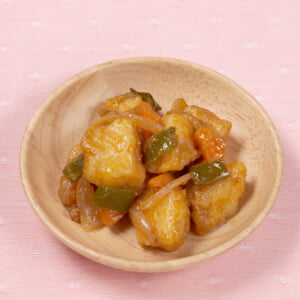
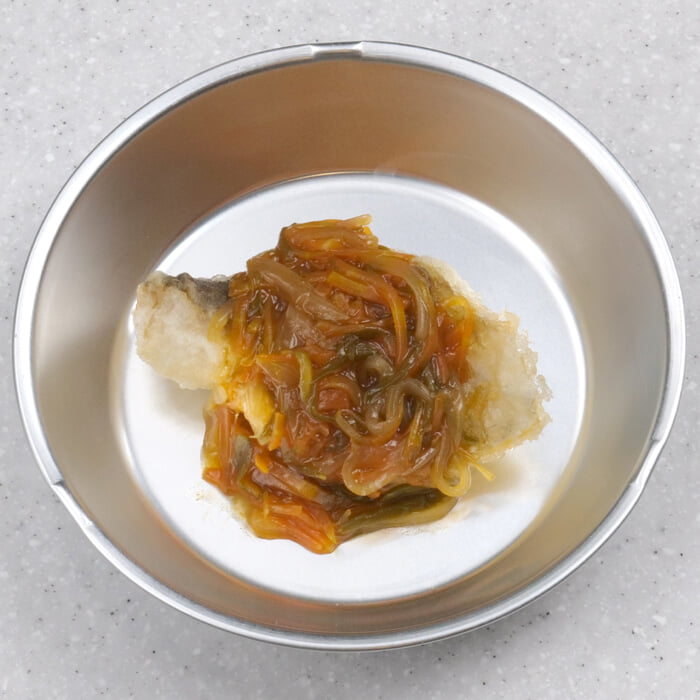
Fried Cod with Vegetable Ankake
タラの野菜あんかけ【オカフーズ版】 · Tara no Yasai Ankake
 By Aoi, licensed nutritionist · From a Japanese preschool lunch menu
Ankake means a dish finished with a glossy, starch-thickened sauce, and here that sauce is a gentle sweet-and-sour mix of ketchup, soy sauce and vinegar simmered with carrot, onion and green bell pepper. The cod is dusted in potato starch and fried until crisp, then the sauce goes over the top so even children who are wary of fish tuck in happily. This version is written for frozen cod from Oka Foods, a Japanese frozen-fish supplier, and the key trick is frying it half-thawed so the fish stays juicy and doesn't shrink.
Added. Open the recipe helper (bottom right) → ☰ Menu → 🛒 Shopping list to see the ingredients for your family size.
Printing uses the number of adults and children set under Ingredients, so set those first.
Ingredients
Amounts for 1 child (1 serving). An adult counts as 2 servings.
One serving here is 1.5× the portion served to a child in a Japanese preschool, sized for Western appetites. An adult counts as two servings. Tap an ingredient to check it off.
Ingredients
- 67.5 gfrozen cod
- 11 gcarrot
- 11 ggreen bell pepper
- 16.5 gonion
Seasonings
- a pinchpepper
- 9 gpotato starch (katakuriko)Japanese potato starch used for thickening sauces and coating fried foods. Substitute: Cornstarch: start with the same amount and add a little more if it is still thin. It thickens a little less than potato starch and needs a couple of minutes at a gentle bubble to reach full thickness.
- 7.5 gvegetable oil
- 1.5 gvegetable oil
- 90 gwater
- 2 gsugar
- 2.6 gsoy sauce
- 2.7 gvinegar
- 1.7 gketchup
- 0.9 gpotato starch (katakuriko)Japanese potato starch used for thickening sauces and coating fried foods. Substitute: Cornstarch: start with the same amount and add a little more if it is still thin. It thickens a little less than potato starch and needs a couple of minutes at a gentle bubble to reach full thickness.
- 2.3 gwater
About the Japanese ingredients in this recipe
- potato starch (katakuriko) (かたくり粉)
- Japanese potato starch used for thickening sauces and coating fried foods. Substitute: Cornstarch: start with the same amount and add a little more if it is still thin. It thickens a little less than potato starch and needs a couple of minutes at a gentle bubble to reach full thickness. Read the guide: Katakuriko (Japanese Potato Starch) and What to Use Instead → Guide: japanese-school-lunch.com/articles/katakuriko-potato-starch/
Directions
- 1
Cut the carrot and green bell pepper into thin matchsticks, and thinly slice the onion.
- 2
Heat the vegetable oil in a frying pan, add the carrot, onion and green bell pepper, and stir-fry over medium heat for about 3 minutes. Add water (just enough to cover the vegetables) and the sugar, and simmer over low heat for about 10 minutes.
- 3
Add the soy sauce, vinegar and ketchup and simmer over low heat for about 3 minutes. Stir in the potato starch dissolved in water and heat briefly over low heat until the sauce thickens.
- 4
Place the frozen cod, still in its bag, in a large bowl and run cold tap water over it for about 10 to 15 minutes to half-thaw. If you prefer not to thaw it in the bag, leave it in the refrigerator for about 4 to 5 hours to half-thaw (half-thawed means the surface is soft while the center is still slightly firm).
- 5
Pat the surface of the cod thoroughly dry with paper towels and sprinkle both sides with pepper. Coat both sides well with potato starch. Note: If using fresh cod, also sprinkle on a pinch of salt.
- 6
Heat the vegetable oil in a frying pan to 180°C (350°F), add the cod and fry for about 5 minutes, turning it over as it cooks.
* The amount of water for the vegetable sauce will vary with the size of your pan, so keep an eye on it and adjust as needed.
* Frying half-thawed cod quickly at a high temperature keeps it from shrinking and locks in its flavor and moisture.
* Adding half-thawed cod to the oil makes the temperature drop sharply, so it takes longer to cook through. For that reason, fry no more than about 5 pieces at a time.
Nutrition
| Per | 1 serving | 1 adult serving | Your total |
|---|---|---|---|
| Energy | 184.5 kcal | 369 kcal | 184.5 kcal |
| Protein | 12.5 g | 24.9 g | 12.5 g |
| Fat | 9.1 g | 18.3 g | 9.1 g |
| Carbohydrates | 14.3 g | 28.5 g | 14.3 g |
| Salt equivalent | 0.6 g | 1.2 g | 0.6 g |
| Calcium | 30 mg | 60 mg | 30 mg |
| Iron | 0.3 mg | 0.6 mg | 0.3 mg |
| Energy | Protein | Fat | Carbs | Salt equiv. | Calcium | Iron | |
|---|---|---|---|---|---|---|---|
| 1 serving | 184.5 kcal | 12.5 g | 9.1 g | 14.3 g | 0.6 g | 30 mg | 0.3 mg |
| 1 adult serving | 369 kcal | 24.9 g | 18.3 g | 28.5 g | 1.2 g | 60 mg | 0.6 mg |
Values are per serving (1.5× the Japanese preschool portion); an adult serving is double. They were calculated by a licensed Japanese nutritionist using the Standard Tables of Food Composition in Japan. "Salt equivalent" is sodium × 2.54, the standard Japanese measure. Allergen flags cover egg, milk and wheat only and come from the nutritionist's records. Soy sauce and miso are made with wheat but are usually allowed on Japanese wheat-free school menus, so check with your doctor.
Cooking for bigger kids? See the elementary-school portion of this recipe.