Pork and Beans
ポークビーンズ
 By Aoi, licensed nutritionist · From a Japanese preschool lunch menu
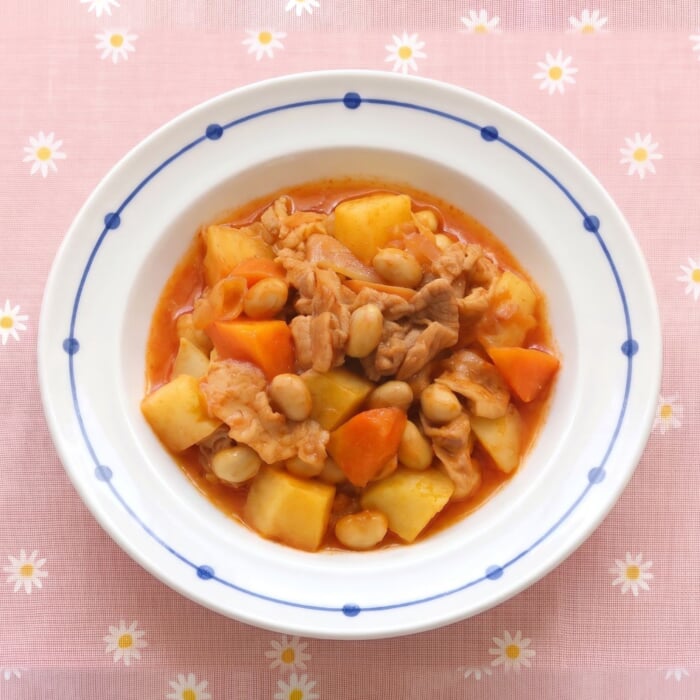
Pork and beans is a fixture on Japanese school lunch menus, and this is the version that comes out of the preschool kitchen: soybeans, pork and soft-cooked vegetables simmered in a gently sweet ketchup sauce. Unlike the American original, the Japanese kyushoku version uses soybeans, which hold their shape and add a nutty bite that children enjoy. Simmering the ketchup for a good while cooks off its sharpness, so even kids who are wary of tangy flavors tend to clean their plates. It contains no egg, milk or wheat.
Toddlers to adults. The whole family can eat this exactly as written.
Added. Open the recipe helper (bottom right) → ☰ Menu → 🛒 Shopping list to see the ingredients for your family size.
Printing uses the number of adults and children set under Ingredients, so set those first.
Ingredients
Amounts for 1 child (1 serving). An adult counts as 2 servings.
One serving here is 1.5× the portion served to a child in a Japanese preschool, sized for Western appetites. An adult counts as two servings. Tap an ingredient to check it off.
Ingredients
- 45 gpotato
- 30 gcarrot
- 45 gonion
- 36 gthinly sliced pork (komagire)Small, thin offcuts of pork sold in Japan for quick stir-fries and simmered dishes. Substitute: Thinly sliced pork shoulder or loin cut into bite-size pieces.
- 3 gvegetable oil
- 60 gboiled soybeans (canned or vacuum-packed)Plain cooked whole soybeans sold in cans or pouches, ready to use. Substitute: Canned chickpeas or white beans.
- 150 mlwater
- 1.5 gsugar
Sauce Mixture (A)
- 30 gketchup
- 0.6 gsalt
- a pinchpepper
About the Japanese ingredients in this recipe
- thinly sliced pork (komagire) (豚こま切れ肉)
- Small, thin offcuts of pork sold in Japan for quick stir-fries and simmered dishes. Substitute: Thinly sliced pork shoulder or loin cut into bite-size pieces.
- boiled soybeans (canned or vacuum-packed) (大豆水煮)
- Plain cooked whole soybeans sold in cans or pouches, ready to use. Substitute: Canned chickpeas or white beans.
Directions
Video is in Japanese — the steps below are synced to it, so tap ▶ on a step to jump to that moment.
- 1
Cut the potato into 2 cm cubes and soak in water for about 5 minutes. Cut the carrot into small rolling-cut (rangiri) chunks. Cut the onion in half crosswise, then slice it 1 cm wide. Cut the pork into 2 cm wide pieces.
- 2
Put the carrot and onion in a microwave-safe container, add 1 tbsp water (not included in the ingredient amounts), cover loosely with plastic wrap and microwave at 1200W for about 3 minutes 30 seconds (7 minutes at 600W).
- 3
Heat the oil in a pot, add the microwaved carrot and onion and stir-fry over medium heat for about 3 minutes. Add the potato and pork and stir-fry, breaking the pork apart, until the pork changes color. (If the bottom of the pot starts to brown, add a small amount of water and scrape up the browned bits as you stir-fry; this adds extra savory depth.)
- 4
Add the boiled soybeans (drained), the water and the sugar. Once it comes to a boil, reduce to low heat and simmer for about 5 minutes. (Sweetness is slow to soak into the ingredients, so the sugar goes in first and simmers before the other seasonings.)
- 5
Add Sauce Mixture (A) and simmer over low heat for about 15 minutes. Leave it to cool in the pot so the flavors soak in. (Ketchup scorches easily, so keep the heat low and stir from time to time. Simmering until almost all the liquid is gone gives a rich, concentrated flavor.)
Simmering well after adding the ketchup cooks off its sharpness, leaving a gentle, sweet-leaning flavor.
It is a natural match for bread, of course, but it is also delicious spooned over rice as pork and beans rice.
Nutrition
| Per | 1 serving | 1 adult serving | Your total |
|---|---|---|---|
| Energy | 256.5 kcal | 513 kcal | 256.5 kcal |
| Protein | 17.4 g | 34.8 g | 17.4 g |
| Fat | 11 g | 21.9 g | 11 g |
| Carbohydrates | 28.8 g | 57.6 g | 28.8 g |
| Fiber | 10.2 g | 20.4 g | 10.2 g |
| Salt equivalent | 1.8 g | 3.6 g | 1.8 g |
| Calcium | 84 mg | 168 mg | 84 mg |
| Iron | 1.8 mg | 3.6 mg | 1.8 mg |
| Potassium | 741 mg | 1482 mg | 741 mg |
| Phosphorus | 231 mg | 462 mg | 231 mg |
| Energy | Protein | Fat | Carbs | Fiber | Salt equiv. | Calcium | Iron | Potassium | Phosphorus | |
|---|---|---|---|---|---|---|---|---|---|---|
| 1 serving | 256.5 kcal | 17.4 g | 11 g | 28.8 g | 10.2 g | 1.8 g | 84 mg | 1.8 mg | 741 mg | 231 mg |
| 1 adult serving | 513 kcal | 34.8 g | 21.9 g | 57.6 g | 20.4 g | 3.6 g | 168 mg | 3.6 mg | 1482 mg | 462 mg |
Values are per serving (1.5× the Japanese preschool portion); an adult serving is double. They were calculated by a licensed Japanese nutritionist using the Standard Tables of Food Composition in Japan. "Salt equivalent" is sodium × 2.54, the standard Japanese measure. Allergen flags cover egg, milk and wheat only and come from the nutritionist's records. Soy sauce and miso are made with wheat but are usually allowed on Japanese wheat-free school menus, so check with your doctor.