Chili con Carne
チリコンカン
 By Aoi, licensed nutritionist · From a Japanese preschool lunch menu
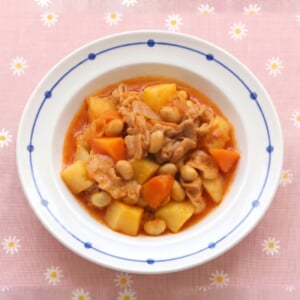
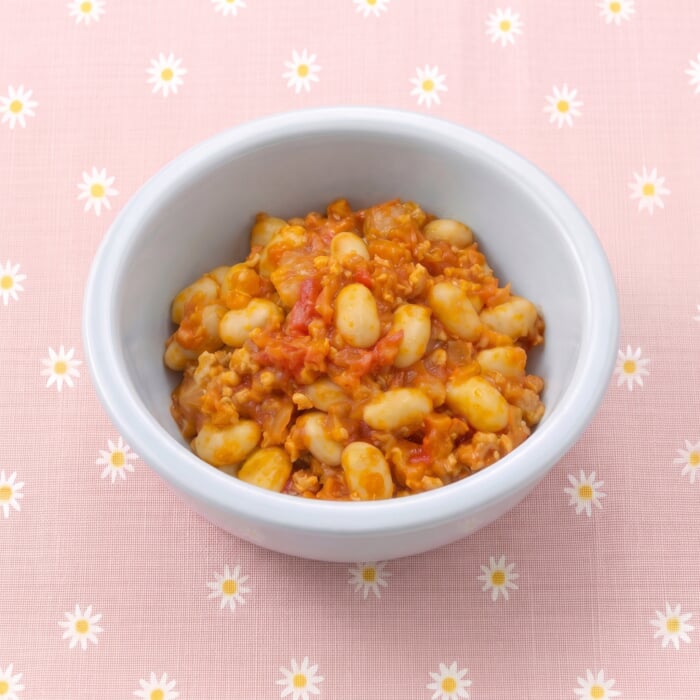
Chili con carne is a favorite on Japanese school lunch menus, and this preschool version swaps the usual kidney beans for soft boiled soybeans, which small children find much easier to chew. Finely chopped onion and carrot cook down into the tomato sauce, and a touch of ketchup and chuno sauce keeps the flavor gently sweet rather than spicy. The chili powder goes in only for the older kids, so one pot can feed the whole family: spoon it over rice or scoop it up with bread.
Toddlers to adults. Portion out the children's share before the final seasoning, then season the rest for adults.
Added. Open the recipe helper (bottom right) → ☰ Menu → 🛒 Shopping list to see the ingredients for your family size.
Printing uses the number of adults and children set under Ingredients, so set those first.
Ingredients
Amounts for 1 child (1 serving). An adult counts as 2 servings.
One serving here is 1.5× the portion served to a child in a Japanese preschool, sized for Western appetites. An adult counts as two servings. Tap an ingredient to check it off.
Ingredients
- 45 gground pork
- 54 gboiled soybeans (canned or vacuum-packed)Plain cooked whole soybeans sold in cans or pouches, ready to use. Substitute: Canned chickpeas or white beans.
- 60 gonion
- 24 gcarrot
- 1.2 ggarlic paste (tube)Grated garlic sold ready to use in a squeeze tube, a staple in Japanese kitchens. Japanese school lunch kitchens grate fresh garlic for its aroma, but for cooking at home Aoi says the tube works just fine. Tube pastes often contain added salt, oil and other ingredients, so check the label. Substitute: Use freshly grated garlic in the same amount. 1 teaspoon of paste is about 5 g.
- 1.5 gvegetable oil
- 105 mlwater
- 75 gcanned diced tomatoes
- 1 gflour
- to tastechili powder
Sauce Mixture (A)
- 0.8 gconsommé granulesA Japanese granulated Western-style soup base, similar to bouillon powder, used for soups and stews. Substitute: Chicken or vegetable bouillon powder, or a crumbled bouillon cube, works.
- 13.5 gketchup
- 4.5 gchuno sauce (Japanese medium-thick brown sauce)A sweet, tangy, fruit-and-vegetable-based brown sauce that sits between thin Worcestershire and thick tonkatsu sauce. Substitute: Tonkatsu sauce, or Worcestershire sauce mixed with a little ketchup.
- 1.8 gsoy sauce
- 0.5 gsalt
- to tastepepper
About the Japanese ingredients in this recipe
- boiled soybeans (canned or vacuum-packed) (大豆水煮)
- Plain cooked whole soybeans sold in cans or pouches, ready to use. Substitute: Canned chickpeas or white beans.
- garlic paste (tube) (にんにくチューブ)
- Grated garlic sold ready to use in a squeeze tube, a staple in Japanese kitchens. Japanese school lunch kitchens grate fresh garlic for its aroma, but for cooking at home Aoi says the tube works just fine. Tube pastes often contain added salt, oil and other ingredients, so check the label. Substitute: Use freshly grated garlic in the same amount. 1 teaspoon of paste is about 5 g.
- consommé granules (コンソメ(顆粒))
- A Japanese granulated Western-style soup base, similar to bouillon powder, used for soups and stews. Substitute: Chicken or vegetable bouillon powder, or a crumbled bouillon cube, works.
- chuno sauce (Japanese medium-thick brown sauce) (中濃ソース)
- A sweet, tangy, fruit-and-vegetable-based brown sauce that sits between thin Worcestershire and thick tonkatsu sauce. Substitute: Tonkatsu sauce, or Worcestershire sauce mixed with a little ketchup.
Directions
Video is in Japanese — the steps below are synced to it, so tap ▶ on a step to jump to that moment.
- 1
Roughly chop the onion and carrot. Place them in a heatproof container, add 1 tbsp water (not included in the ingredient amounts), cover loosely with plastic wrap leaving a gap, and microwave at 1200W for about 4 minutes (8 minutes at 600W).
- 2
Heat the oil in a pot, add the vegetables from step 1 and stir-fry over medium heat for about 3 minutes. Add the ground pork and garlic paste and stir-fry until cooked through.
- 3
Add the water and canned diced tomatoes and simmer over low heat for about 5 minutes.
- 4
Add the soybeans and (A) and simmer over low heat for about 10 minutes, stirring occasionally, until reduced. (If you are also making a toddler version, use about 70% of the combined amount of (A), then set the toddlers' portion aside after adding the flour in step 5. For elementary-school age and up, add the remaining seasonings and the chili powder to taste and simmer for about 2 minutes more.)
- 5
To finish, add the flour and cook over low heat, stirring, until thickened. Let cool so the flavors meld. (Chili powder is spicy, so leave it out of the portions for elementary-school-age children and younger.)
Tips for Best Results
- Simmer until you can draw a line across the bottom of the pot with a wooden spatula; this mellows the acidity of the tomatoes and gives a rich, concentrated flavor.
- When serving over rice, leave out the flour; when serving with bread, thickening it with the flour makes it easier to eat.
Freezing
Let cool, then divide into single-meal portions in freezer bags and freeze. Reheat in the microwave to serve.
Keeps about 2 weeks (best eaten as soon as possible).
Nutrition
| Per | 1 serving | 1 adult serving | Your total |
|---|---|---|---|
| Energy | 246 kcal | 492 kcal | 246 kcal |
| Protein | 16.8 g | 33.6 g | 16.8 g |
| Fat | 13.1 g | 26.1 g | 13.1 g |
| Carbohydrates | 21.3 g | 42.6 g | 21.3 g |
| Fiber | 6.5 g | 12.9 g | 6.5 g |
| Salt equivalent | 2.1 g | 4.2 g | 2.1 g |
| Calcium | 84 mg | 168 mg | 84 mg |
| Iron | 2.1 mg | 4.2 mg | 2.1 mg |
| Potassium | 675 mg | 1350 mg | 675 mg |
| Phosphorus | 198 mg | 396 mg | 198 mg |
| Energy | Protein | Fat | Carbs | Fiber | Salt equiv. | Calcium | Iron | Potassium | Phosphorus | |
|---|---|---|---|---|---|---|---|---|---|---|
| 1 serving | 246 kcal | 16.8 g | 13.1 g | 21.3 g | 6.5 g | 2.1 g | 84 mg | 2.1 mg | 675 mg | 198 mg |
| 1 adult serving | 492 kcal | 33.6 g | 26.1 g | 42.6 g | 12.9 g | 4.2 g | 168 mg | 4.2 mg | 1350 mg | 396 mg |
Values are per serving (1.5× the Japanese preschool portion); an adult serving is double. They were calculated by a licensed Japanese nutritionist using the Standard Tables of Food Composition in Japan. "Salt equivalent" is sodium × 2.54, the standard Japanese measure. Allergen flags cover egg, milk and wheat only and come from the nutritionist's records. Soy sauce and miso are made with wheat but are usually allowed on Japanese wheat-free school menus, so check with your doctor.
Cooking for bigger kids? See the elementary-school portion of this recipe.