Oni Keema Curry (Japanese Demon Rice Plate)
鬼キーマカレー(乳なし)
 By Aoi, licensed nutritionist · From a Japanese preschool lunch menu
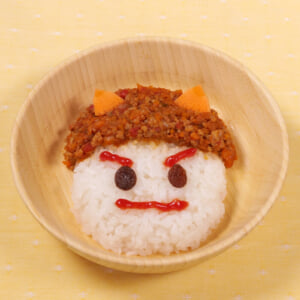
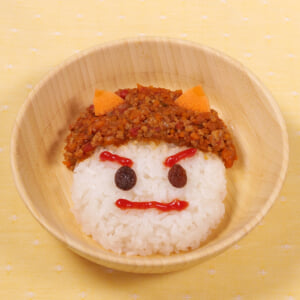
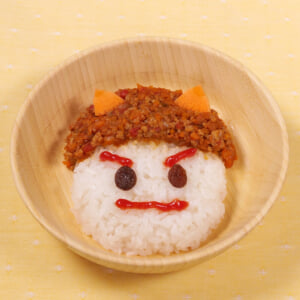
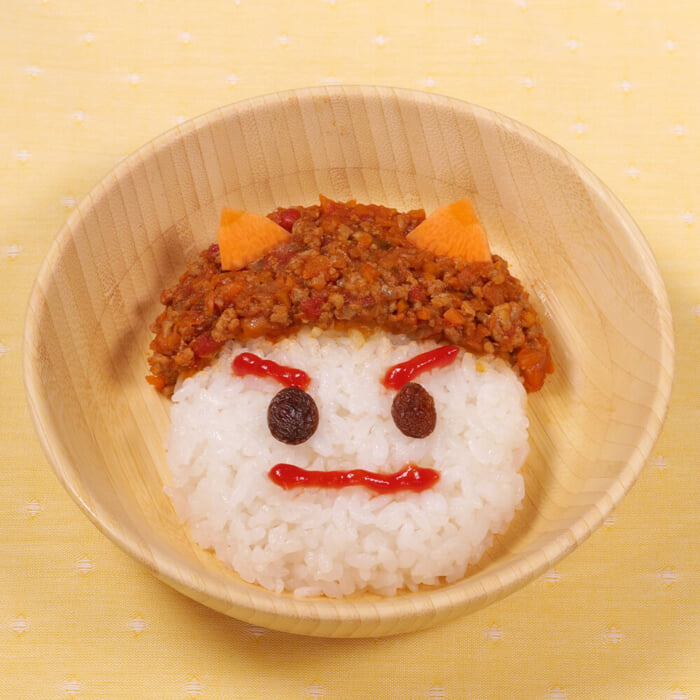
This playful keema curry is served as the face of an oni, the horned demon of Japanese folklore. A flat oval of rice becomes the face, the spiced ground pork becomes a shock of hair, two little carrot pieces make the horns, and raisins and ketchup finish the eyes, eyebrows and mouth. In preschool kitchens we serve it around Setsubun, the early-February bean-throwing festival when children chase the oni out of the house, and even the shyest eaters light up when a demon arrives on their plate. The curry itself is mild and tomato-sweet, thickened with a little flour, and made without egg.
Added. Open the recipe helper (bottom right) → ☰ Menu → 🛒 Shopping list to see the ingredients for your family size.
Printing uses the number of adults and children set under Ingredients, so set those first.
Ingredients
Amounts for 1 child (1 serving). An adult counts as 2 servings.
One serving here is 1.5× the portion served to a child in a Japanese preschool, sized for Western appetites. An adult counts as two servings. Tap an ingredient to check it off.
Ingredients
- 75 griceJapanese short-grain white rice (japonica), which cooks up soft and slightly sticky. The amount listed is for uncooked rice. Substitute: Sushi rice, or another short-grain or medium-grain rice such as Calrose.
- 30 gcarrot
- 30 gonion
- 9 ggreen bell pepper
- 52.5 gground pork
- 37.5 gwater
- 4.5 graisins
Seasonings
- 6 gvegetable oil
- 3.5 gflour
- 0.3 ggarlic paste (tube)Grated garlic sold ready to use in a squeeze tube, a staple in Japanese kitchens. Japanese school lunch kitchens grate fresh garlic for its aroma, but for cooking at home Aoi says the tube works just fine. Tube pastes often contain added salt, oil and other ingredients, so check the label. Substitute: Use freshly grated garlic in the same amount. 1 teaspoon of paste is about 5 g.
- 0.2 gcurry powder
- 8.3 gketchup
- 0.3 gconsommé bouillon (allergen-free)Japanese-style consommé stock granules or cubes, used as a Western-style soup base. This kind is made without egg and milk, but most recipes on this site that use it list wheat in their allergens, so check the label if you avoid wheat. Substitute: A chicken or vegetable bouillon powder or cube made without egg, milk or wheat (check the label).
- 0.2 gsalt
- 2.6 gWorcestershire sauce
About the Japanese ingredients in this recipe
- rice (米)
- Japanese short-grain white rice (japonica), which cooks up soft and slightly sticky. The amount listed is for uncooked rice. Substitute: Sushi rice, or another short-grain or medium-grain rice such as Calrose.
- garlic paste (tube) (にんにくチューブ)
- Grated garlic sold ready to use in a squeeze tube, a staple in Japanese kitchens. Japanese school lunch kitchens grate fresh garlic for its aroma, but for cooking at home Aoi says the tube works just fine. Tube pastes often contain added salt, oil and other ingredients, so check the label. Substitute: Use freshly grated garlic in the same amount. 1 teaspoon of paste is about 5 g.
- consommé bouillon (allergen-free) (コンソメ(アレルゲン不使用))
- Japanese-style consommé stock granules or cubes, used as a Western-style soup base. This kind is made without egg and milk, but most recipes on this site that use it list wheat in their allergens, so check the label if you avoid wheat. Substitute: A chicken or vegetable bouillon powder or cube made without egg, milk or wheat (check the label).
- Worcestershire sauce (ウスターソース)
- Read the guide: Bull-Dog Worcestershire Sauce: Japan's Everyday Brown Sauce → Guide: japanese-school-lunch.com/articles/bull-dog-worcestershire-sauce/
Directions
- 1
For the horns, cut 2 small quarter-rounds of carrot per face and boil them in hot water for 3 minutes. Boil the raisins in hot water for about 1 minute and drain.
- 2
Finely chop the remaining carrot, the onion and the green bell pepper. Heat the oil in a frying pan and sauté over medium heat for about 6 minutes.
- 3
Add the ground pork, turn the heat to low and cook for about 2 minutes. Turn off the heat, sprinkle in the flour and stir to coat.
- 4
Add the garlic paste, curry powder, ketchup, consommé, salt, Worcestershire sauce and water. Return to low heat and simmer, stirring, for about 3 to 5 minutes.
- 5
Cook the rice and shape it into a flat oval to make the oni's face. Spoon the curried meat over the top part of the oval to make the oni's hair.
- 6
Push a carrot quarter-round into the hair on each side to make the horns, then draw the eyebrows and mouth with ketchup. Add raisins for the eyes.
Nutrition
| Per | 1 serving | 1 adult serving | Your total |
|---|---|---|---|
| Energy | 481.5 kcal | 963 kcal | 481.5 kcal |
| Protein | 15.2 g | 30.3 g | 15.2 g |
| Fat | 15.8 g | 31.5 g | 15.8 g |
| Carbohydrates | 73.7 g | 147.3 g | 73.7 g |
| Fiber | 2.6 g | 5.1 g | 2.6 g |
| Salt equivalent | 0.8 g | 1.5 g | 0.8 g |
| Calcium | 30 mg | 60 mg | 30 mg |
| Iron | 1.5 mg | 3 mg | 1.5 mg |
| Potassium | 451.5 mg | 903 mg | 451.5 mg |
| Energy | Protein | Fat | Carbs | Fiber | Salt equiv. | Calcium | Iron | Potassium | |
|---|---|---|---|---|---|---|---|---|---|
| 1 serving | 481.5 kcal | 15.2 g | 15.8 g | 73.7 g | 2.6 g | 0.8 g | 30 mg | 1.5 mg | 451.5 mg |
| 1 adult serving | 963 kcal | 30.3 g | 31.5 g | 147.3 g | 5.1 g | 1.5 g | 60 mg | 3 mg | 903 mg |
Values are per serving (1.5× the Japanese preschool portion); an adult serving is double. They were calculated by a licensed Japanese nutritionist using the Standard Tables of Food Composition in Japan. "Salt equivalent" is sodium × 2.54, the standard Japanese measure. Allergen flags cover egg, milk and wheat only and come from the nutritionist's records. Soy sauce and miso are made with wheat but are usually allowed on Japanese wheat-free school menus, so check with your doctor.