Salmon Momiji-yaki (Baked Salmon with Carrot Mayo)
鮭のもみじ焼き(小麦なし) · Sake no Momijiyaki
 By Aoi, licensed nutritionist · From a Japanese preschool lunch menu
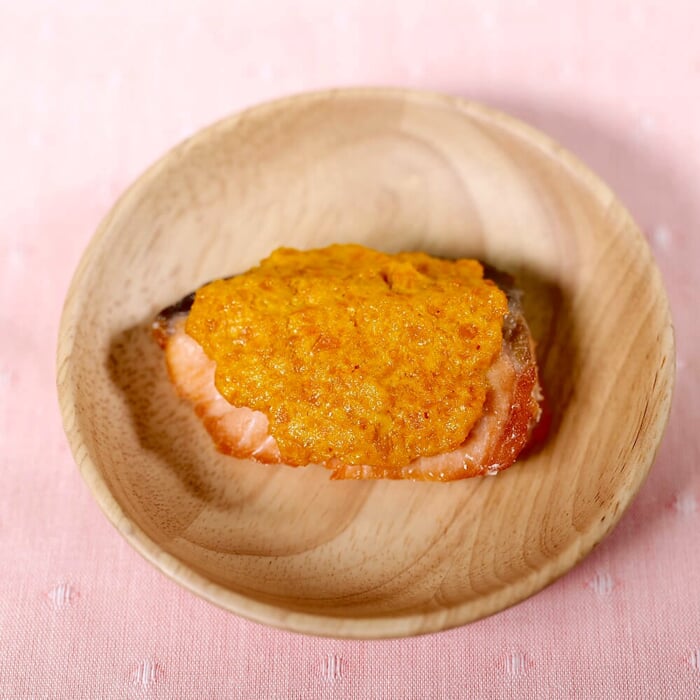
Momiji means maple leaves, and this dish takes its name from the bright orange topping of mashed carrot and mayonnaise that looks like autumn foliage on the fish. The creamy, slightly sweet sauce softens the taste of the salmon, so even children who are unsure about fish tend to clean their plates. In our preschool kitchen we use egg-free Mayodore and dust the salmon with rice flour instead of wheat flour. It bakes in the oven with very little hands-on work, making it an easy weeknight main.
Wheat-free, but uses soy sauce (made with wheat). Japanese school-lunch allergy menus usually allow it, so check with your doctor. How to read the labels
Added. Open the recipe helper (bottom right) → ☰ Menu → 🛒 Shopping list to see the ingredients for your family size.
Printing uses the number of adults and children set under Ingredients, so set those first.
Ingredients
Amounts for 1 child (1 serving). An adult counts as 2 servings.
One serving here is 1.5× the portion served to a child in a Japanese preschool, sized for Western appetites. An adult counts as two servings. Tap an ingredient to check it off.
Ingredients
- 67.5 gsalmon fillet (skinless, boneless)
- 10.8 gcarrot
Seasonings
- 0.1 gsalt
- 2.1 gjoshinko (Japanese non-glutinous rice flour)Fine flour milled from regular short-grain rice, used for chewy Japanese sweets like dango. Substitute: Plain rice flour (not glutinous/sweet rice flour).
- 1.5 gvegetable oil
- 4.1 gegg-free mayonnaise (Mayodore)A Japanese egg-free mayonnaise-style dressing. Substitute: Any egg-free or vegan mayonnaise.
- 0.4 gsoy sauce
About the Japanese ingredients in this recipe
- joshinko (Japanese non-glutinous rice flour) (上新粉)
- Fine flour milled from regular short-grain rice, used for chewy Japanese sweets like dango. Substitute: Plain rice flour (not glutinous/sweet rice flour).
- egg-free mayonnaise (Mayodore) (マヨドレ)
- A Japanese egg-free mayonnaise-style dressing. Substitute: Any egg-free or vegan mayonnaise.
Directions
- 1
Sprinkle the salmon with salt to season it.
- 2
Boil the carrot until soft and mash it into a paste. Mix in the mayonnaise (egg-free Mayodore) and soy sauce.
- 3
Grease a baking sheet with the oil. Dust the salmon from step 1 with joshinko, arrange the pieces on the sheet, and bake in an oven preheated to 200°C (390°F) for about 10 minutes.
- 4
Partway through, take the salmon out, spoon the carrot mixture from step 2 on top, and bake for about 5 minutes more.
Nutrition
| Per | 1 serving | 1 adult serving | Your total |
|---|---|---|---|
| Energy | 133.5 kcal | 267 kcal | 133.5 kcal |
| Protein | 15.5 g | 30.9 g | 15.5 g |
| Fat | 6.9 g | 13.8 g | 6.9 g |
| Carbohydrates | 3 g | 6 g | 3 g |
| Fiber | 0.3 g | 0.6 g | 0.3 g |
| Salt equivalent | 0.3 g | 0.6 g | 0.3 g |
| Calcium | 10.5 mg | 21 mg | 10.5 mg |
| Iron | 0.3 mg | 0.6 mg | 0.3 mg |
| Potassium | 292.5 mg | 585 mg | 292.5 mg |
| Energy | Protein | Fat | Carbs | Fiber | Salt equiv. | Calcium | Iron | Potassium | |
|---|---|---|---|---|---|---|---|---|---|
| 1 serving | 133.5 kcal | 15.5 g | 6.9 g | 3 g | 0.3 g | 0.3 g | 10.5 mg | 0.3 mg | 292.5 mg |
| 1 adult serving | 267 kcal | 30.9 g | 13.8 g | 6 g | 0.6 g | 0.6 g | 21 mg | 0.6 mg | 585 mg |
Values are per serving (1.5× the Japanese preschool portion); an adult serving is double. They were calculated by a licensed Japanese nutritionist using the Standard Tables of Food Composition in Japan. "Salt equivalent" is sodium × 2.54, the standard Japanese measure. Allergen flags cover egg, milk and wheat only and come from the nutritionist's records. Soy sauce and miso are made with wheat but are usually allowed on Japanese wheat-free school menus, so check with your doctor.