Natto and Shirasu (Baby Sardine) Tempura
納豆としらすの天ぷら(小麦なし) · Natto to Shirasu no Tempura
 By Aoi, licensed nutritionist · From a Japanese preschool lunch menu
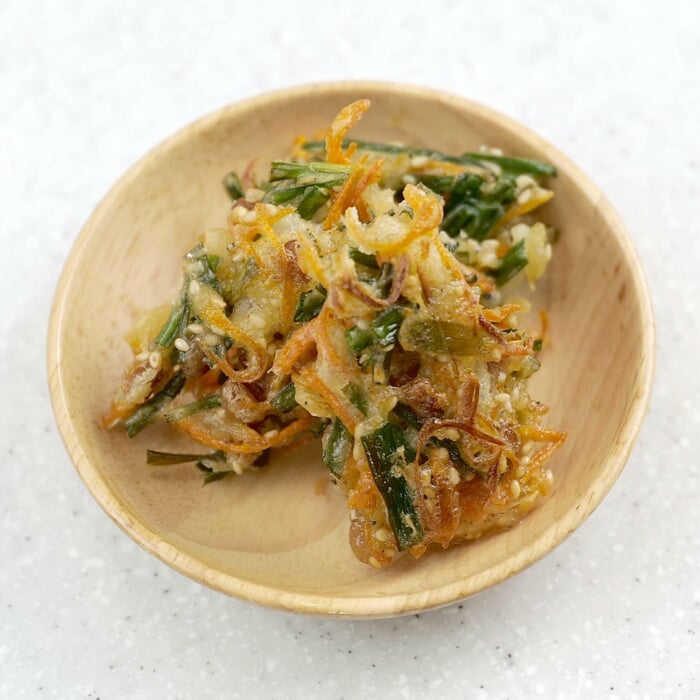
These little fritters are a kakiage-style tempura: natto, shirasu and thin slivers of garlic chives, carrot and onion, held together in a light batter made with joshinko rice flour and soy milk instead of wheat flour. Frying mellows natto's strong aroma and tames its stringiness, so even children who turn their noses up at natto on rice tend to enjoy it this way. The shirasu bring a gentle savory saltiness, which is why the batter itself needs only a pinch of salt.
Wheat-free, but uses soy sauce (made with wheat). Japanese school-lunch allergy menus usually allow it, so check with your doctor. How to read the labels
Added. Open the recipe helper (bottom right) → ☰ Menu → 🛒 Shopping list to see the ingredients for your family size.
Printing uses the number of adults and children set under Ingredients, so set those first.
Ingredients
Amounts for 1 child (1 serving). An adult counts as 2 servings.
One serving here is 1.5× the portion served to a child in a Japanese preschool, sized for Western appetites. An adult counts as two servings. Tap an ingredient to check it off.
Ingredients
- 10.5 ggarlic chives (nira)Flat-leaved chives with a mild garlic flavor, sold in bunches at Asian markets. Substitute: Scallion greens with a little minced garlic.
- 15 gcarrot
- 15 gonion
- 12 gnatto (fermented soybeans)Sticky fermented soybeans with a strong savory flavor, sold in small packs (often frozen) at Japanese grocers. Substitute: No close substitute; look for it in the frozen section of an Asian grocer.
- 4.1 gshirasu (dried baby sardines)Tiny, lightly salted and dried whole baby sardines that add gentle saltiness and calcium. Substitute: A small amount of flaked canned sardines, or omit.
Seasonings
- 0.3 gsoy sauce
- 11.6 gjoshinko (Japanese non-glutinous rice flour)Fine flour milled from regular short-grain rice, used for chewy Japanese sweets like dango. Substitute: Plain rice flour (not glutinous/sweet rice flour).
- 0.8 gbaking powder
- 18 gsweetened soy milk (Japanese chosei tonyu)Japanese 'prepared' soy milk that is lightly sweetened and flavored to taste milder than plain soy milk. Substitute: Regular (original, lightly sweetened) soy milk from the supermarket.
- 2.8 gwhite sesame seeds
- 0.2 gsalt
- 9 gvegetable oil
About the Japanese ingredients in this recipe
- garlic chives (nira) (にら)
- Flat-leaved chives with a mild garlic flavor, sold in bunches at Asian markets. Substitute: Scallion greens with a little minced garlic.
- natto (fermented soybeans) (納豆)
- Sticky fermented soybeans with a strong savory flavor, sold in small packs (often frozen) at Japanese grocers. Substitute: No close substitute; look for it in the frozen section of an Asian grocer.
- shirasu (dried baby sardines) (しらす干し)
- Tiny, lightly salted and dried whole baby sardines that add gentle saltiness and calcium. Substitute: A small amount of flaked canned sardines, or omit.
- joshinko (Japanese non-glutinous rice flour) (上新粉)
- Fine flour milled from regular short-grain rice, used for chewy Japanese sweets like dango. Substitute: Plain rice flour (not glutinous/sweet rice flour).
- sweetened soy milk (Japanese chosei tonyu) (調製豆乳)
- Japanese 'prepared' soy milk that is lightly sweetened and flavored to taste milder than plain soy milk. Substitute: Regular (original, lightly sweetened) soy milk from the supermarket.
Directions
- 1
Cut the garlic chives into 2 cm lengths, cut the carrot into short matchsticks, and thinly slice the onion, then cut the slices in half so they are half their length.
- 2
Put the natto in a bowl, add the soy sauce and mix to season it. Add the vegetables from step 1 and the shirasu and mix together.
- 3
In a separate bowl, combine the joshinko, baking powder, soy milk, white sesame seeds and salt, and stir lightly until just mixed.
- 4
Add the natto mixture from step 2 to the batter from step 3 and fold together gently. (Because natto is sticky, the batter will be thick and heavy - that is fine.)
- 5
Heat the oil to 170°C (340°F), scoop up the batter with a spoon and drop it into the oil to fry. (Tip: pour a little oil into a small container and rest the spoon in it before scooping; the batter will slide off the spoon much more easily.)
Nutrition
| Per | 1 serving | 1 adult serving | Your total |
|---|---|---|---|
| Energy | 186 kcal | 372 kcal | 186 kcal |
| Protein | 5.4 g | 10.8 g | 5.4 g |
| Fat | 12.6 g | 25.2 g | 12.6 g |
| Carbohydrates | 15.2 g | 30.3 g | 15.2 g |
| Fiber | 2.7 g | 5.4 g | 2.7 g |
| Salt equivalent | 0.5 g | 0.9 g | 0.5 g |
| Calcium | 93 mg | 186 mg | 93 mg |
| Iron | 1 mg | 2.1 mg | 1 mg |
| Potassium | 295.5 mg | 591 mg | 295.5 mg |
| Energy | Protein | Fat | Carbs | Fiber | Salt equiv. | Calcium | Iron | Potassium | |
|---|---|---|---|---|---|---|---|---|---|
| 1 serving | 186 kcal | 5.4 g | 12.6 g | 15.2 g | 2.7 g | 0.5 g | 93 mg | 1 mg | 295.5 mg |
| 1 adult serving | 372 kcal | 10.8 g | 25.2 g | 30.3 g | 5.4 g | 0.9 g | 186 mg | 2.1 mg | 591 mg |
Values are per serving (1.5× the Japanese preschool portion); an adult serving is double. They were calculated by a licensed Japanese nutritionist using the Standard Tables of Food Composition in Japan. "Salt equivalent" is sodium × 2.54, the standard Japanese measure. Allergen flags cover egg, milk and wheat only and come from the nutritionist's records. Soy sauce and miso are made with wheat but are usually allowed on Japanese wheat-free school menus, so check with your doctor.
Ingredients in this recipe
You might also like
All recipes →
Tofu Tsukune (Baked Chicken and Tofu Patties) (Wheat-Free)
Pork Chap (Pork in Ketchup Sauce)
Kabocha Squash Gratin (Wheat-Free)
Soybean Kakiage (Mixed Tempura Fritters) (Wheat-Free)
Tofu Chanpuru (Okinawan Stir-Fry)