Gapao Rice (Thai-Style Stir-Fried Pork Over Rice)
ガパオライス
 By Aoi, licensed nutritionist · From a Japanese preschool lunch menu
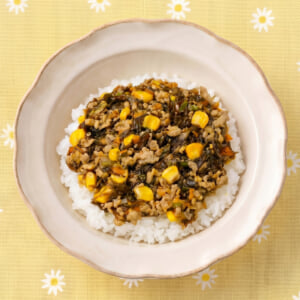
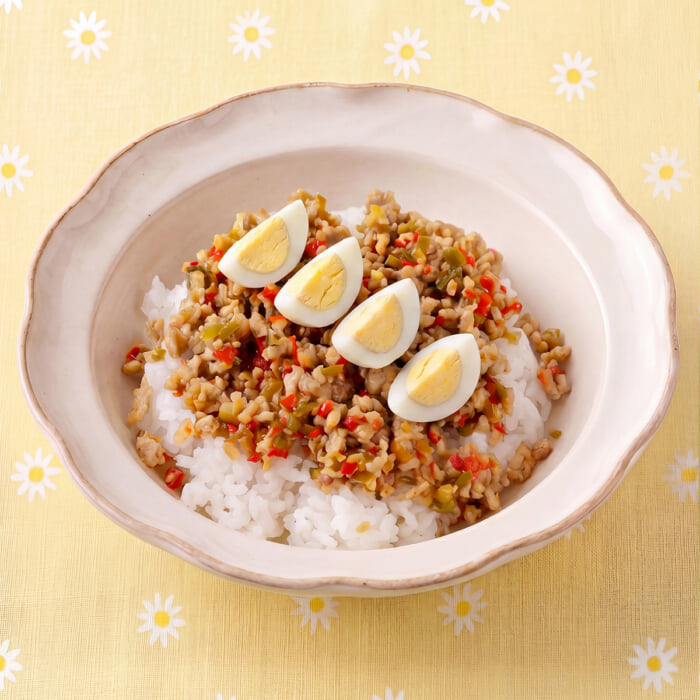
Gapao rice is Japan's take on the Thai street-food favorite pad kra pao - stir-fried minced meat spooned over rice - and it has become a popular cafe and lunch-plate dish across Japan. This preschool version leaves out the chili and holy basil and instead seasons the pork with soy sauce, a little sugar, Worcestershire sauce, and garlic, so it tastes savory and gently sweet rather than spicy. The green and red bell peppers are chopped fine and cooked down until soft, which softens their bitterness and helps even pepper-wary kids clean their plates. A few boiled quail eggs on top stand in for the usual fried egg and make the plate fun to look at.
Toddlers to adults. The whole family can eat this exactly as written.
Wheat-free, but uses soy sauce (made with wheat). Japanese school-lunch allergy menus usually allow it, so check with your doctor. How to read the labels
Added. Open the recipe helper (bottom right) → ☰ Menu → 🛒 Shopping list to see the ingredients for your family size.
Printing uses the number of adults and children set under Ingredients, so set those first.
Ingredients
Amounts for 1 child (1 serving). An adult counts as 2 servings.
One serving here is 1.5× the portion served to a child in a Japanese preschool, sized for Western appetites. An adult counts as two servings. Tap an ingredient to check it off.
Ingredients
- 72 gground pork
- 24 gonion
- 18 ggreen bell pepper
- 18 gred bell pepper
- 3.6 gvegetable oil
Seasonings (A)
- 0.4 ggarlic paste (tube)Grated garlic sold ready to use in a squeeze tube, a staple in Japanese kitchens. Japanese school lunch kitchens grate fresh garlic for its aroma, but for cooking at home Aoi says the tube works just fine. Tube pastes often contain added salt, oil and other ingredients, so check the label. Substitute: Use freshly grated garlic in the same amount. 1 teaspoon of paste is about 5 g.
- 3.6 gsoy sauce
- 0.9 gsugar
- 4.2 gWorcestershire sauce
- 0.2 gchicken stock powder (Chinese-style)Japanese granulated chicken bone soup base used for Chinese-style soups and stir-fries. Substitute: Chicken bouillon granules or powder.
Toppings
- 18 gboiled quail eggs (canned)Ready-boiled quail eggs sold in cans or pouches at Asian grocers. Substitute: Fresh quail eggs, boiled and peeled, or quartered hard-boiled chicken eggs.
To Finish
- 0.9 cup (rice bowl)warm cooked rice
About the Japanese ingredients in this recipe
- garlic paste (tube) (にんにくチューブ)
- Grated garlic sold ready to use in a squeeze tube, a staple in Japanese kitchens. Japanese school lunch kitchens grate fresh garlic for its aroma, but for cooking at home Aoi says the tube works just fine. Tube pastes often contain added salt, oil and other ingredients, so check the label. Substitute: Use freshly grated garlic in the same amount. 1 teaspoon of paste is about 5 g.
- Worcestershire sauce (ウスターソース)
- Read the guide: Bull-Dog Worcestershire Sauce: Japan's Everyday Brown Sauce → Guide: japanese-school-lunch.com/articles/bull-dog-worcestershire-sauce/
- chicken stock powder (Chinese-style) (鶏ガラスープの素)
- Japanese granulated chicken bone soup base used for Chinese-style soups and stir-fries. Substitute: Chicken bouillon granules or powder.
- boiled quail eggs (canned) (うずらの卵(水煮))
- Ready-boiled quail eggs sold in cans or pouches at Asian grocers. Substitute: Fresh quail eggs, boiled and peeled, or quartered hard-boiled chicken eggs.
Directions
- 1
Finely chop the onion, green bell pepper, and red bell pepper.
- 2
Heat the vegetable oil in a frying pan over medium heat, add the chopped vegetables from step 1, and stir-fry for about 3 minutes. Turn the heat down to low and stir-fry for about 2 minutes more.
- 3
Add the ground pork, turn the heat back up to medium, and stir-fry for about 1 minute, until the pork is cooked through.
- 4
Add the Seasonings (A) and stir-fry over low heat for about 3 minutes.
- 5
Spoon the mixture over the rice and top with the quail eggs. Note: When serving to children, cut each quail egg into quarters or smaller pieces.
Tips for Making It Well
- Stir-fry the vegetables until they have cooked down to about one-third of their original volume. This softens their bitterness and makes them much easier for kids to eat.
- If you have leftover bell pepper, it is great in a dish like chinjao rosu (Chinese-style pepper and beef stir-fry).
- This recipe can be enjoyed as is by everyone from toddlers to adults - no need to set aside a separate portion for the kids.
Freezing Instructions
Layer the rice and then the gapao topping (without the quail eggs) in a heatproof container, cover with the lid, and freeze. To eat, reheat in the microwave in the same container and top with the quail eggs.
Keeps for about 2 weeks (but is best eaten as soon as possible).
Nutrition
| Per | 1 serving | 1 adult serving | Your total |
|---|---|---|---|
| Energy | 235.5 kcal | 471 kcal | 235.5 kcal |
| Protein | 15.6 g | 31.2 g | 15.6 g |
| Fat | 18.6 g | 37.2 g | 18.6 g |
| Carbohydrates | 6.6 g | 13.2 g | 6.6 g |
| Fiber | 1 g | 2.1 g | 1 g |
| Salt equivalent | 0.9 g | 1.8 g | 0.9 g |
| Calcium | 25.5 mg | 51 mg | 25.5 mg |
| Iron | 1.2 mg | 2.4 mg | 1.2 mg |
| Potassium | 339 mg | 678 mg | 339 mg |
| Phosphorus | 135 mg | 270 mg | 135 mg |
| Energy | Protein | Fat | Carbs | Fiber | Salt equiv. | Calcium | Iron | Potassium | Phosphorus | |
|---|---|---|---|---|---|---|---|---|---|---|
| 1 serving | 235.5 kcal | 15.6 g | 18.6 g | 6.6 g | 1 g | 0.9 g | 25.5 mg | 1.2 mg | 339 mg | 135 mg |
| 1 adult serving | 471 kcal | 31.2 g | 37.2 g | 13.2 g | 2.1 g | 1.8 g | 51 mg | 2.4 mg | 678 mg | 270 mg |
Values are per serving (1.5× the Japanese preschool portion); an adult serving is double. They were calculated by a licensed Japanese nutritionist using the Standard Tables of Food Composition in Japan. "Salt equivalent" is sodium × 2.54, the standard Japanese measure. Allergen flags cover egg, milk and wheat only and come from the nutritionist's records. Soy sauce and miso are made with wheat but are usually allowed on Japanese wheat-free school menus, so check with your doctor.