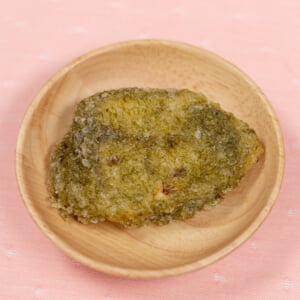
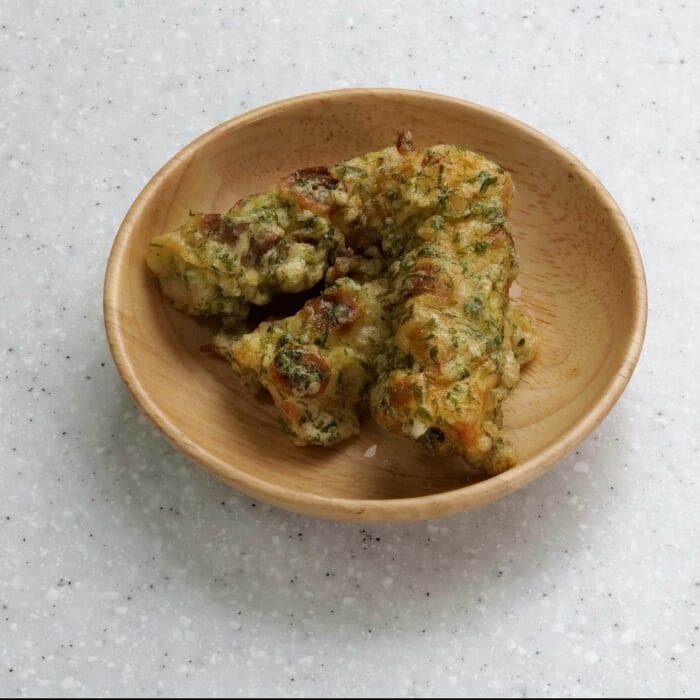
Chikuwa Isobe-age (Fish Cake in Seaweed Batter)
ちくわの磯辺揚げ(小麦なし) · Chikuwa no Isobeage
 By Aoi, licensed nutritionist · From a Japanese preschool lunch menu
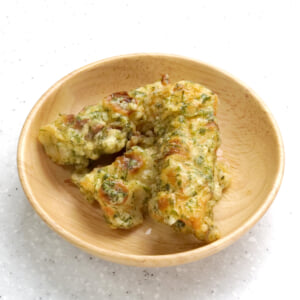
Isobe-age takes its name from isobe, the rocky seashore, because of the fragrant green aonori seaweed stirred into the batter. Here, chikuwa (a tube-shaped Japanese fish cake) is cut into bite-sized pieces, dipped in a light batter and fried until it puffs up and turns crisp. In preschool kitchens we make the batter with potato starch instead of wheat flour, and the whole dish is made without egg or milk. Kids love the crunchy coating and the gentle savory flavor of the chikuwa, so these disappear fast.
Added. Open the recipe helper (bottom right) → ☰ Menu → 🛒 Shopping list to see the ingredients for your family size.
Printing uses the number of adults and children set under Ingredients, so set those first.
Ingredients
Amounts for 1 child (1 serving). An adult counts as 2 servings.
One serving here is 1.5× the portion served to a child in a Japanese preschool, sized for Western appetites. An adult counts as two servings. Tap an ingredient to check it off.
Ingredients
- 45 ggrilled chikuwa (egg- and wheat-free)Chikuwa is a tube-shaped Japanese fish cake made from fish paste and grilled; this version contains no egg or wheat. Substitute: Another egg- and wheat-free Japanese fish cake such as kamaboko; otherwise there is no close substitute, so look for it at a Japanese or Asian grocery, or online.
Seasonings
- 4.5 gpotato starch (katakuriko)Japanese potato starch used for thickening sauces and coating fried foods. Substitute: Cornstarch: start with the same amount and add a little more if it is still thin. It thickens a little less than potato starch and needs a couple of minutes at a gentle bubble to reach full thickness.
- 7.5 gwater
- 0.3 gaonori (green seaweed flakes)Fine, fragrant flakes of dried green seaweed sprinkled over dishes like okonomiyaki and yakisoba. Substitute: Crumbled nori sheets, or omit.
- 9 gvegetable oil
About the Japanese ingredients in this recipe
- grilled chikuwa (egg- and wheat-free) (焼き竹輪(卵小麦不使用))
- Chikuwa is a tube-shaped Japanese fish cake made from fish paste and grilled; this version contains no egg or wheat. Substitute: Another egg- and wheat-free Japanese fish cake such as kamaboko; otherwise there is no close substitute, so look for it at a Japanese or Asian grocery, or online.
- potato starch (katakuriko) (かたくり粉)
- Japanese potato starch used for thickening sauces and coating fried foods. Substitute: Cornstarch: start with the same amount and add a little more if it is still thin. It thickens a little less than potato starch and needs a couple of minutes at a gentle bubble to reach full thickness. Read the guide: Katakuriko (Japanese Potato Starch) and What to Use Instead → Guide: japanese-school-lunch.com/articles/katakuriko-potato-starch/
- aonori (green seaweed flakes) (あおのり)
- Fine, fragrant flakes of dried green seaweed sprinkled over dishes like okonomiyaki and yakisoba. Substitute: Crumbled nori sheets, or omit.
Directions
- 1
Slice the chikuwa in half lengthwise, then cut each half crosswise into 3 pieces, so that each chikuwa gives 6 pieces.
- 2
Combine the potato starch, water and aonori and mix lightly to make the batter.
- 3
Add the chikuwa from step 1 to the batter from step 2 and toss to coat, then deep-fry in oil at 170°C (340°F) for about 1 1/2 to 2 minutes. Remove the pieces once the chikuwa puffs up.
Nutrition
| Per | 1 serving | 1 adult serving | Your total |
|---|---|---|---|
| Energy | 142.5 kcal | 285 kcal | 142.5 kcal |
| Protein | 6.1 g | 12.3 g | 6.1 g |
| Fat | 9.1 g | 18.3 g | 9.1 g |
| Carbohydrates | 9.8 g | 19.5 g | 9.8 g |
| Fiber | 0.2 g | 0.3 g | 0.2 g |
| Salt equivalent | 1.2 g | 2.4 g | 1.2 g |
| Calcium | 24 mg | 48 mg | 24 mg |
| Iron | 0.5 mg | 0.9 mg | 0.5 mg |
| Potassium | 34.5 mg | 69 mg | 34.5 mg |
| Energy | Protein | Fat | Carbs | Fiber | Salt equiv. | Calcium | Iron | Potassium | |
|---|---|---|---|---|---|---|---|---|---|
| 1 serving | 142.5 kcal | 6.1 g | 9.1 g | 9.8 g | 0.2 g | 1.2 g | 24 mg | 0.5 mg | 34.5 mg |
| 1 adult serving | 285 kcal | 12.3 g | 18.3 g | 19.5 g | 0.3 g | 2.4 g | 48 mg | 0.9 mg | 69 mg |
Values are per serving (1.5× the Japanese preschool portion); an adult serving is double. They were calculated by a licensed Japanese nutritionist using the Standard Tables of Food Composition in Japan. "Salt equivalent" is sodium × 2.54, the standard Japanese measure. Allergen flags cover egg, milk and wheat only and come from the nutritionist's records. Soy sauce and miso are made with wheat but are usually allowed on Japanese wheat-free school menus, so check with your doctor.