Chikuwa Isobe-age (Seaweed-Battered Fish Cake)
ちくわの磯辺揚げ(卵なし) · Chikuwa no Isobeage
 By Aoi, licensed nutritionist · From a Japanese preschool lunch menu
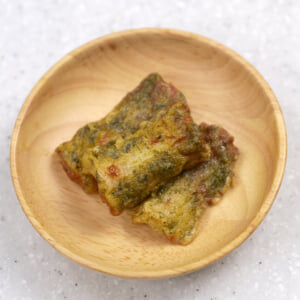
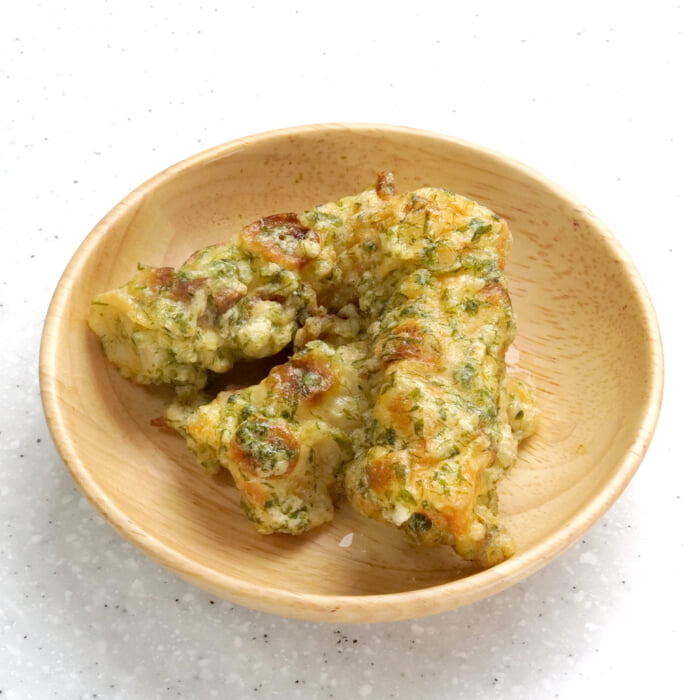
Isobe-age is a Japanese favorite in which chikuwa, a mild grilled fish cake tube, is dipped in a batter flecked with aonori seaweed and fried until just crisp. It turns up in bento boxes and school lunches all over Japan, and children love its soft, chewy center and the gentle savory flavor of the seaweed. In this version the batter gets its light, puffy lift from baking powder, and the chikuwa is cut into small pieces that are easy for little hands to pick up and finish. Fry only until lightly colored so the coating stays tender rather than hard.
Added. Open the recipe helper (bottom right) → ☰ Menu → 🛒 Shopping list to see the ingredients for your family size.
Printing uses the number of adults and children set under Ingredients, so set those first.
Ingredients
Amounts for 1 child (1 serving). An adult counts as 2 servings.
One serving here is 1.5× the portion served to a child in a Japanese preschool, sized for Western appetites. An adult counts as two servings. Tap an ingredient to check it off.
Ingredients
- 45 gchikuwa (grilled fish cake tube)A mild, slightly chewy tube-shaped fish cake made from white fish paste grilled around a stick. Substitute: Imitation crab sticks or other mild fish cake (kamaboko); check the label, as fish cakes often contain egg white and wheat.
- 15 gflour
Seasonings
- 4.1 gpotato starch (katakuriko)Japanese potato starch used for thickening sauces and coating fried foods. Substitute: Cornstarch: start with the same amount and add a little more if it is still thin. It thickens a little less than potato starch and needs a couple of minutes at a gentle bubble to reach full thickness.
- 0.9 gbaking powder
- 1.8 gvegetable oil
- 27 gwater
- 0.5 gaonori (green seaweed flakes)Fine, fragrant flakes of dried green seaweed sprinkled over dishes like okonomiyaki and yakisoba. Substitute: Crumbled nori sheets, or omit.
- 9 gvegetable oil
About the Japanese ingredients in this recipe
- chikuwa (grilled fish cake tube) (焼き竹輪)
- A mild, slightly chewy tube-shaped fish cake made from white fish paste grilled around a stick. Substitute: Imitation crab sticks or other mild fish cake (kamaboko); check the label, as fish cakes often contain egg white and wheat.
- potato starch (katakuriko) (かたくり粉)
- Japanese potato starch used for thickening sauces and coating fried foods. Substitute: Cornstarch: start with the same amount and add a little more if it is still thin. It thickens a little less than potato starch and needs a couple of minutes at a gentle bubble to reach full thickness. Read the guide: Katakuriko (Japanese Potato Starch) and What to Use Instead → Guide: japanese-school-lunch.com/articles/katakuriko-potato-starch/
- aonori (green seaweed flakes) (あおのり)
- Fine, fragrant flakes of dried green seaweed sprinkled over dishes like okonomiyaki and yakisoba. Substitute: Crumbled nori sheets, or omit.
Directions
- 1
Slice each chikuwa in half lengthwise, then cut each half crosswise into 3 pieces, so that each tube gives you 6 pieces.
- 2
In a bowl, stir together the flour, potato starch and baking powder. Add the oil, water and aonori and mix lightly until just combined.
- 3
Add the chikuwa to the batter and toss to coat, then slip the pieces into oil heated to 170°C (340°F).
- 4
After 1 minute 30 seconds, turn the pieces over and fry the other side for another 1 minute 30 seconds - about 3 minutes in total, until just lightly colored.
Nutrition
| Per | 1 serving | 1 adult serving | Your total |
|---|---|---|---|
| Energy | 219 kcal | 438 kcal | 219 kcal |
| Protein | 6.9 g | 13.8 g | 6.9 g |
| Fat | 12 g | 24 g | 12 g |
| Carbohydrates | 23 g | 45.9 g | 23 g |
| Salt equivalent | 1 g | 2.1 g | 1 g |
| Calcium | 36 mg | 72 mg | 36 mg |
| Iron | 0.9 mg | 1.8 mg | 0.9 mg |
| Energy | Protein | Fat | Carbs | Salt equiv. | Calcium | Iron | |
|---|---|---|---|---|---|---|---|
| 1 serving | 219 kcal | 6.9 g | 12 g | 23 g | 1 g | 36 mg | 0.9 mg |
| 1 adult serving | 438 kcal | 13.8 g | 24 g | 45.9 g | 2.1 g | 72 mg | 1.8 mg |
Values are per serving (1.5× the Japanese preschool portion); an adult serving is double. They were calculated by a licensed Japanese nutritionist using the Standard Tables of Food Composition in Japan. "Salt equivalent" is sodium × 2.54, the standard Japanese measure. Allergen flags cover egg, milk and wheat only and come from the nutritionist's records. Soy sauce and miso are made with wheat but are usually allowed on Japanese wheat-free school menus, so check with your doctor.