Tonjiru (Pork Miso Soup) (Elementary School Portion)
【小学校】豚汁 · Tonjiru
 By Aoi, licensed nutritionist · From a Japanese elementary school lunch menu
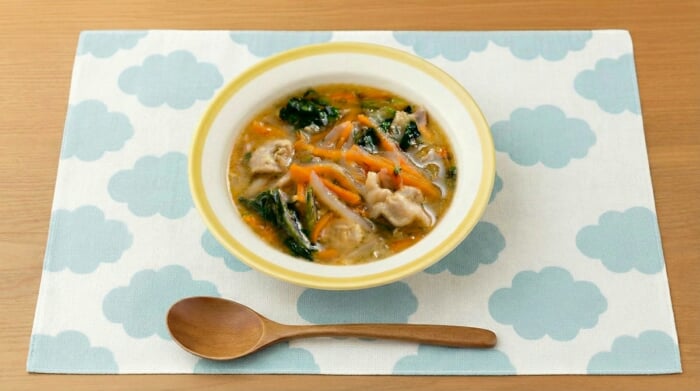
Tonjiru is the heartier cousin of everyday miso soup: thin slices of pork simmered with carrot, daikon, gobo, potato, tofu and shirataki in a dashi and miso broth. It is a fixture of Japanese school lunch menus, especially through the colder months, because one bowl delivers vegetables, protein and warmth all at once. Children love it because the pork and the savory fat give the broth a gentle richness, and the vegetables turn soft and sweet as they cook. This is the elementary school version of the recipe from our lunch kitchen.
Wheat-free, but uses miso (made with wheat). Japanese school-lunch allergy menus usually allow it, so check with your doctor. How to read the labels
Added. Open the recipe helper (bottom right) → ☰ Menu → 🛒 Shopping list to see the ingredients for your family size.
Printing uses the number of adults and children set under Ingredients, so set those first.
Ingredients
Amounts for 1 child (1 serving). An adult counts as 2 servings.
One serving here is 1.5× the portion served to a child in a Japanese elementary school, sized for Western appetites. An adult counts as two servings. Tap an ingredient to check it off.
Ingredients
- 14.4 gcarrot
- 22.2 gdaikon radish
- 7.2 ggobo (burdock root)A long, slender, earthy-tasting root vegetable with a pleasant crunch, usually scraped rather than peeled. Substitute: Parsnip or carrot.
- 28.8 gpotato
- 9 ggreen onion (naga negi)Japanese long onion, thicker and milder than Western scallions. Substitute: Scallions or the white part of a leek.
- 14.4 gshirataki (konjac noodles)Translucent, chewy, very low-calorie noodles made from konjac yam, sold in water-filled packs. Substitute: Glass noodles, or omit.
- 17.7 gthinly sliced pork (komagire)Small, thin offcuts of pork sold in Japan for quick stir-fries and simmered dishes. Substitute: Thinly sliced pork shoulder or loin cut into bite-size pieces.
- 22.2 gsilken tofu
- 222 gdashi stockJapanese soup stock, usually made from kombu (dried kelp) and/or bonito flakes; the base of most Japanese soups and simmered dishes. Substitute: Instant dashi granules dissolved in water, or a mild unsalted chicken or vegetable stock.
Seasonings
- 2.1 gvegetable oil
- 11.4 gmisoFermented soybean paste. Salty and savory, it is Japan's everyday seasoning for miso soup and many simmered dishes. Substitute: Any light (white or awase) miso. Misos differ in saltiness, so start with a little less and taste. Some misos are made with barley or wheat, so check the label if you avoid them.
About the Japanese ingredients in this recipe
- gobo (burdock root) (ごぼう)
- A long, slender, earthy-tasting root vegetable with a pleasant crunch, usually scraped rather than peeled. Substitute: Parsnip or carrot.
- green onion (naga negi) (ねぎ)
- Japanese long onion, thicker and milder than Western scallions. Substitute: Scallions or the white part of a leek.
- shirataki (konjac noodles) (糸こんにゃく)
- Translucent, chewy, very low-calorie noodles made from konjac yam, sold in water-filled packs. Substitute: Glass noodles, or omit.
- thinly sliced pork (komagire) (豚こま切れ肉)
- Small, thin offcuts of pork sold in Japan for quick stir-fries and simmered dishes. Substitute: Thinly sliced pork shoulder or loin cut into bite-size pieces.
- dashi stock (だし汁)
- Japanese soup stock, usually made from kombu (dried kelp) and/or bonito flakes; the base of most Japanese soups and simmered dishes. Substitute: Instant dashi granules dissolved in water, or a mild unsalted chicken or vegetable stock.
- miso (みそ)
- Fermented soybean paste. Salty and savory, it is Japan's everyday seasoning for miso soup and many simmered dishes. Substitute: Any light (white or awase) miso. Misos differ in saltiness, so start with a little less and taste. Some misos are made with barley or wheat, so check the label if you avoid them.
Directions
- 1
Cut the carrot and daikon into quarter-rounds (icho-giri). Halve the gobo lengthwise, slice it thinly on the diagonal, and soak in water for 5 minutes. Cut the potato into thick quarter-rounds and soak in water for 5 minutes. Slice the green onion into thin rounds.
- 2
Cut the shirataki lengthwise into 3 pieces, then cut into 1 cm lengths. Place in a heatproof container, cover with plastic wrap, and microwave at 1200W for about 30 seconds to 1 minute. After heating, rinse under running water to remove the bitterness (aku).
- 3
Cut the pork into 2 cm strips and the tofu into 1.5 cm cubes.
- 4
Heat the oil in a pot, add the carrot, daikon, gobo, potato, and green onion, and stir-fry over medium heat for 2 to 3 minutes. Add the shirataki and pork, stir-fry until the pork changes color, then add the dashi stock.
- 5
Once it comes to a boil, reduce to low heat, skim off any scum, and simmer for about 15 minutes. Add the tofu, dissolve in the miso, and simmer over low heat for 5 minutes.
When making regular miso soup, the miso goes in at the very end and is not boiled, so its aroma does not cook off. Tonjiru is different: here we want the miso flavor to soak into the vegetables, so we add it earlier and let it simmer.
Nutrition
| Per | 1 serving | 1 adult serving | Your total |
|---|---|---|---|
| Energy | 122.1 kcal | 244.2 kcal | 122.1 kcal |
| Protein | 8 g | 15.9 g | 8 g |
| Fat | 5.4 g | 10.8 g | 5.4 g |
| Carbohydrates | 13.1 g | 26.1 g | 13.1 g |
| Fiber | 5.1 g | 10.2 g | 5.1 g |
| Salt equivalent | 1.7 g | 3.3 g | 1.7 g |
| Calcium | 59.9 mg | 119.7 mg | 59.9 mg |
| Iron | 0.9 mg | 1.8 mg | 0.9 mg |
| Potassium | 538.3 mg | 1076.7 mg | 538.3 mg |
| Energy | Protein | Fat | Carbs | Fiber | Salt equiv. | Calcium | Iron | Potassium | |
|---|---|---|---|---|---|---|---|---|---|
| 1 serving | 122.1 kcal | 8 g | 5.4 g | 13.1 g | 5.1 g | 1.7 g | 59.9 mg | 0.9 mg | 538.3 mg |
| 1 adult serving | 244.2 kcal | 15.9 g | 10.8 g | 26.1 g | 10.2 g | 3.3 g | 119.7 mg | 1.8 mg | 1076.7 mg |
Values are per serving (1.5× the Japanese elementary-school portion); an adult serving is double. They were calculated by a licensed Japanese nutritionist using the Standard Tables of Food Composition in Japan. "Salt equivalent" is sodium × 2.54, the standard Japanese measure. Allergen flags cover egg, milk and wheat only and come from the nutritionist's records. Soy sauce and miso are made with wheat but are usually allowed on Japanese wheat-free school menus, so check with your doctor.
This is the elementary-school portion of Tonjiru (Pork and Vegetable Miso Soup) (larger quantities, same method).
Ingredients in this recipe
You might also like
All recipes →
Tonjiru with Onion (Pork and Vegetable Miso Soup)
Satsuma-jiru (Miso Soup with Sweet Potato)
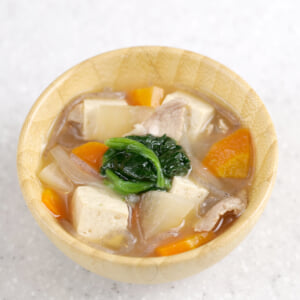
Tonjiru with Spinach (Pork and Vegetable Miso Soup)
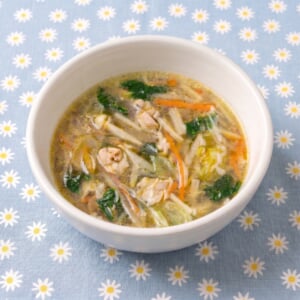
Sawaniwan (Pork and Julienned Vegetable Soup)
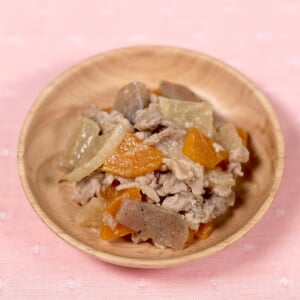
Buta Daikon (Simmered Pork and Daikon) (Wheat-Free)