Sawaniwan (Pork and Julienned Vegetable Soup)
沢煮椀 · Sawaniwan
 By Aoi, licensed nutritionist · From a Japanese preschool lunch menu
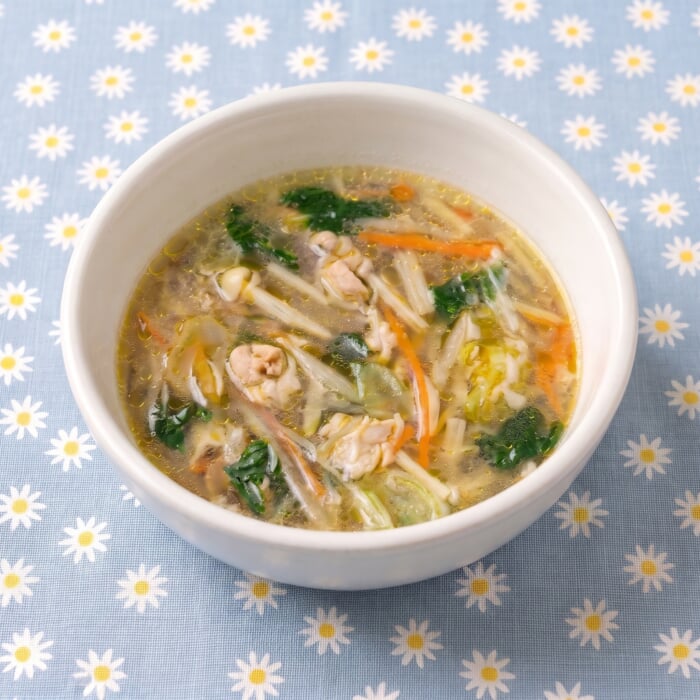
Sawaniwan is a clear, dashi-based soup filled with finely julienned vegetables and thin strips of pork. The "sawa" in its name is usually explained as an old word meaning "plenty," a nod to the many ingredients that go into the bowl, and it is a familiar soup on Japanese school lunch menus. Cutting everything into fine matchsticks keeps the textures soft and easy for small children to manage, and a light thickening with potato starch helps the soup stay warm until the last spoonful. This version is made without egg or milk.
Toddlers to adults. The whole family can eat this exactly as written.
Wheat-free, but uses soy sauce (made with wheat). Japanese school-lunch allergy menus usually allow it, so check with your doctor. How to read the labels
Added. Open the recipe helper (bottom right) → ☰ Menu → 🛒 Shopping list to see the ingredients for your family size.
Printing uses the number of adults and children set under Ingredients, so set those first.
Ingredients
Amounts for 1 child (1 serving). An adult counts as 2 servings.
One serving here is 1.5× the portion served to a child in a Japanese preschool, sized for Western appetites. An adult counts as two servings. Tap an ingredient to check it off.
Ingredients
- 18 gthinly sliced pork (komagire)Small, thin offcuts of pork sold in Japan for quick stir-fries and simmered dishes. Substitute: Thinly sliced pork shoulder or loin cut into bite-size pieces.
- 18 ggobo (burdock root)A long, slender, earthy-tasting root vegetable with a pleasant crunch, usually scraped rather than peeled. Substitute: Parsnip or carrot.
- 15 gcarrot
- 18 genoki mushroomsLong, thin white mushrooms sold in bunches; mild flavor and a slight chew. Substitute: Thinly sliced button or shimeji mushrooms.
- 7.5 gJapanese long onion (naga-negi)A long, thick scallion with a mild, sweet flavor when cooked, used in Japanese soups and stir-fries. Substitute: Leek (white and light green parts) or thick scallions.
- 4.5 gmitsuba (Japanese wild parsley)A delicate Japanese herb with three-lobed leaves and a mild, fresh flavor, used as a garnish. Substitute: Flat-leaf parsley or tender celery leaves.
- 1.5 gvegetable oil
- 225 mldashi stockJapanese soup stock, usually made from kombu (dried kelp) and/or bonito flakes; the base of most Japanese soups and simmered dishes. Substitute: Instant dashi granules dissolved in water, or a mild unsalted chicken or vegetable stock.
- 3.6 gsoy sauce
- 0.8 gsalt
Sauce Mixture (A)
- 1.2 gpotato starchJapanese katakuriko, a fine potato starch used for thickening sauces and coating food before frying. Substitute: Cornstarch: start with the same amount and add a little more if it is still thin. It thickens a little less than potato starch and needs a couple of minutes at a gentle bubble to reach full thickness.
- 3 mlwater
About the Japanese ingredients in this recipe
- thinly sliced pork (komagire) (豚こま切れ肉)
- Small, thin offcuts of pork sold in Japan for quick stir-fries and simmered dishes. Substitute: Thinly sliced pork shoulder or loin cut into bite-size pieces.
- gobo (burdock root) (ごぼう)
- A long, slender, earthy-tasting root vegetable with a pleasant crunch, usually scraped rather than peeled. Substitute: Parsnip or carrot.
- enoki mushrooms (えのき)
- Long, thin white mushrooms sold in bunches; mild flavor and a slight chew. Substitute: Thinly sliced button or shimeji mushrooms.
- Japanese long onion (naga-negi) (長ねぎ)
- A long, thick scallion with a mild, sweet flavor when cooked, used in Japanese soups and stir-fries. Substitute: Leek (white and light green parts) or thick scallions.
- mitsuba (Japanese wild parsley) (三つ葉)
- A delicate Japanese herb with three-lobed leaves and a mild, fresh flavor, used as a garnish. Substitute: Flat-leaf parsley or tender celery leaves.
- dashi stock (だし汁)
- Japanese soup stock, usually made from kombu (dried kelp) and/or bonito flakes; the base of most Japanese soups and simmered dishes. Substitute: Instant dashi granules dissolved in water, or a mild unsalted chicken or vegetable stock.
- potato starch (片栗粉)
- Japanese katakuriko, a fine potato starch used for thickening sauces and coating food before frying. Substitute: Cornstarch: start with the same amount and add a little more if it is still thin. It thickens a little less than potato starch and needs a couple of minutes at a gentle bubble to reach full thickness. Read the guide: Katakuriko (Japanese Potato Starch) and What to Use Instead → Guide: japanese-school-lunch.com/articles/katakuriko-potato-starch/
Directions
Video is in Japanese — the steps below are synced to it, so tap ▶ on a step to jump to that moment.
- 1
Cut the gobo and carrot into fine matchsticks (julienne), and soak the gobo in water for about 5 minutes. Cut the pork into 1 cm strips, the enoki into 3 cm lengths, slice the long onion into thin rounds, and cut the mitsuba into 2 cm lengths. (This is also delicious made with mizuna or komatsuna in place of the mitsuba.)
- 2
Heat the oil in a pot, add the gobo, carrot and pork, and sauté over low heat for about 2 minutes.
- 3
Add the dashi stock. Once it comes to a boil, add the enoki and simmer over low heat for about 10 minutes. Add the soy sauce, salt, long onion and mitsuba and bring just back to a boil. (Giving the long onion and mitsuba a quick cook softens their sharpness and any bitterness, which makes them easier for children to eat.)
- 4
Turn off the heat, stir A together, add it to the pot and mix. Return the pot to low heat and cook briefly until the soup thickens slightly. (Adding the potato starch after turning off the heat helps keep it from forming lumps.)
Tips for Best Results
• A well-made dashi is the key to this soup. If you use a dashi packet, soak it in the water for about 10 minutes before turning on the heat to draw out more umami.
• The light thickening keeps the soup from cooling quickly, so it stays warm longer. Simmer shiratama dango (soft rice-flour dumplings) or mochi in it and it becomes a simple take on ozoni, the Japanese New Year's mochi soup.
Freezing Instructions
Let the soup cool, then divide into single portions in freezer bags and freeze. Reheat in the microwave to serve.
Keeps for about 2 weeks (best eaten as soon as possible).
Nutrition
| Per | 1 serving | 1 adult serving | Your total |
|---|---|---|---|
| Energy | 79.5 kcal | 159 kcal | 79.5 kcal |
| Protein | 5.7 g | 11.4 g | 5.7 g |
| Fat | 3.5 g | 6.9 g | 3.5 g |
| Carbohydrates | 8.3 g | 16.5 g | 8.3 g |
| Fiber | 2.4 g | 4.8 g | 2.4 g |
| Salt equivalent | 1.5 g | 3 g | 1.5 g |
| Calcium | 24 mg | 48 mg | 24 mg |
| Iron | 0.6 mg | 1.2 mg | 0.6 mg |
| Potassium | 421.5 mg | 843 mg | 421.5 mg |
| Phosphorus | 111 mg | 222 mg | 111 mg |
| Energy | Protein | Fat | Carbs | Fiber | Salt equiv. | Calcium | Iron | Potassium | Phosphorus | |
|---|---|---|---|---|---|---|---|---|---|---|
| 1 serving | 79.5 kcal | 5.7 g | 3.5 g | 8.3 g | 2.4 g | 1.5 g | 24 mg | 0.6 mg | 421.5 mg | 111 mg |
| 1 adult serving | 159 kcal | 11.4 g | 6.9 g | 16.5 g | 4.8 g | 3 g | 48 mg | 1.2 mg | 843 mg | 222 mg |
Values are per serving (1.5× the Japanese preschool portion); an adult serving is double. They were calculated by a licensed Japanese nutritionist using the Standard Tables of Food Composition in Japan. "Salt equivalent" is sodium × 2.54, the standard Japanese measure. Allergen flags cover egg, milk and wheat only and come from the nutritionist's records. Soy sauce and miso are made with wheat but are usually allowed on Japanese wheat-free school menus, so check with your doctor.
Cooking for bigger kids? See the elementary-school portion of this recipe.