Smile Potatoes (Smiley Face Potato Bites)
スマイルポテト
 By Aoi, licensed nutritionist · From a Japanese preschool lunch menu
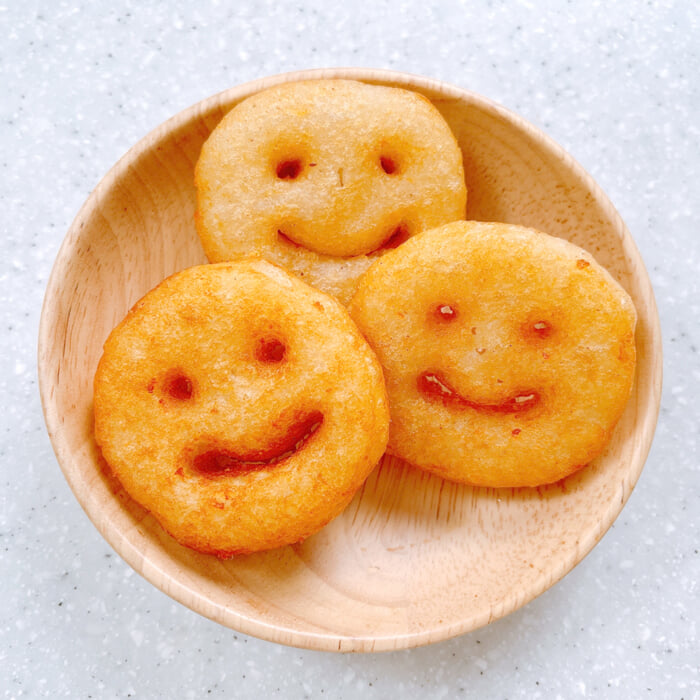
Smiley-faced potato bites are a familiar frozen snack in Japan, and children light up when they spot those little grinning faces on their plates. This version is made from scratch with instant mashed potato flakes, which keeps the dough smooth and easy for small hands to help shape. Potato starch and a little butter give the rounds a crisp outside and a soft, fluffy inside once fried, and a drinking straw is all you need to punch out the eyes and mouth.
Added. Open the recipe helper (bottom right) → ☰ Menu → 🛒 Shopping list to see the ingredients for your family size.
Printing uses the number of adults and children set under Ingredients, so set those first.
Ingredients
Amounts for 1 child (1 serving). An adult counts as 2 servings.
One serving here is 1.5× the portion served to a child in a Japanese preschool, sized for Western appetites. An adult counts as two servings. Tap an ingredient to check it off.
Ingredients
- 18.8 ginstant mashed potato flakes
Seasonings
- 0.3 gsalt
- 42 ghot water
- 3 gpotato starchJapanese katakuriko, a fine potato starch used for thickening sauces and coating food before frying. Substitute: Cornstarch: start with the same amount and add a little more if it is still thin. It thickens a little less than potato starch and needs a couple of minutes at a gentle bubble to reach full thickness.
- 2 gunsalted butter
- 9 gvegetable oil
About the Japanese ingredients in this recipe
- potato starch (片栗粉)
- Japanese katakuriko, a fine potato starch used for thickening sauces and coating food before frying. Substitute: Cornstarch: start with the same amount and add a little more if it is still thin. It thickens a little less than potato starch and needs a couple of minutes at a gentle bubble to reach full thickness. Read the guide: Katakuriko (Japanese Potato Starch) and What to Use Instead → Guide: japanese-school-lunch.com/articles/katakuriko-potato-starch/
Directions
- 1
Put the potato flakes and salt in a bowl and stir together. Add the hot water and mix until combined.
- 2
While the mixture is still warm, add the potato starch and unsalted butter and mix well.
- 3
Wrap the mixture in a large sheet of plastic wrap and roll it into a round log about 10 cm long.
- 4
Remove the plastic wrap and slice the log into 1 cm-thick rounds with a knife. Use a drinking straw to punch out two eyes and a mouth in each round.
- 5
Heat the frying oil to medium temperature (180°C / 350°F), add the potato rounds, and fry for about 2 minutes.
Nutrition
| Per | 1 serving | 1 adult serving | Your total |
|---|---|---|---|
| Energy | 169.5 kcal | 339 kcal | 169.5 kcal |
| Protein | 1.2 g | 2.4 g | 1.2 g |
| Fat | 10.6 g | 21.3 g | 10.6 g |
| Carbohydrates | 18.6 g | 37.2 g | 18.6 g |
| Salt equivalent | 0.3 g | 0.6 g | 0.3 g |
| Calcium | 6 mg | 12 mg | 6 mg |
| Iron | 0.6 mg | 1.2 mg | 0.6 mg |
| Energy | Protein | Fat | Carbs | Salt equiv. | Calcium | Iron | |
|---|---|---|---|---|---|---|---|
| 1 serving | 169.5 kcal | 1.2 g | 10.6 g | 18.6 g | 0.3 g | 6 mg | 0.6 mg |
| 1 adult serving | 339 kcal | 2.4 g | 21.3 g | 37.2 g | 0.6 g | 12 mg | 1.2 mg |
Values are per serving (1.5× the Japanese preschool portion); an adult serving is double. They were calculated by a licensed Japanese nutritionist using the Standard Tables of Food Composition in Japan. "Salt equivalent" is sodium × 2.54, the standard Japanese measure. Allergen flags cover egg, milk and wheat only and come from the nutritionist's records. Soy sauce and miso are made with wheat but are usually allowed on Japanese wheat-free school menus, so check with your doctor.