French Salad
フレンチサラダ
 By Aoi, licensed nutritionist · From a Japanese preschool lunch menu
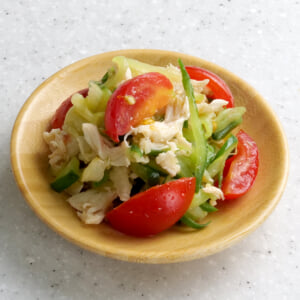
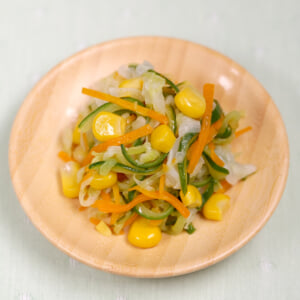
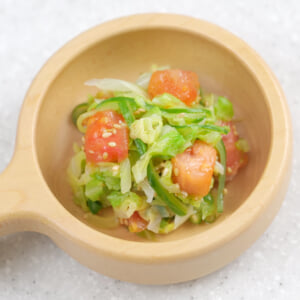
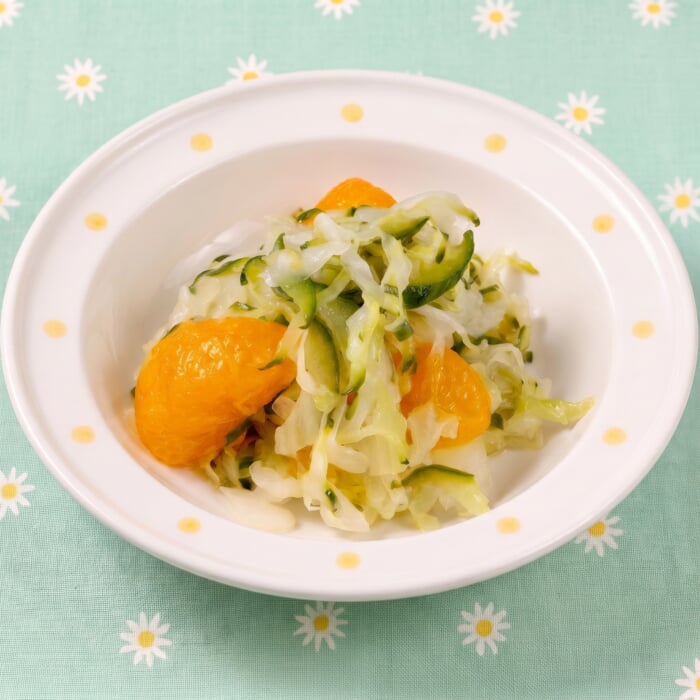
"French salad" is a familiar side dish on Japanese school lunch menus: blanched cabbage and cucumber tossed with mandarin orange segments in a simple vinaigrette-style dressing. The mandarin adds a gentle sweetness that softens the vinegar, so even children who shy away from sour flavors tend to go back for more. A quick turn in the microwave takes the sharp edge off the dressing, and the whole thing is made without egg, milk or wheat.
Toddlers to adults. The whole family can eat this exactly as written.
Added. Open the recipe helper (bottom right) → ☰ Menu → 🛒 Shopping list to see the ingredients for your family size.
Printing uses the number of adults and children set under Ingredients, so set those first.
Ingredients
Amounts for 1 child (1 serving). An adult counts as 2 servings.
One serving here is 1.5× the portion served to a child in a Japanese preschool, sized for Western appetites. An adult counts as two servings. Tap an ingredient to check it off.
Ingredients
- 60 gcabbage
- 24 gcucumber
- 30 gcanned mandarin orange segments
Sauce Mixture (A)
- 3 gvegetable oil
- 3.6 gvinegar
- 0.6 gsalt
- 0.5 gsugar
- to tastepepper
Directions
Video is in Japanese — the steps below are synced to it, so tap ▶ on a step to jump to that moment.
- 1
Cut the cabbage and cucumber into thin strips. (Cutting the cabbage into slightly thicker strips helps children build their chewing strength.)
- 2
Boil the cabbage in boiling water for about 2 minutes, then add the cucumber and boil for about 1 minute more. Rinse under running water to cool. (For elementary-school-age children and younger, boiling the cabbage for about 3 minutes makes it softer and easier to eat.)
- 3
Tip the canned mandarin segments into a colander and drain off the syrup.
- 4
Put the ingredients for A in a microwave-safe bowl and stir. Cover loosely with plastic wrap, leaving a gap for steam to escape, and microwave at 1200W for about 15 seconds (30 seconds at 600W), then let cool slightly. (Heating the vinegar mellows its sharpness, which makes the dressing easier for children to eat.)
- 5
Squeeze the vegetables from step 2 firmly to remove the excess water, then toss them with the mandarin segments from step 3 and the dressing from step 4. Chill in the refrigerator. (Even if the mandarin breaks up a little, it coats the vegetables nicely and the salad still tastes delicious.)
Tips for Making It Well
- The mandarin orange adds vitamin C and rounds off the sharpness of the vinegar, so even children who dislike sour foods find this easy to eat.
- If you are not eating it right away, store the vegetables and the dressing separately and toss them together just before serving so the salad does not turn watery.
Freezing
This salad does not freeze well. Keep it in the refrigerator and finish it by the next day.
Nutrition
| Per | 1 serving | 1 adult serving | Your total |
|---|---|---|---|
| Energy | 64.5 kcal | 129 kcal | 64.5 kcal |
| Protein | 1 g | 2.1 g | 1 g |
| Fat | 3.2 g | 6.3 g | 3.2 g |
| Carbohydrates | 8.9 g | 17.7 g | 8.9 g |
| Fiber | 1.5 g | 3 g | 1.5 g |
| Salt equivalent | 0.6 g | 1.2 g | 0.6 g |
| Calcium | 33 mg | 66 mg | 33 mg |
| Iron | 0.3 mg | 0.6 mg | 0.3 mg |
| Potassium | 183 mg | 366 mg | 183 mg |
| Phosphorus | 25.5 mg | 51 mg | 25.5 mg |
| Energy | Protein | Fat | Carbs | Fiber | Salt equiv. | Calcium | Iron | Potassium | Phosphorus | |
|---|---|---|---|---|---|---|---|---|---|---|
| 1 serving | 64.5 kcal | 1 g | 3.2 g | 8.9 g | 1.5 g | 0.6 g | 33 mg | 0.3 mg | 183 mg | 25.5 mg |
| 1 adult serving | 129 kcal | 2.1 g | 6.3 g | 17.7 g | 3 g | 1.2 g | 66 mg | 0.6 mg | 366 mg | 51 mg |
Values are per serving (1.5× the Japanese preschool portion); an adult serving is double. They were calculated by a licensed Japanese nutritionist using the Standard Tables of Food Composition in Japan. "Salt equivalent" is sodium × 2.54, the standard Japanese measure. Allergen flags cover egg, milk and wheat only and come from the nutritionist's records. Soy sauce and miso are made with wheat but are usually allowed on Japanese wheat-free school menus, so check with your doctor.
Cooking for bigger kids? See the elementary-school portion of this recipe.