Marinated Tomato and Tuna Salad
トマトとツナのマリネ
 By Aoi, licensed nutritionist · From a Japanese preschool lunch menu
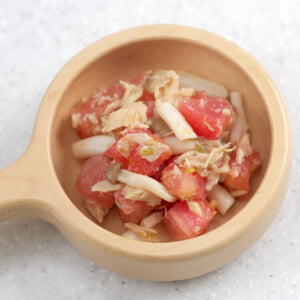
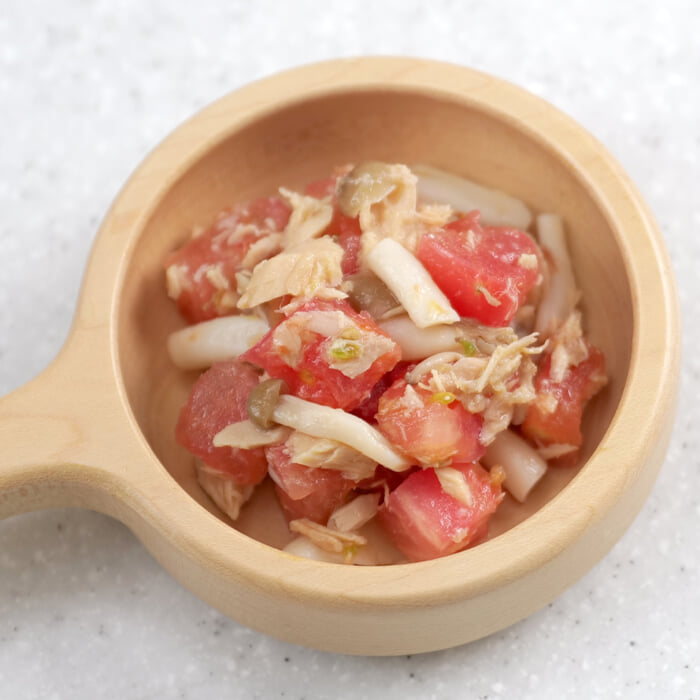
This is a simple marinated side dish: juicy diced tomato, boiled shimeji mushrooms and canned tuna, tossed in a light oil-and-vinegar dressing. Warming the dressing first cooks off the sharp edge of the vinegar, which is what makes a vinegary salad go down easily with small children. Blanching and peeling the tomatoes gives a soft texture with no tough skins to chew, and the tuna adds savoriness that keeps kids coming back for another forkful.
Added. Open the recipe helper (bottom right) → ☰ Menu → 🛒 Shopping list to see the ingredients for your family size.
Printing uses the number of adults and children set under Ingredients, so set those first.
Ingredients
Amounts for 1 child (1 serving). An adult counts as 2 servings.
One serving here is 1.5× the portion served to a child in a Japanese preschool, sized for Western appetites. An adult counts as two servings. Tap an ingredient to check it off.
Ingredients
- 55.5 gtomato
- 18 gshimeji mushroomsSmall brown-capped mushrooms sold in clusters, with a mild, nutty flavor. Substitute: Oyster or button mushrooms.
- 13.5 gcanned tuna in oil
Seasonings
- 1.8 gvegetable oil
- 1.8 gvinegar
- 1.5 gsugar
- 0.2 gsalt
- to tastepepper
- 0.2 gdried parsley
About the Japanese ingredients in this recipe
- shimeji mushrooms (しめじ)
- Small brown-capped mushrooms sold in clusters, with a mild, nutty flavor. Substitute: Oyster or button mushrooms.
Directions
- 1
Cut the shimeji mushrooms into 2 cm lengths, boil them, then rinse under cold running water to cool.
- 2
Blanch the tomatoes in hot water to peel them, cut into dice, and leave in a colander so they do not release liquid into the salad.
- 3
Combine the dressing ingredients and heat them to cook off the sharpness of the vinegar.
- 4
Squeeze the mushrooms well to remove excess water, then toss them with the tomatoes, the dressing and the dried parsley.
Nutrition
| Per | 1 serving | 1 adult serving | Your total |
|---|---|---|---|
| Energy | 73.5 kcal | 147 kcal | 73.5 kcal |
| Protein | 3.3 g | 6.6 g | 3.3 g |
| Fat | 4.8 g | 9.6 g | 4.8 g |
| Carbohydrates | 4.5 g | 9 g | 4.5 g |
| Salt equivalent | 0.3 g | 0.6 g | 0.3 g |
| Calcium | 7.5 mg | 15 mg | 7.5 mg |
| Iron | 0.3 mg | 0.6 mg | 0.3 mg |
| Energy | Protein | Fat | Carbs | Salt equiv. | Calcium | Iron | |
|---|---|---|---|---|---|---|---|
| 1 serving | 73.5 kcal | 3.3 g | 4.8 g | 4.5 g | 0.3 g | 7.5 mg | 0.3 mg |
| 1 adult serving | 147 kcal | 6.6 g | 9.6 g | 9 g | 0.6 g | 15 mg | 0.6 mg |
Values are per serving (1.5× the Japanese preschool portion); an adult serving is double. They were calculated by a licensed Japanese nutritionist using the Standard Tables of Food Composition in Japan. "Salt equivalent" is sodium × 2.54, the standard Japanese measure. Allergen flags cover egg, milk and wheat only and come from the nutritionist's records. Soy sauce and miso are made with wheat but are usually allowed on Japanese wheat-free school menus, so check with your doctor.