Ohagi (Japanese Sweet Rice Balls)
おはぎ · Ohagi
 By Aoi, licensed nutritionist · From a Japanese preschool lunch menu
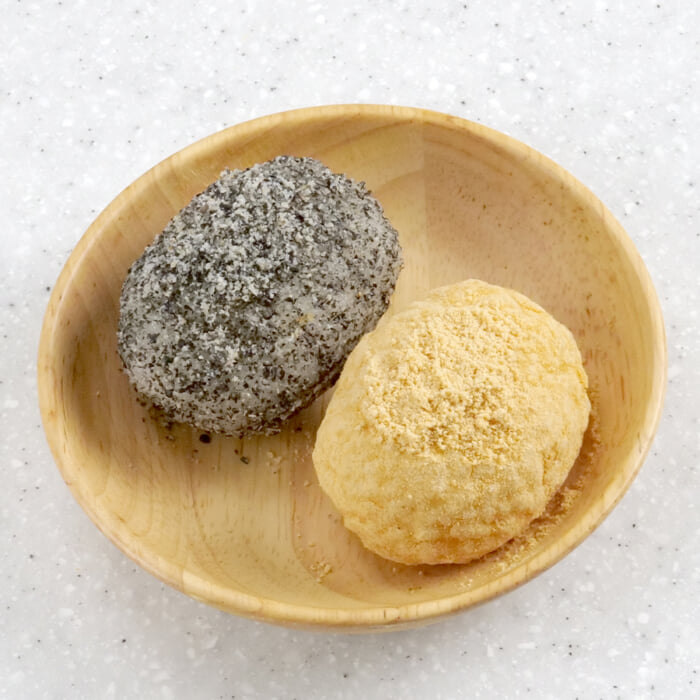
Ohagi are a traditional Japanese sweet: balls of cooked rice rolled in a sweet coating, most often red bean paste, kinako (roasted soybean flour) or ground sesame. They are closely tied to the spring and autumn equinox weeks (higan), when families make them as an offering to their ancestors; the same sweet goes by the name botamochi in spring, after the peony, and ohagi in autumn, after the bush clover. This preschool version keeps things simple with plain cooked rice and two coatings, nutty kinako and fragrant black sesame, each sweetened lightly with a pinch of salt to round out the flavor. Children enjoy the soft, chewy rice and the fun of having one of each flavor on their plate.
Added. Open the recipe helper (bottom right) → ☰ Menu → 🛒 Shopping list to see the ingredients for your family size.
Printing uses the number of adults and children set under Ingredients, so set those first.
Ingredients
Amounts for 1 child (1 serving). An adult counts as 2 servings.
One serving here is 1.5× the portion served to a child in a Japanese preschool, sized for Western appetites. An adult counts as two servings. Tap an ingredient to check it off.
Ingredients
- 60 griceJapanese short-grain white rice (japonica), which cooks up soft and slightly sticky. The amount listed is for uncooked rice. Substitute: Sushi rice, or another short-grain or medium-grain rice such as Calrose.
- 3.6 gkinako (roasted soybean flour)A nutty, lightly sweet powder made from roasted ground soybeans, often dusted over mochi or rice. Substitute: No close substitute - look for kinako (sometimes sold as roasted soybean flour) at a Japanese or Asian grocery, or online.
- 3.6 gground black sesame seedsToasted black sesame that has been coarsely ground so the flavor and nutrients are easier for children to take in. Substitute: Toasted black sesame seeds, lightly crushed in a mortar or spice grinder.
Seasonings
- 2.7 gsugar (for the kinako)
- 0 gsalt (for the kinako coating)
- 2.7 gsugar (for the sesame coating)
- 0 gsalt (for the sesame coating)
About the Japanese ingredients in this recipe
- rice (米)
- Japanese short-grain white rice (japonica), which cooks up soft and slightly sticky. The amount listed is for uncooked rice. Substitute: Sushi rice, or another short-grain or medium-grain rice such as Calrose.
- kinako (roasted soybean flour) (きな粉)
- A nutty, lightly sweet powder made from roasted ground soybeans, often dusted over mochi or rice. Substitute: No close substitute - look for kinako (sometimes sold as roasted soybean flour) at a Japanese or Asian grocery, or online.
- ground black sesame seeds (すり黒ごま)
- Toasted black sesame that has been coarsely ground so the flavor and nutrients are easier for children to take in. Substitute: Toasted black sesame seeds, lightly crushed in a mortar or spice grinder.
Directions
- 1
Cook the rice as usual, then divide it into 2 equal portions.
- 2
In a bowl, mix together the kinako, sugar and salt. In a separate bowl, mix together the ground black sesame seeds, sugar and salt.
- 3
Coat the rice from step 1 in the mixtures from step 2, rolling one portion in the kinako mixture and the other in the sesame mixture, to make one kinako ohagi and one sesame ohagi.
Nutrition
| Per | 1 serving | 1 adult serving | Your total |
|---|---|---|---|
| Energy | 265.5 kcal | 531 kcal | 265.5 kcal |
| Protein | 5.7 g | 11.4 g | 5.7 g |
| Fat | 3.5 g | 6.9 g | 3.5 g |
| Carbohydrates | 53.6 g | 107.1 g | 53.6 g |
| Fiber | 1.4 g | 2.7 g | 1.4 g |
| Salt equivalent | 0 g | 0 g | 0 g |
| Calcium | 54 mg | 108 mg | 54 mg |
| Iron | 1 mg | 2.1 mg | 1 mg |
| Potassium | 141 mg | 282 mg | 141 mg |
| Energy | Protein | Fat | Carbs | Fiber | Salt equiv. | Calcium | Iron | Potassium | |
|---|---|---|---|---|---|---|---|---|---|
| 1 serving | 265.5 kcal | 5.7 g | 3.5 g | 53.6 g | 1.4 g | 0 g | 54 mg | 1 mg | 141 mg |
| 1 adult serving | 531 kcal | 11.4 g | 6.9 g | 107.1 g | 2.7 g | 0 g | 108 mg | 2.1 mg | 282 mg |
Values are per serving (1.5× the Japanese preschool portion); an adult serving is double. They were calculated by a licensed Japanese nutritionist using the Standard Tables of Food Composition in Japan. "Salt equivalent" is sodium × 2.54, the standard Japanese measure. Allergen flags cover egg, milk and wheat only and come from the nutritionist's records. Soy sauce and miso are made with wheat but are usually allowed on Japanese wheat-free school menus, so check with your doctor.