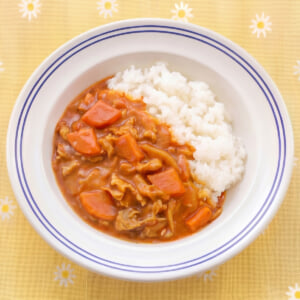
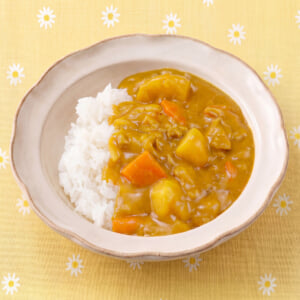
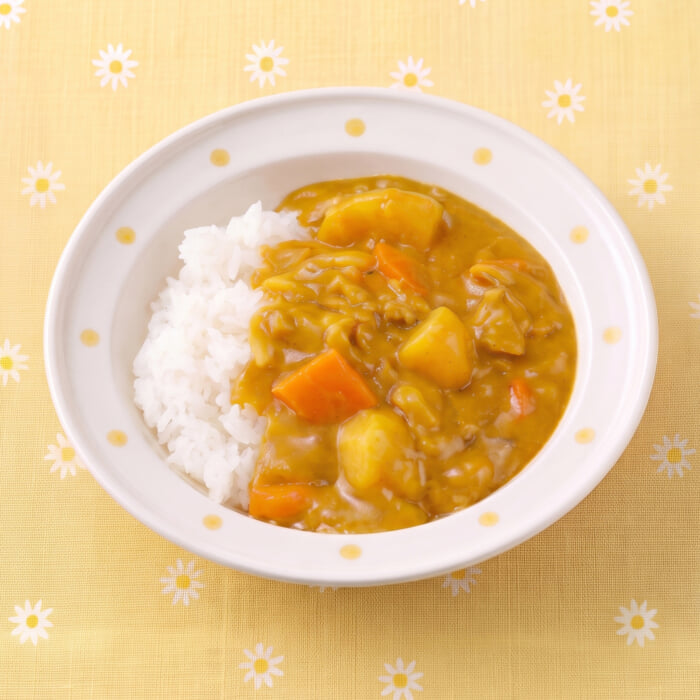
Japanese Curry Rice with Store-Bought Roux
カレーライス【市販ルウ使用】
 By Aoi, licensed nutritionist · From a Japanese preschool lunch menu
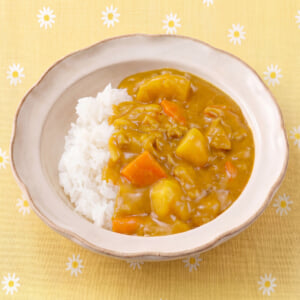
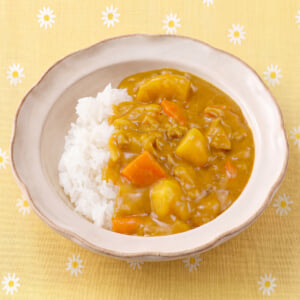
Curry rice is one of the most beloved dishes on Japanese school lunch menus, and this version is made with a box of store-bought Japanese curry roux. A little sliced cheese, ketchup and Worcestershire sauce go in before the roux. For a curry even closer to the school-lunch version, use one block less roux and thicken it with potato starch (see my tips below). I use mild Vermont Curry, a very popular Japanese roux with a gentle, slightly fruity sweetness, and the vegetables get a head start in the microwave so they turn soft and sweet. The recipe as written contains no egg, but check the labels on your roux and cheese.
Toddlers to adults. For ages 1½ to 5, make the Toddler Version below from the finished curry.
For young children: This curry is seasoned for adults. For children aged 1½ to 5, serve the Toddler Version (see the notes below the steps), which thins the finished curry with water, milk and potato starch so it is about half as salty.
Contains honey, which should not be given to babies under 1 year old.
Added. Open the recipe helper (bottom right) → ☰ Menu → 🛒 Shopping list to see the ingredients for your family size.
Printing uses the number of adults and children set under Ingredients, so set those first.
Ingredients
Amounts for 1 child (1 serving). An adult counts as 2 servings.
One serving here is 1.5× the portion served to a child in a Japanese preschool, sized for Western appetites. An adult counts as two servings. Tap an ingredient to check it off. This recipe was written as a family meal (the Japanese original gives one adult plate), so the amounts have been converted to the same serving size as our other recipes.
Ingredients
- 31.5 gonion
- 13.5 gcarrot
- 22.5 gpotato
- 24 gthinly sliced pork (komagire)Small, thin offcuts of pork sold in Japan for quick stir-fries and simmered dishes. Substitute: Thinly sliced pork shoulder or loin cut into bite-size pieces.
- 2 gvegetable oil
- 97.5 mlwater
Seasonings (A)
- 6.3 gsliced cheese
- 2.1 gketchup
- 1.7 gWorcestershire sauce
Ingredients
- 12.5 mlmilk
- 18 gJapanese curry roux (Vermont Curry, mild)Japanese curry roux is a solid block of pre-seasoned roux (flour, fat, curry spices, and sweeteners) that dissolves into a thick, mild curry sauce; Vermont Curry is a popular brand whose mild version, sweetened with apple and honey, is a favorite for young children. It contains honey, so do not give it to babies under 1 year old. The Japanese box also contains soy, banana, pork (lard and pork extract), beef tallow and chicken extract. Labels outside Japan differ, so check the box you buy. Substitute: Use any block of Japanese curry roux labeled mild or sweet (甘口), such as S&B Golden Curry or Java Curry; you can also thicken a curry-powder-seasoned sauce with a cornstarch slurry, though the flavor will be less rich. Note that most Japanese curry roux contains wheat.
- to servewarm cooked rice
- optionalgaram masala
About the Japanese ingredients in this recipe
- thinly sliced pork (komagire) (豚こま切れ肉)
- Small, thin offcuts of pork sold in Japan for quick stir-fries and simmered dishes. Substitute: Thinly sliced pork shoulder or loin cut into bite-size pieces.
- Worcestershire sauce (ウスターソース)
- Read the guide: Bull-Dog Worcestershire Sauce: Japan's Everyday Brown Sauce → Guide: japanese-school-lunch.com/articles/bull-dog-worcestershire-sauce/
- Japanese curry roux (Vermont Curry, mild) (カレールウ(バーモントカレー甘口))
- Japanese curry roux is a solid block of pre-seasoned roux (flour, fat, curry spices, and sweeteners) that dissolves into a thick, mild curry sauce; Vermont Curry is a popular brand whose mild version, sweetened with apple and honey, is a favorite for young children. It contains honey, so do not give it to babies under 1 year old. The Japanese box also contains soy, banana, pork (lard and pork extract), beef tallow and chicken extract. Labels outside Japan differ, so check the box you buy. Substitute: Use any block of Japanese curry roux labeled mild or sweet (甘口), such as S&B Golden Curry or Java Curry; you can also thicken a curry-powder-seasoned sauce with a cornstarch slurry, though the flavor will be less rich. Note that most Japanese curry roux contains wheat. Read the guide: House Vermont Curry (Mild): The Japanese Curry Roux I Use → Guide: japanese-school-lunch.com/articles/house-vermont-curry/
Directions
Video is in Japanese — the steps below are synced to it, so tap ▶ on a step to jump to that moment.
- 1
Cut the onion into 1.5 cm wedges, the carrot into quarter-rounds, and the potato into thick quarter-rounds. Cut the pork into 2 cm wide pieces. Note: A waxy potato that holds its shape is best (May Queen in Japan; Yukon Gold or red potatoes work well). If using a floury potato such as Danshaku (similar to a russet), cut it into larger pieces because it falls apart more easily.
- 2
Put the onion, carrot and 1 tbsp water (extra, not from the ingredient list) in a microwave-safe container and mix. Cover loosely with plastic wrap, leaving a gap for steam, and microwave at 1200W for about 5 minutes (10 minutes at 600W). Note: These times are for a full pot of about 7 servings on this page (about 210 g onion and 90 g carrot). For a smaller amount, microwave for less time, checking until the vegetables are soft. For a double batch, heat at 1200W for about 7 minutes 30 seconds (15 minutes at 600W).
- 3
Put the oil, onion and carrot in the pot before turning on the heat (the microwaved vegetables are wet and would spatter in hot oil). Sauté over medium heat for about 5 minutes. Once they brown in places, add a little water and keep stirring, scraping up the browned bits so they coat the vegetables.
- 4
Add the potato and pork and sauté until the pork changes color.
- 5
Add the water and bring to a boil, then skim off any scum and simmer over low heat for about 5 minutes. Add the Seasonings (A) and simmer over low heat for about 10 more minutes.
- 6
Turn off the heat, add the curry roux and stir until it dissolves. Add the milk and simmer over low heat for about 5 minutes, stirring from the bottom of the pot, until the roux is fully blended in. Serve over warm cooked rice.
Tips for the Best Results
- For a result even closer to school lunch curry, use one block less roux (the full pot of about 7 servings uses 6 blocks, about 120 g) and thicken with potato starch instead. It also tastes great made with the full amount of roux as written.
- If you prefer a medium or hot curry, sprinkle garam masala over the plated curry to taste.
- With 5 blocks of roux, the salt comes to about 1.9 g per serving on this page (about 2.5 g per Japanese adult plate, down from 3.5 g).
How to Freeze
Mash the potatoes into the curry, then spoon single portions into freezer bags, flatten them thin and freeze. To eat, reheat in the microwave, or transfer to a pot and warm through, adding a little water as needed.
Keeps for about 2 weeks (best eaten as soon as possible).
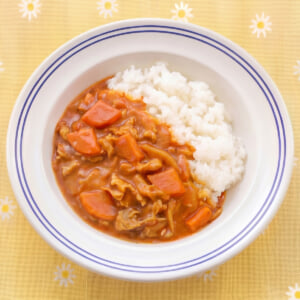
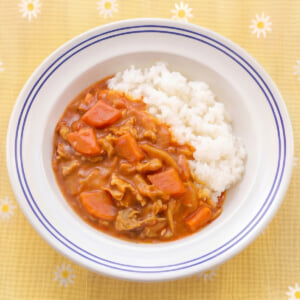
Toddler Version (Ages 1½ to 5)
This turns the finished curry into a milder, toddler-friendly version.
Ingredients (for 2 ladles / for 4 ladles of curry)
- finished curry: 2 ladles (200 g) / 4 ladles (400 g)
- water: 8 tbsp (120 g) / 16 tbsp (240 g)
- milk: 3 1/3 tbsp (50 g) / 6 2/3 tbsp (100 g)
- potato starch (katakuriko; cornstarch works too): 3 2/3 tsp (11 g) / 7 1/3 tsp (22 g)
Method
1. Ladle the finished curry into a separate pot.
2. In a bowl, mix the water, milk and potato starch until the starch dissolves, then pour into the pot.
3. Cook over low heat, stirring, until thickened. Note: The ingredients are already simmered soft, so once it has thickened, it is done.
4. Snip the ingredients into small pieces with kitchen scissors.
- Potatoes break down easily, so take them out first and return them just before serving to keep them from turning to mush.
- This is the gentle flavor we serve at preschool. With extra milk added to the base curry, it is also rich in calcium.
Nutrition
Nutrition values do not include the rice.
| Per | 1 serving | 1 adult serving | Your total |
|---|---|---|---|
| Energy | 220.5 kcal | 441 kcal | 220.5 kcal |
| Protein | 8.8 g | 17.5 g | 8.8 g |
| Fat | 13.4 g | 26.9 g | 13.4 g |
| Carbohydrates | 19.6 g | 39.2 g | 19.6 g |
| Fiber | 3.8 g | 7.7 g | 3.8 g |
| Salt equivalent | 2.6 g | 5.3 g | 2.6 g |
| Calcium | 77.3 mg | 154.5 mg | 77.3 mg |
| Iron | 0.8 mg | 1.7 mg | 0.8 mg |
| Potassium | 345.8 mg | 691.5 mg | 345.8 mg |
| Phosphorus | 148.5 mg | 297 mg | 148.5 mg |
| Energy | Protein | Fat | Carbs | Fiber | Salt equiv. | Calcium | Iron | Potassium | Phosphorus | |
|---|---|---|---|---|---|---|---|---|---|---|
| 1 serving | 220.5 kcal | 8.8 g | 13.4 g | 19.6 g | 3.8 g | 2.6 g | 77.3 mg | 0.8 mg | 345.8 mg | 148.5 mg |
| 1 adult serving | 441 kcal | 17.5 g | 26.9 g | 39.2 g | 7.7 g | 5.3 g | 154.5 mg | 1.7 mg | 691.5 mg | 297 mg |
Values are per serving (1.5× the Japanese preschool portion); an adult serving is double. They were calculated by a licensed Japanese nutritionist using the Standard Tables of Food Composition in Japan. "Salt equivalent" is sodium × 2.54, the standard Japanese measure. Allergen flags cover egg, milk and wheat only and come from the nutritionist's records. Soy sauce and miso are made with wheat but are usually allowed on Japanese wheat-free school menus, so check with your doctor.