House Vermont Curry (Mild): The Japanese Curry Roux I Use
バーモントカレー 甘口
 By Aoi, licensed nutritionist · September 26, 2026 · 4 min read
What House Vermont Curry is, how I use the Mild roux in my school lunch curry video, and what to use instead if you can't find it outside Japan.
House Vermont Curry is a Japanese curry roux, a solid block that melts into a thick, glossy curry sauce. I used the Mild version for the school lunch curry in my video. Here is what it is, how I use it, and what to buy if you can't find it.
What it is
House Foods describes curry roux as a mixture of flour, fats and oils, blended spices and seasonings that is heated and then cooled into solid form. When you simmer it in the pot, it becomes a thick curry sauce. The block has grooves, so you can snap it into cubes and use only what you need.
House Foods launched Vermont Curry in 1963. The company says it wanted a curry that adults could enjoy together with children, so it kept the flavor, aroma and color of curry while dialing back the heat. The name comes from a health trend that reached Japan at the time, inspired by a book on Vermont folk medicine that featured apple cider vinegar and honey. House describes the Mild as having a mild flavor of apple and honey, and both apple paste and honey are on the ingredient list.
Vermont Curry comes in three heat levels: Mild, Medium Hot and Hot. House's English product page lists the 230 g box as 12 servings (6 servings x 2).
For families with allergies or dietary needs: the ingredients differ by market. The Japanese box lists wheat, milk, soy, chicken, pork, banana and apple, and its fat is a blend of beef tallow and lard, plus palm oil. The English-language product page lists vegetable oil (palm and canola) instead and names soybeans, wheat and milk as allergens under U.S. rules, but banana paste and apple paste are still in its ingredients. Formulas change, so please read the label on the box you buy.
Not for babies under 1: both the Japanese box and the English product page list honey. Japan's Ministry of Health, Labour and Welfare advises not giving honey, or foods and drinks that contain honey, to babies under 1 year old, because ordinary cooking does not kill the bacteria that cause infant botulism. The toddler version in my video is for children from 18 months.
How I use it in the video
- 1:19 Choosing a roux. There are so many kinds, but if you want to get close to the taste of school lunch, I recommend Vermont Curry Mild. In fact, quite a few nursery schools use store-bought roux, too. (At 1:30 I pick up the wrong heat level and swap it for Mild.)
- 8:16 Once the seasonings have blended in, I turn off the heat, then add the roux and milk. The milk makes the curry mellow and easier for children to eat. At 8:27, I snap the roux along its grooves before opening the tray.
- 8:31 Why the heat goes off: if the pot is still boiling, only the outside of the roux sets all at once and turns into lumps. Letting the temperature drop a little helps it melt smoothly. House's own directions also say to turn off the heat at this step.
- 8:47 Once it has dissolved, I turn the heat back on. Curry scorches easily once the roux is in, so keep it on low heat and stir from the bottom of the pot now and then.
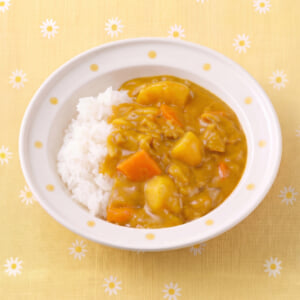
- 9:30 The pot now tastes like school lunch. From here I make a toddler version with water, milk and potato starch, and at 11:20 I show how adults can sprinkle garam masala on top for heat.
I used six cubes (120 g in my recipe) for five servings.
Tips
- Roux is salty. In my recipe, one serving of the curry comes to about 3.5 g salt equivalent.
- For a texture closer to school lunch, use one cube less and thicken with potato starch instead.
- Cook with Mild and let adults add spice at the table. It is much easier to add heat to one plate than to take it out of the whole pot.
If you can't find it
- In Japan: House lists Vermont Curry Mild as sold nationwide. I bought mine at a supermarket in Okinawa.
- In the U.S.: House's brand site shows Vermont Curry among its products for the U.S., so try Japanese or Asian grocery stores and online shops. Another Japanese roux, S&B Golden Curry Mild, is also carried by some mainstream U.S. retailers. The U.S. version on S&B's global site lists no apple, honey or milk, and it does list chili pepper, celery seed and mustard, so the flavor is a little different. Please check the label, especially for young children. The cheese, milk and ketchup in my recipe help round out the flavor.
- Anywhere Japanese roux is hard to find: Make the sauce from scratch. My nursery school recipes build it from flour, fat and curry powder (see below).
Related recipes
- Japanese Curry Rice with Store-Bought Roux (the recipe from my video)
- Japanese Curry Rice (from scratch, with cheese and milk)
- Japanese Curry Rice (milk-free, thickened with rice flour; check the allergen box on the recipe page)
- Recipes with curry powder
- Potato starch (katakuriko)
- Japanese ingredient glossary
Official information
- House Foods: Vermont Curry (Mild), product information
- House Foods: Vermont Curry brand site
- House Foods Japan: Vermont Curry Mild 230 g (Japanese)
- House Foods: What is Japanese-style curry? (about curry roux)
- House Foods: How to make Japanese curry
- S&B Foods: Golden Curry Mix Mild
- Ministry of Health, Labour and Welfare: No honey before age 1 (Japanese)