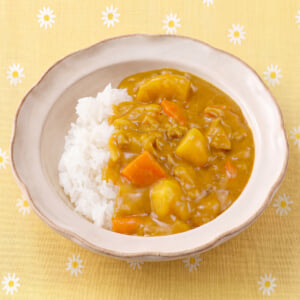
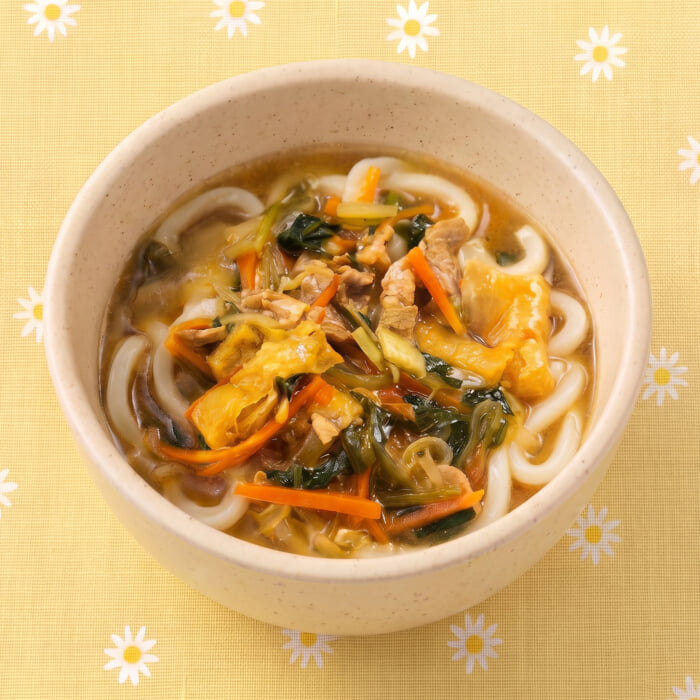
Curry Udon
カレーうどん · Kare Udon
 By Aoi, licensed nutritionist · From a Japanese preschool lunch menu
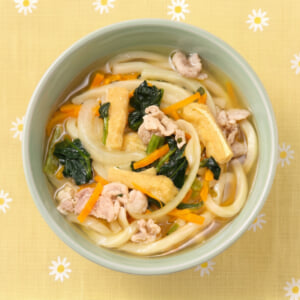
Curry udon is a Japanese noodle-shop favorite: instead of a plain dashi broth, the udon is bathed in a curry-flavored soup thickened with a little starch so it clings to every noodle. Here the curry is built on homemade dashi, soy sauce and mirin, with pork, carrot, onion, komatsuna and aburaage tucked in, so the spice is soft and the sweetness of the vegetables comes through. Children love slurping the thick, golden broth, and because the curry powder and seasonings are added in stages, you can make a milder batch for the little ones and a fuller-flavored one for older kids from the same pot.
Toddlers to adults. Portion out the children's share before the final seasoning, then season the rest for adults.
Added. Open the recipe helper (bottom right) → ☰ Menu → 🛒 Shopping list to see the ingredients for your family size.
Printing uses the number of adults and children set under Ingredients, so set those first.
Ingredients
Amounts for 1 child (1 serving). An adult counts as 2 servings.
One serving here is 1.5× the portion served to a child in a Japanese preschool, sized for Western appetites. An adult counts as two servings. Tap an ingredient to check it off.
Ingredients
- 15 gcarrot
- 12 gonion
- 9 gJapanese long onion (naga-negi)A long, thick scallion with a mild, sweet flavor when cooked, used in Japanese soups and stir-fries. Substitute: Leek (white and light green parts) or thick scallions.
- 9 gkomatsunaJapanese mustard spinach, a mild leafy green with tender stems. Substitute: Spinach or bok choy.
- 3.6 gaburaage (fried tofu pouch)Thin slices of tofu deep-fried until puffy and golden, sold in packs in the refrigerated section of Japanese and Asian markets. Substitute: Firm tofu, thinly sliced and pan-fried until golden.
- 30 gthinly sliced pork (komagire)Small, thin offcuts of pork sold in Japan for quick stir-fries and simmered dishes. Substitute: Thinly sliced pork shoulder or loin cut into bite-size pieces.
- 1.5 gvegetable oil
- 240 mldashi stockJapanese soup stock, usually made from kombu (dried kelp) and/or bonito flakes; the base of most Japanese soups and simmered dishes. Substitute: Instant dashi granules dissolved in water, or a mild unsalted chicken or vegetable stock.
- 1 gcurry powder
Seasonings (A)
- 6.6 gsoy sauce
- 3.9 gmirinMirin is a sweet Japanese rice seasoning that adds gentle sweetness and a glossy finish. Hon-mirin (true mirin) contains about 14% alcohol; "mirin-style seasoning" has little or no alcohol. Some alcohol can remain after short cooking. If you prefer no alcohol for children, use the substitute. Substitute: For each tablespoon of mirin, use 1 tablespoon water plus 1 to 2 teaspoons sugar.
Ingredients
- 1.2 gsalt
- 0.9 ball(s)cooked udon noodles (pre-boiled)Thick wheat noodles sold pre-boiled in vacuum packs that only need a quick reheat. Substitute: Dried udon, boiled according to the package.
Starch Slurry
- 4.5 gpotato starch (katakuriko)Japanese potato starch used for thickening sauces and coating fried foods. Substitute: Cornstarch: start with the same amount and add a little more if it is still thin. It thickens a little less than potato starch and needs a couple of minutes at a gentle bubble to reach full thickness.
- 9 gwater
About the Japanese ingredients in this recipe
- Japanese long onion (naga-negi) (長ねぎ)
- A long, thick scallion with a mild, sweet flavor when cooked, used in Japanese soups and stir-fries. Substitute: Leek (white and light green parts) or thick scallions.
- komatsuna (小松菜)
- Japanese mustard spinach, a mild leafy green with tender stems. Substitute: Spinach or bok choy.
- aburaage (fried tofu pouch) (油揚げ)
- Thin slices of tofu deep-fried until puffy and golden, sold in packs in the refrigerated section of Japanese and Asian markets. Substitute: Firm tofu, thinly sliced and pan-fried until golden.
- thinly sliced pork (komagire) (豚こま切れ肉)
- Small, thin offcuts of pork sold in Japan for quick stir-fries and simmered dishes. Substitute: Thinly sliced pork shoulder or loin cut into bite-size pieces.
- dashi stock (だし汁)
- Japanese soup stock, usually made from kombu (dried kelp) and/or bonito flakes; the base of most Japanese soups and simmered dishes. Substitute: Instant dashi granules dissolved in water, or a mild unsalted chicken or vegetable stock.
- mirin (みりん)
- Mirin is a sweet Japanese rice seasoning that adds gentle sweetness and a glossy finish. Hon-mirin (true mirin) contains about 14% alcohol; "mirin-style seasoning" has little or no alcohol. Some alcohol can remain after short cooking. If you prefer no alcohol for children, use the substitute. Substitute: For each tablespoon of mirin, use 1 tablespoon water plus 1 to 2 teaspoons sugar.
- potato starch (katakuriko) (かたくり粉)
- Japanese potato starch used for thickening sauces and coating fried foods. Substitute: Cornstarch: start with the same amount and add a little more if it is still thin. It thickens a little less than potato starch and needs a couple of minutes at a gentle bubble to reach full thickness. Read the guide: Katakuriko (Japanese Potato Starch) and What to Use Instead → Guide: japanese-school-lunch.com/articles/katakuriko-potato-starch/
- cooked udon noodles (pre-boiled) (ゆでうどん)
- Thick wheat noodles sold pre-boiled in vacuum packs that only need a quick reheat. Substitute: Dried udon, boiled according to the package.
Directions
Video is in Japanese — the steps below are synced to it, so tap ▶ on a step to jump to that moment.
- 1
Make the dashi stock (see step 1 of the Oyakodon recipe).
- 2
Cut the carrot into thin strips, thinly slice the onion, cut the long onion into thin rounds, and cut the komatsuna into 3 cm lengths. Pour boiling water over the aburaage to remove excess oil, then cut it into short rectangular strips. Cut the pork into 1 cm wide pieces. Note: Komatsuna leaves are hard for little ones to bite through, so chop them finely for the preschool version.
- 3
Heat the oil in a pot and sauté the carrot and onion over medium heat for about 3 minutes. Add the pork and curry powder and cook, stirring, until the pork is cooked through. Note: If you are also making a preschool version, reduce the curry powder to about 20% of the amount.
- 4
Add a small amount of the dashi stock and stir until it blends with the curry powder, then add the rest. Once it comes to a boil, add the long onion, komatsuna, aburaage and the (A) seasonings, and simmer over low heat for about 15 minutes. Note: If you are also making a preschool version, use about 70% of the combined seasonings (and of the salt in step 5 as well), then proceed as written.
- 5
Add the salt to adjust the seasoning, turn off the heat, and stir in the starch slurry. Return to low heat and stir until the broth thickens. Note: For elementary-school age and up, add the remaining curry powder and seasonings, tasting as you go, and simmer for another 2 to 3 minutes.
- 6
Boil the udon in hot water and drain well. Place the udon in bowls and pour the curry broth over the top. Note: For the preschool version, boil the udon about 5 minutes longer.
Tips for Best Results
- Sautéing for about 5 minutes in step 3 gives the curry even more depth of flavor.
- For the aburaage strips, cut the pouch in half lengthwise, turn it 90 degrees, and slice it into 5 mm wide strips - this is the easiest way to do it.
Freezing Instructions
Divide the curry broth into single portions in freezer bags and freeze. Reheat in the microwave and pour over freshly boiled udon.
Keeps for: about 2 weeks (best eaten as soon as possible).
Nutrition
Nutrition values include the soup.
Nutrition values do not include the noodles.
| Per | 1 serving | 1 adult serving | Your total |
|---|---|---|---|
| Energy | 129 kcal | 258 kcal | 129 kcal |
| Protein | 9 g | 18 g | 9 g |
| Fat | 5.9 g | 11.7 g | 5.9 g |
| Carbohydrates | 10.5 g | 21 g | 10.5 g |
| Fiber | 1.4 g | 2.8 g | 1.4 g |
| Salt equivalent | 2.3 g | 4.7 g | 2.3 g |
| Calcium | 52.5 mg | 105 mg | 52.5 mg |
| Iron | 1.1 mg | 2.3 mg | 1.1 mg |
| Potassium | 436.5 mg | 873 mg | 436.5 mg |
| Phosphorus | 134.3 mg | 268.5 mg | 134.3 mg |
| Energy | Protein | Fat | Carbs | Fiber | Salt equiv. | Calcium | Iron | Potassium | Phosphorus | |
|---|---|---|---|---|---|---|---|---|---|---|
| 1 serving | 129 kcal | 9 g | 5.9 g | 10.5 g | 1.4 g | 2.3 g | 52.5 mg | 1.1 mg | 436.5 mg | 134.3 mg |
| 1 adult serving | 258 kcal | 18 g | 11.7 g | 21 g | 2.8 g | 4.7 g | 105 mg | 2.3 mg | 873 mg | 268.5 mg |
Values are per serving (1.5× the Japanese preschool portion); an adult serving is double. They were calculated by a licensed Japanese nutritionist using the Standard Tables of Food Composition in Japan. "Salt equivalent" is sodium × 2.54, the standard Japanese measure. Allergen flags cover egg, milk and wheat only and come from the nutritionist's records. Soy sauce and miso are made with wheat but are usually allowed on Japanese wheat-free school menus, so check with your doctor.