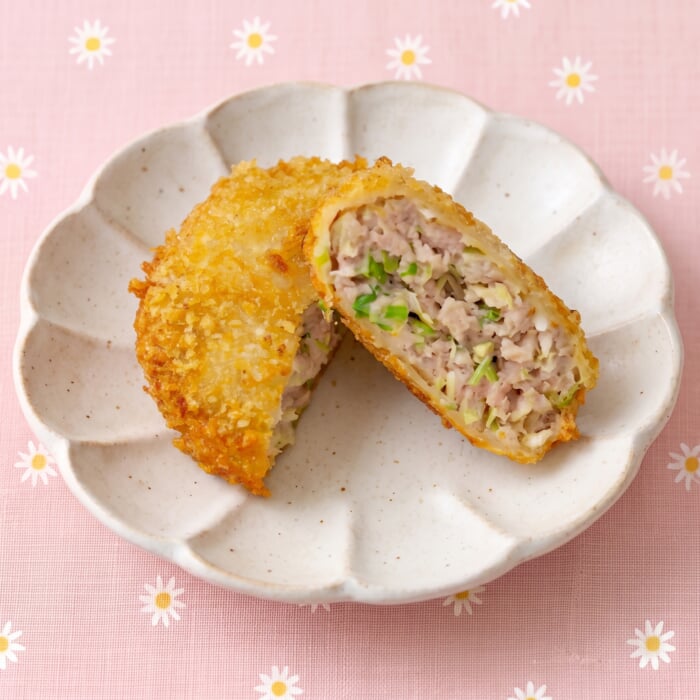
Cabbage Menchi Katsu (Breaded Pork Patties)
キャベツのメンチカツ · Kyabetsu no Menchi Katsu
 By Aoi, licensed nutritionist · From a Japanese preschool lunch menu
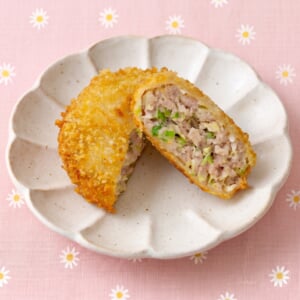
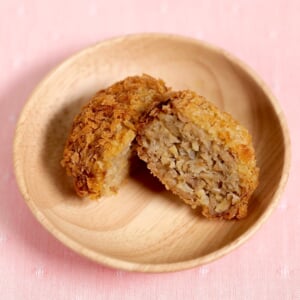
Menchi katsu is a Japanese comfort-food classic: a seasoned ground meat patty coated in panko and deep-fried until golden and crunchy. In this version, a generous amount of finely chopped cabbage goes into the meat mixture, which keeps the patties juicy and gives them a lighter, fresher bite than meat alone. Because the cabbage is chopped so small, even children who are wary of vegetables tend to polish these off without noticing them. A little skim milk powder in the meat mixture is the preschool kitchen's quiet way of adding extra calcium.
Toddlers to adults. The whole family can eat this exactly as written.
Added. Open the recipe helper (bottom right) → ☰ Menu → 🛒 Shopping list to see the ingredients for your family size.
Printing uses the number of adults and children set under Ingredients, so set those first.
Ingredients
Amounts for 1 child (1 serving). An adult counts as 2 servings.
One serving here is 1.5× the portion served to a child in a Japanese preschool, sized for Western appetites. An adult counts as two servings. Tap an ingredient to check it off.
Ingredients
- 54 gcabbage
- 0.2 gsalt (for the vegetables)
- 45 gground pork
Seasonings
- 9 gpanko (for the meat mixture)
- 2.1 gskim milk powderMilk with the fat and water removed. Substitute: No skim milk powder? Leave it out and use milk in place of the water it is dissolved in, in the same amount (for example, 30 g skim milk powder + 130 g water becomes 130 g milk). Milk still contains milk, so this swap is not for a milk allergy.
- 9 gegg (for the meat mixture)
- 0.3 gsalt (for the meat mixture)
- to tastepepper
Coating
- 12 gegg (for the coating)
- 6 gflour
- 6 gwater
- 9 gpanko (for coating)
- to tasteoil for deep-frying
About the Japanese ingredients in this recipe
- skim milk powder (スキムミルク)
- Milk with the fat and water removed. Substitute: No skim milk powder? Leave it out and use milk in place of the water it is dissolved in, in the same amount (for example, 30 g skim milk powder + 130 g water becomes 130 g milk). Milk still contains milk, so this swap is not for a milk allergy.
Directions
Video is in Japanese — the steps below are synced to it, so tap ▶ on a step to jump to that moment.
- 1
Finely chop the cabbage. Sprinkle with the salt, rub it in, and let stand for about 15 minutes, then squeeze out the moisture thoroughly. Chopping by hand with a knife keeps some texture and gives the best flavor; if your child is not keen on vegetables, chopping the cabbage very finely in a food processor works well.
- 2
Add the panko, skim milk powder, egg, salt, and pepper to the ground pork and knead well until the mixture becomes sticky. This gives the patties a smooth, tender texture. The skim milk powder is there for extra calcium, so you can leave it out if you like.
- 3
Add the cabbage from step 1 and mix thoroughly. It will look like far too much cabbage, but keep mixing and it will blend in well.
- 4
Divide the mixture into equal portions. Toss each portion back and forth between your palms to knock out the air, then shape into rounds.
- 5
In a bowl, mix together the egg, flour, and water. Dip each patty in the batter, then coat with the panko.
- 6
Lower the patties into oil heated to 170°C (340°F). Fry for a total of about 7 minutes, turning them over every 2 minutes.
This recipe works for everyone at the table, from toddlers to adults. With plenty of cabbage, it delivers a good helping of vegetables, and the patties eat lighter and less heavy than an all-meat version. To freeze, wrap the breaded, uncooked patties individually in plastic wrap, place them in a freezer bag, and freeze. When you are ready to eat, fry them straight from frozen in 170°C (340°F) oil for about 9 to 10 minutes. They keep for about 2 weeks in the freezer, but are best eaten as soon as possible.
Nutrition
| Per | 1 serving | 1 adult serving | Your total |
|---|---|---|---|
| Energy | 361.5 kcal | 723 kcal | 361.5 kcal |
| Protein | 15 g | 30 g | 15 g |
| Fat | 25.8 g | 51.6 g | 25.8 g |
| Carbohydrates | 20.5 g | 41.1 g | 20.5 g |
| Fiber | 2.3 g | 4.5 g | 2.3 g |
| Salt equivalent | 0.8 g | 1.5 g | 0.8 g |
| Calcium | 64.5 mg | 129 mg | 64.5 mg |
| Iron | 1.2 mg | 2.4 mg | 1.2 mg |
| Potassium | 333 mg | 666 mg | 333 mg |
| Phosphorus | 151.5 mg | 303 mg | 151.5 mg |
| Energy | Protein | Fat | Carbs | Fiber | Salt equiv. | Calcium | Iron | Potassium | Phosphorus | |
|---|---|---|---|---|---|---|---|---|---|---|
| 1 serving | 361.5 kcal | 15 g | 25.8 g | 20.5 g | 2.3 g | 0.8 g | 64.5 mg | 1.2 mg | 333 mg | 151.5 mg |
| 1 adult serving | 723 kcal | 30 g | 51.6 g | 41.1 g | 4.5 g | 1.5 g | 129 mg | 2.4 mg | 666 mg | 303 mg |
Values are per serving (1.5× the Japanese preschool portion); an adult serving is double. They were calculated by a licensed Japanese nutritionist using the Standard Tables of Food Composition in Japan. "Salt equivalent" is sodium × 2.54, the standard Japanese measure. Allergen flags cover egg, milk and wheat only and come from the nutritionist's records. Soy sauce and miso are made with wheat but are usually allowed on Japanese wheat-free school menus, so check with your doctor.