Koinobori (Carp Streamer) Hamburg Steak
鯉のぼりハンバーグ · Koinobori Hanbāgu
 By Aoi, licensed nutritionist · From a Japanese preschool lunch menu
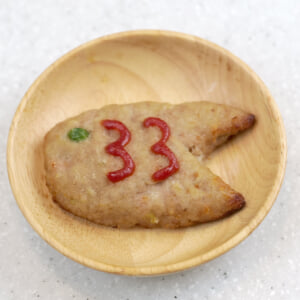
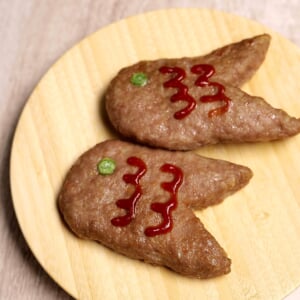
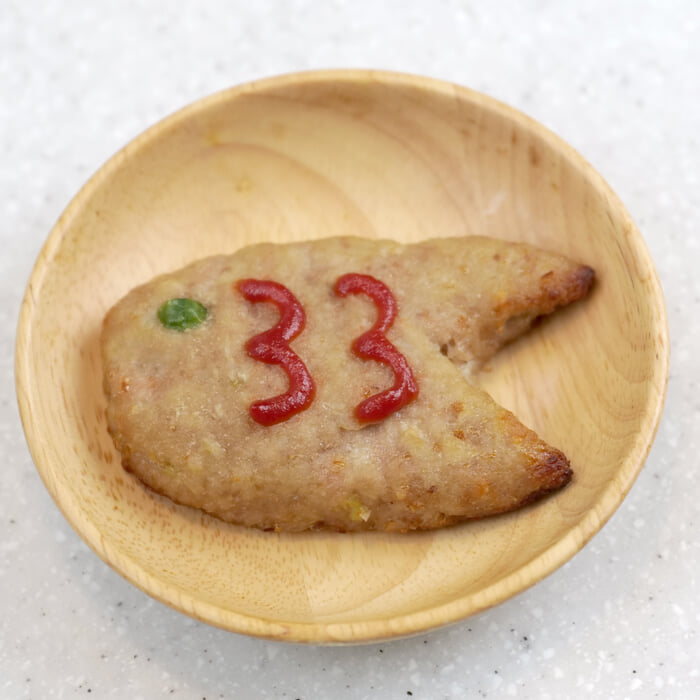
Koinobori are the carp-shaped streamers that fly over Japanese homes in the run-up to Children's Day on May 5, a wish for kids to grow up strong and healthy. Here that cheerful carp becomes a soft pork Hamburg steak, with a notched tail, a green pea for the eye and scales drawn on in ketchup. Kids love spotting the fish on their plate, and baking the patties in the oven means they cook through gently without drying out. It is a small bit of festival fun that also happens to be an easy, tender main dish.
Added. Open the recipe helper (bottom right) → ☰ Menu → 🛒 Shopping list to see the ingredients for your family size.
Printing uses the number of adults and children set under Ingredients, so set those first.
Ingredients
Amounts for 1 child (1 serving). An adult counts as 2 servings.
One serving here is 1.5× the portion served to a child in a Japanese preschool, sized for Western appetites. An adult counts as two servings. Tap an ingredient to check it off.
Ingredients
- 22.5 gonion
- 67.5 gground pork
- 0.8 gfrozen green peas
Seasonings
- 1.5 gvegetable oil
- 7.8 gpanko
- 2 gskim milk powderMilk with the fat and water removed. Substitute: No skim milk powder? Leave it out and use milk in place of the water it is dissolved in, in the same amount (for example, 30 g skim milk powder + 130 g water becomes 130 g milk). Milk still contains milk, so this swap is not for a milk allergy.
- 7.5 gwater
- 0.2 gsalt
- to tastepepper
- 3 gketchup
About the Japanese ingredients in this recipe
- skim milk powder (スキムミルク)
- Milk with the fat and water removed. Substitute: No skim milk powder? Leave it out and use milk in place of the water it is dissolved in, in the same amount (for example, 30 g skim milk powder + 130 g water becomes 130 g milk). Milk still contains milk, so this swap is not for a milk allergy.
Directions
Video is in Japanese and may show a different version of this dish (other ingredients or steps). Follow the ingredients and steps on this page, especially when cooking for allergies.
- 1
Finely chop the onion. Heat the vegetable oil in a frying pan and sauté the onion until soft and lightly golden, then let it cool.
- 2
In a bowl, combine the cooled onion, ground pork, panko, the skim milk powder dissolved in lukewarm water, and the salt and pepper. Knead well until the mixture becomes sticky.
- 3
Divide into equal portions, then toss each portion lightly from one hand to the other to knock out any air pockets.
- 4
Shape each portion into a koinobori carp: roll it into a cylinder, then flatten it into an oval (or use a knife to square it off into a rectangle). Cut a triangular notch into one end and remove the cut-out piece to form the tail.
- 5
Press a green pea into each patty for the eye, then bake in an oven preheated to 180°C (350°F) for about 20 minutes.
- 6
Once baked, draw scales on each carp with ketchup.
The patties shrink as they bake, so when shaping them, aim to make them longer and thinner than you think you need. Cut the tail notch generously too, removing roughly one third of the patty's length.
Nutrition
| Per | 1 serving | 1 adult serving | Your total |
|---|---|---|---|
| Energy | 199.5 kcal | 399 kcal | 199.5 kcal |
| Protein | 14.1 g | 28.2 g | 14.1 g |
| Fat | 13.4 g | 26.7 g | 13.4 g |
| Carbohydrates | 9.3 g | 18.6 g | 9.3 g |
| Fiber | 0.8 g | 1.5 g | 0.8 g |
| Salt equivalent | 0.5 g | 0.9 g | 0.5 g |
| Calcium | 31.5 mg | 63 mg | 31.5 mg |
| Iron | 0.9 mg | 1.8 mg | 0.9 mg |
| Potassium | 291 mg | 582 mg | 291 mg |
| Energy | Protein | Fat | Carbs | Fiber | Salt equiv. | Calcium | Iron | Potassium | |
|---|---|---|---|---|---|---|---|---|---|
| 1 serving | 199.5 kcal | 14.1 g | 13.4 g | 9.3 g | 0.8 g | 0.5 g | 31.5 mg | 0.9 mg | 291 mg |
| 1 adult serving | 399 kcal | 28.2 g | 26.7 g | 18.6 g | 1.5 g | 0.9 g | 63 mg | 1.8 mg | 582 mg |
Values are per serving (1.5× the Japanese preschool portion); an adult serving is double. They were calculated by a licensed Japanese nutritionist using the Standard Tables of Food Composition in Japan. "Salt equivalent" is sodium × 2.54, the standard Japanese measure. Allergen flags cover egg, milk and wheat only and come from the nutritionist's records. Soy sauce and miso are made with wheat but are usually allowed on Japanese wheat-free school menus, so check with your doctor.