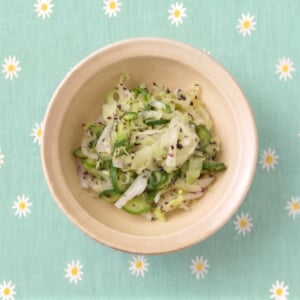
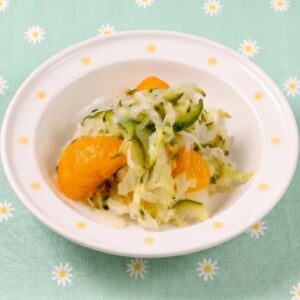
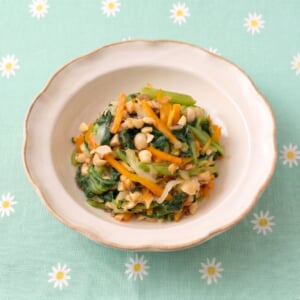
Cabbage and Bean Sprout Yukari-ae (Red Shiso Salad)
ゆかり和え(もやし) · Yukari-ae
 By Aoi, licensed nutritionist · From a Japanese preschool lunch menu
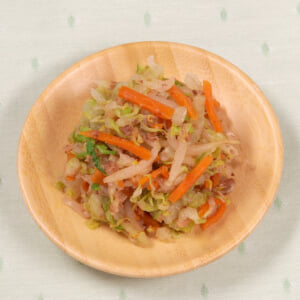
Yukari-ae is one of the simplest side dishes on our preschool menu: cabbage and bean sprouts are boiled, cooled, squeezed dry and tossed with yukari. Yukari is a dried, salted red shiso (perilla) seasoning that is usually sprinkled over rice; it turns the vegetables a pretty purple and gives them a gentle, tangy saltiness that children find easy to like. The vegetables are shredded and cut short so even small children can manage them without trouble, and with no egg, milk or wheat in the dish it slots easily into almost any lunch.
Added. Open the recipe helper (bottom right) → ☰ Menu → 🛒 Shopping list to see the ingredients for your family size.
Printing uses the number of adults and children set under Ingredients, so set those first.
Ingredients
Amounts for 1 child (1 serving). An adult counts as 2 servings.
One serving here is 1.5× the portion served to a child in a Japanese preschool, sized for Western appetites. An adult counts as two servings. Tap an ingredient to check it off.
Ingredients
- 60 gcabbage
- 30 gbean sprouts
Seasonings
- 0.9 gyukari (dried red shiso seasoning)A tangy, salty purple sprinkle made from dried red shiso (perilla) leaves, usually shaken over rice. Substitute: Shiso furikake, or a pinch of salt plus a few drops of umeboshi (pickled plum) vinegar.
About the Japanese ingredients in this recipe
- yukari (dried red shiso seasoning) (ゆかり)
- A tangy, salty purple sprinkle made from dried red shiso (perilla) leaves, usually shaken over rice. Substitute: Shiso furikake, or a pinch of salt plus a few drops of umeboshi (pickled plum) vinegar.
Directions
- 1
Cut the cabbage into short, thin shreds. Cut the bean sprouts into 2 cm lengths.
- 2
Boil the cabbage and bean sprouts separately, then rinse under cold running water to cool.
- 3
Squeeze the vegetables well to remove the water, then toss with the yukari.
Yukari loses its flavor as it sits, so toss it with the vegetables just before serving.
Nutrition
| Per | 1 serving | 1 adult serving | Your total |
|---|---|---|---|
| Energy | 19.5 kcal | 39 kcal | 19.5 kcal |
| Protein | 1.4 g | 2.7 g | 1.4 g |
| Fat | 0 g | 0 g | 0 g |
| Carbohydrates | 4.2 g | 8.4 g | 4.2 g |
| Fiber | 1.5 g | 3 g | 1.5 g |
| Salt equivalent | 0.5 g | 0.9 g | 0.5 g |
| Calcium | 31.5 mg | 63 mg | 31.5 mg |
| Iron | 0.3 mg | 0.6 mg | 0.3 mg |
| Potassium | 141 mg | 282 mg | 141 mg |
| Energy | Protein | Fat | Carbs | Fiber | Salt equiv. | Calcium | Iron | Potassium | |
|---|---|---|---|---|---|---|---|---|---|
| 1 serving | 19.5 kcal | 1.4 g | 0 g | 4.2 g | 1.5 g | 0.5 g | 31.5 mg | 0.3 mg | 141 mg |
| 1 adult serving | 39 kcal | 2.7 g | 0 g | 8.4 g | 3 g | 0.9 g | 63 mg | 0.6 mg | 282 mg |
Values are per serving (1.5× the Japanese preschool portion); an adult serving is double. They were calculated by a licensed Japanese nutritionist using the Standard Tables of Food Composition in Japan. "Salt equivalent" is sodium × 2.54, the standard Japanese measure. Allergen flags cover egg, milk and wheat only and come from the nutritionist's records. Soy sauce and miso are made with wheat but are usually allowed on Japanese wheat-free school menus, so check with your doctor.