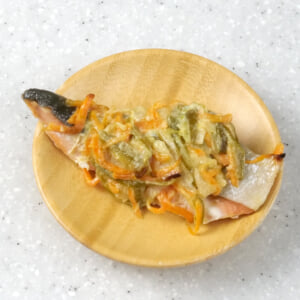
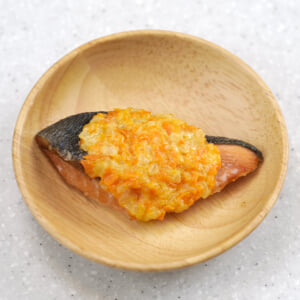
Baked Flounder with Miso Mayonnaise
かれいの味噌マヨネーズ焼き · Karei no Miso Mayonēzu Yaki
 By Aoi, licensed nutritionist · From a Japanese preschool lunch menu
Flounder (karei) is a favorite white fish in Japanese school kitchens: it is mild, soft and easy for small children to eat. Here it is baked under a blanket of sautéed carrot, green bell pepper and onion folded into miso and mayonnaise, so the topping keeps the fish moist and adds a gentle, savory richness. The miso-mayonnaise combination is a classic Japanese home-cooking trick, and it is a good way to get vegetables and fish onto the same fork for kids who are wary of one or the other.
Added. Open the recipe helper (bottom right) → ☰ Menu → 🛒 Shopping list to see the ingredients for your family size.
Printing uses the number of adults and children set under Ingredients, so set those first.
Ingredients
Amounts for 1 child (1 serving). An adult counts as 2 servings.
One serving here is 1.5× the portion served to a child in a Japanese preschool, sized for Western appetites. An adult counts as two servings. Tap an ingredient to check it off.
Ingredients
- 75 gflounder
- 10.5 gcarrot
- 9 ggreen bell pepper
- 18 gonion
Seasonings
- 0.2 gsalt
- to tastepepper
- 1.5 gvegetable oil
- 6.8 gmayonnaise
- 1.2 glight rice misoA pale, salty rice miso, the standard everyday miso in Japan. Substitute: Any light, white, or awase (blended) miso.
About the Japanese ingredients in this recipe
- light rice miso (米みそ(淡色辛みそ))
- A pale, salty rice miso, the standard everyday miso in Japan. Substitute: Any light, white, or awase (blended) miso.
Directions
- 1
Season the fish with salt and pepper.
- 2
Cut the carrot, green bell pepper and onion into short, thin strips. Heat the vegetable oil in a frying pan and sauté the vegetables.
- 3
Once the vegetables have cooled slightly, mix them with the mayonnaise and miso.
- 4
Line a baking sheet with parchment paper and arrange the seasoned fish on it. Spoon the vegetable mixture over the fish and bake in a 180°C (350°F) oven for about 20 minutes.
Nutrition
| Per | 1 serving | 1 adult serving | Your total |
|---|---|---|---|
| Energy | 139.5 kcal | 279 kcal | 139.5 kcal |
| Protein | 15.3 g | 30.6 g | 15.3 g |
| Fat | 7.7 g | 15.3 g | 7.7 g |
| Carbohydrates | 2.3 g | 4.5 g | 2.3 g |
| Salt equivalent | 0.6 g | 1.2 g | 0.6 g |
| Calcium | 40.5 mg | 81 mg | 40.5 mg |
| Iron | 0.3 mg | 0.6 mg | 0.3 mg |
| Energy | Protein | Fat | Carbs | Salt equiv. | Calcium | Iron | |
|---|---|---|---|---|---|---|---|
| 1 serving | 139.5 kcal | 15.3 g | 7.7 g | 2.3 g | 0.6 g | 40.5 mg | 0.3 mg |
| 1 adult serving | 279 kcal | 30.6 g | 15.3 g | 4.5 g | 1.2 g | 81 mg | 0.6 mg |
Values are per serving (1.5× the Japanese preschool portion); an adult serving is double. They were calculated by a licensed Japanese nutritionist using the Standard Tables of Food Composition in Japan. "Salt equivalent" is sodium × 2.54, the standard Japanese measure. Allergen flags cover egg, milk and wheat only and come from the nutritionist's records. Soy sauce and miso are made with wheat but are usually allowed on Japanese wheat-free school menus, so check with your doctor.