Baked Fish with Tartar Sauce
魚のタルタルソース焼き
 By Aoi, licensed nutritionist · From a Japanese preschool lunch menu
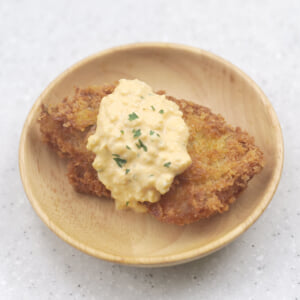
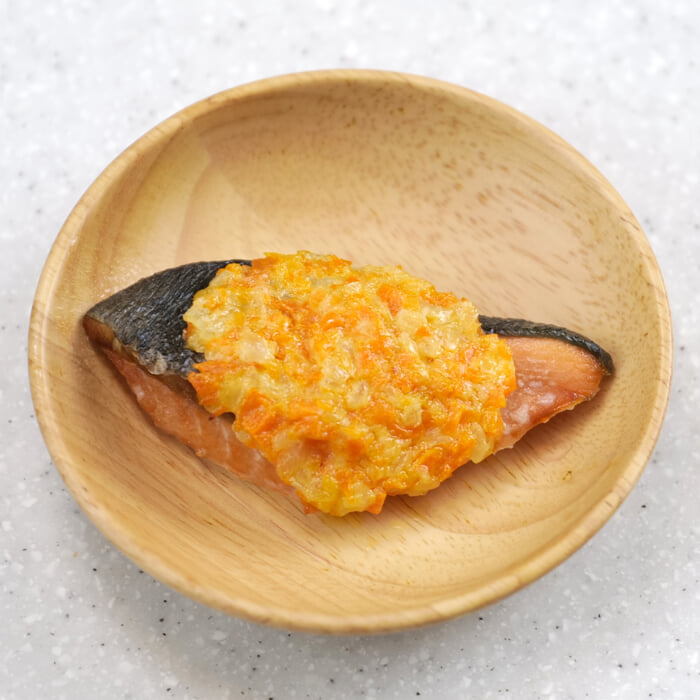
This is a preschool-kitchen take on tartar sauce: instead of pickles and hard-boiled egg, finely chopped carrot and onion are cooked slowly until sweet, then folded into mayonnaise. Spread over salmon and baked until lightly golden, the sauce keeps the fish moist and gives it a gentle, creamy flavor that even children who are wary of fish tend to accept. Because the vegetables are minced and softened before they go into the sauce, they disappear into every bite - an easy way to get a little extra veg onto the plate.
Added. Open the recipe helper (bottom right) → ☰ Menu → 🛒 Shopping list to see the ingredients for your family size.
Printing uses the number of adults and children set under Ingredients, so set those first.
Ingredients
Amounts for 1 child (1 serving). An adult counts as 2 servings.
One serving here is 1.5× the portion served to a child in a Japanese preschool, sized for Western appetites. An adult counts as two servings. Tap an ingredient to check it off.
Ingredients
- 67.5 gsalmon fillet (skinless, boneless)
- 11.3 gcarrot
- 8.1 gonion
Seasonings
- 0.1 gsalt
- to tastepepper
- 1.4 gvegetable oil
- 5.4 gmayonnaise
Directions
- 1
Sprinkle both sides of the salmon with salt and pepper and let it sit for 15 minutes so the seasoning soaks in.
- 2
Finely mince the carrot and onion.
- 3
Heat the oil in a frying pan, add the minced vegetables from step 2 and cook over low heat for 10 minutes.
- 4
Once the vegetables from step 3 have cooled slightly, mix in the mayonnaise, and a little dried parsley if you like, to make the tartar sauce.
- 5
Arrange the salmon from step 1 on a baking tray and bake in a toaster oven (or an oven preheated to 200°C / 400°F) for 10 minutes.
- 6
After 10 minutes, take the salmon out, spoon the sauce from step 4 on top and bake for another 5 minutes.
Nutrition
| Per | 1 serving | 1 adult serving | Your total |
|---|---|---|---|
| Energy | 141 kcal | 282 kcal | 141 kcal |
| Protein | 15.5 g | 30.9 g | 15.5 g |
| Fat | 8.6 g | 17.1 g | 8.6 g |
| Carbohydrates | 0.6 g | 1.2 g | 0.6 g |
| Salt equivalent | 0.3 g | 0.6 g | 0.3 g |
| Calcium | 12 mg | 24 mg | 12 mg |
| Iron | 0.3 mg | 0.6 mg | 0.3 mg |
| Energy | Protein | Fat | Carbs | Salt equiv. | Calcium | Iron | |
|---|---|---|---|---|---|---|---|
| 1 serving | 141 kcal | 15.5 g | 8.6 g | 0.6 g | 0.3 g | 12 mg | 0.3 mg |
| 1 adult serving | 282 kcal | 30.9 g | 17.1 g | 1.2 g | 0.6 g | 24 mg | 0.6 mg |
Values are per serving (1.5× the Japanese preschool portion); an adult serving is double. They were calculated by a licensed Japanese nutritionist using the Standard Tables of Food Composition in Japan. "Salt equivalent" is sodium × 2.54, the standard Japanese measure. Allergen flags cover egg, milk and wheat only and come from the nutritionist's records. Soy sauce and miso are made with wheat but are usually allowed on Japanese wheat-free school menus, so check with your doctor.