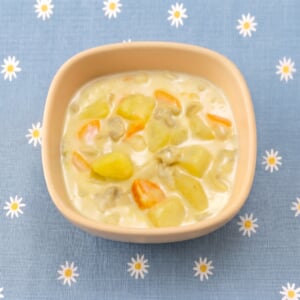
Cream Stew
クリームシチュー
 By Aoi, licensed nutritionist · From a Japanese preschool lunch menu
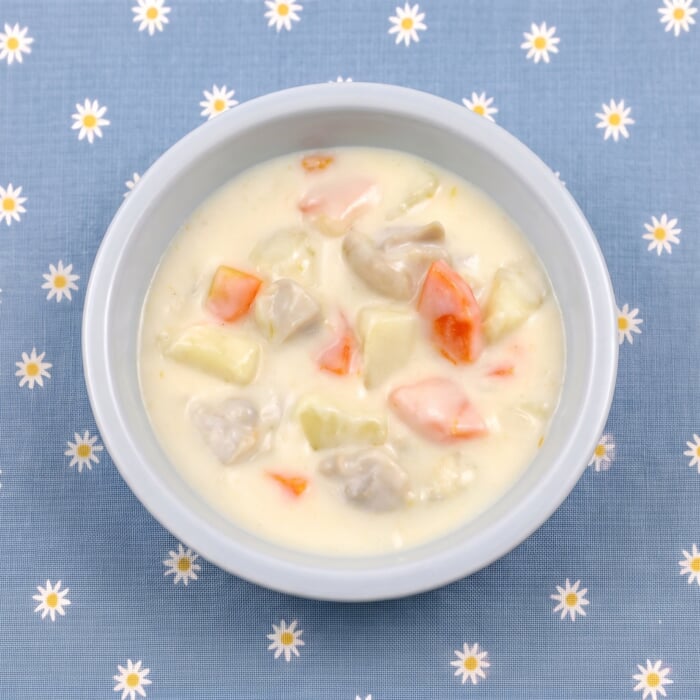
Cream stew is one of Japan's best-loved Western-style home dishes: chicken, onion, carrot and potato simmered in a gentle, milky sauce. Most families make it with a store-bought roux block, but this preschool-kitchen version builds the sauce from flour, milk and a little processed cheese, so you control the salt and the flavor stays mild and creamy. The vegetables are softened in the microwave first and then sautéed to bring out their sweetness, which is why it tastes so rich with only a light hand on the seasoning. It is made without egg and goes just as well with bread as with rice.
Toddlers to adults. The whole family can eat this exactly as written.
Added. Open the recipe helper (bottom right) → ☰ Menu → 🛒 Shopping list to see the ingredients for your family size.
Printing uses the number of adults and children set under Ingredients, so set those first.
Ingredients
Amounts for 1 child (1 serving). An adult counts as 2 servings.
One serving here is 1.5× the portion served to a child in a Japanese preschool, sized for Western appetites. An adult counts as two servings. Tap an ingredient to check it off.
- 36 gchicken thigh
- 45 gonion
- 30 gcarrot
- 75 gpotato
- 6 gbutter
- 6 gvegetable oil
- 12 gflour
- 120 mlwater
- 120 mlmilk
- 1.8 gconsommé bouillon (granules or cube)Japanese-style Western soup stock powder or cubes, similar to chicken or vegetable bouillon. Substitute: Chicken or vegetable bouillon granules or a bouillon cube.
- 6 gprocessed cheese
- 0.9 gsalt
- to tastepepper
About the Japanese ingredients in this recipe
- consommé bouillon (granules or cube) (コンソメ)
- Japanese-style Western soup stock powder or cubes, similar to chicken or vegetable bouillon. Substitute: Chicken or vegetable bouillon granules or a bouillon cube.
Directions
Video is in Japanese — the steps below are synced to it, so tap ▶ on a step to jump to that moment.
- 1
Cut the onion into 1.5 cm dice, the carrot into quarter-rounds (ichō-giri), the potato into 2 cm dice and the chicken into 1.5 cm pieces.
- 2
Put the onion, carrot and 1 tbsp water (not included in the ingredient amounts) in a microwave-safe bowl and mix. Cover loosely with plastic wrap, leaving a gap for steam to escape, and microwave at 1200W for about 3 minutes 30 seconds (7 minutes at 600W). Add the potato, stir, and microwave for about 1 minute more (2 minutes at 600W). (Heating time varies with the amount, so check and adjust as needed.)
- 3
Heat the butter and oil in a pot, add the vegetables from step 2 and sauté over medium heat for about 2 minutes. Add the chicken and sauté until it changes color.
- 4
Turn off the heat, sprinkle in the flour and toss to coat everything. Add the water, milk and consommé, then set over low heat and stir until the flour blends in smoothly. (Adding the flour with the heat off makes it much less likely to form lumps.)
- 5
Add the cheese and simmer over low heat for about 10 minutes, stirring from the bottom of the pot now and then so it doesn't scorch. Season to taste with salt and pepper.
Tips for the Best Results
- Sautéing the vegetables well to draw out their sweetness gives the stew real depth even with very little seasoning.
- Adding cheese makes the stew rich and creamy without using a roux block. It goes well with both bread and rice.
How to Freeze
Remove the potato first, since its texture changes when frozen. Let the stew cool, then pack single portions into freezer bags and freeze. To serve, reheat in the microwave and stir well.
Keeps about 2 weeks (best eaten as soon as possible).
Nutrition
| Per | 1 serving | 1 adult serving | Your total |
|---|---|---|---|
| Energy | 373.5 kcal | 747 kcal | 373.5 kcal |
| Protein | 14.7 g | 29.4 g | 14.7 g |
| Fat | 22.8 g | 45.6 g | 22.8 g |
| Carbohydrates | 35.3 g | 70.5 g | 35.3 g |
| Fiber | 8.6 g | 17.1 g | 8.6 g |
| Salt equivalent | 2.3 g | 4.5 g | 2.3 g |
| Calcium | 195 mg | 390 mg | 195 mg |
| Iron | 0.9 mg | 1.8 mg | 0.9 mg |
| Potassium | 777 mg | 1554 mg | 777 mg |
| Phosphorus | 285 mg | 570 mg | 285 mg |
| Energy | Protein | Fat | Carbs | Fiber | Salt equiv. | Calcium | Iron | Potassium | Phosphorus | |
|---|---|---|---|---|---|---|---|---|---|---|
| 1 serving | 373.5 kcal | 14.7 g | 22.8 g | 35.3 g | 8.6 g | 2.3 g | 195 mg | 0.9 mg | 777 mg | 285 mg |
| 1 adult serving | 747 kcal | 29.4 g | 45.6 g | 70.5 g | 17.1 g | 4.5 g | 390 mg | 1.8 mg | 1554 mg | 570 mg |
Values are per serving (1.5× the Japanese preschool portion); an adult serving is double. They were calculated by a licensed Japanese nutritionist using the Standard Tables of Food Composition in Japan. "Salt equivalent" is sodium × 2.54, the standard Japanese measure. Allergen flags cover egg, milk and wheat only and come from the nutritionist's records. Soy sauce and miso are made with wheat but are usually allowed on Japanese wheat-free school menus, so check with your doctor.
Cooking for bigger kids? See the elementary-school portion of this recipe.