Shrimp Cream Rice
えびクリームライス
 By Aoi, licensed nutritionist · From a Japanese preschool lunch menu
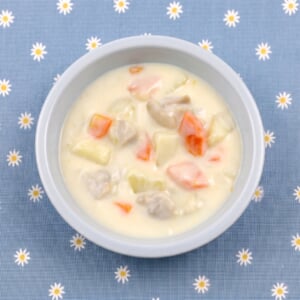
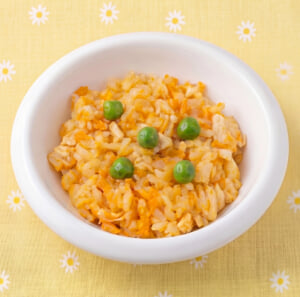
Shrimp cream rice is a Western-style (yoshoku) dish that shows up on Japanese preschool lunch menus: carrot rice cooked with a little butter, salt and sake, topped with a gentle white sauce full of shrimp, chicken and shimeji mushrooms. Children love anything creamy, and because the carrot is minced finely and cooked right into the rice, even kids who usually push vegetables aside eat it without a second thought. The sauce is thickened with flour in the pan rather than a separate roux, so it comes together in one frying pan. For the youngest children in the nursery we simply chop the shrimp small once the sauce is done.
Added. Open the recipe helper (bottom right) → ☰ Menu → 🛒 Shopping list to see the ingredients for your family size.
Printing uses the number of adults and children set under Ingredients, so set those first.
Ingredients
Amounts for 1 child (1 serving). An adult counts as 2 servings.
One serving here is 1.5× the portion served to a child in a Japanese preschool, sized for Western appetites. An adult counts as two servings. Tap an ingredient to check it off.
Ingredients
- 75 griceJapanese short-grain white rice (japonica), which cooks up soft and slightly sticky. The amount listed is for uncooked rice. Substitute: Sushi rice, or another short-grain or medium-grain rice such as Calrose.
- 15 gcarrot
- 30 gonion
- 10.5 gshimeji mushroomsSmall brown-capped mushrooms sold in clusters, with a mild, slightly nutty flavor and a pleasant chew. Substitute: Oyster mushrooms or sliced button mushrooms.
- 16.5 gchicken thigh
- 27 gsmall shrimp (shiba shrimp)A small, sweet variety of shrimp commonly used in Japan. Substitute: Any small peeled shrimp.
- 48 gwater
Seasonings
- 1.5 gsakeSake (Japanese rice wine) is used in small amounts to soften the smell of fish and meat and add depth. Japanese "cooking sake" often contains added salt. Some alcohol can remain after short cooking. If you prefer no alcohol for children, use the substitute. Substitute: The same amount of water (the taste will be a little simpler), or dry white wine.
- 0.5 gsalt
- 1 gsalted butter (for the rice)
- 3 gvegetable oil
- 3 gsalted butter (for the sauce)
- 2.1 gsake (for the sauce)Sake (Japanese rice wine) is used in small amounts to soften the smell of fish and meat and add depth. Japanese "cooking sake" often contains added salt. Some alcohol can remain after short cooking. If you prefer no alcohol for children, use the substitute. Substitute: The same amount of water (the taste will be a little simpler), or dry white wine.
- 6.3 gflour
- 42 gmilk
- 0.3 gconsommé bouillon (granules or cube)Japanese-style Western soup stock powder or cubes, similar to chicken or vegetable bouillon. Substitute: Chicken or vegetable bouillon granules or a bouillon cube.
- 0.3 gsalt (for the sauce)
- to tastepepper
About the Japanese ingredients in this recipe
- rice (米)
- Japanese short-grain white rice (japonica), which cooks up soft and slightly sticky. The amount listed is for uncooked rice. Substitute: Sushi rice, or another short-grain or medium-grain rice such as Calrose.
- sake (酒)
- Sake (Japanese rice wine) is used in small amounts to soften the smell of fish and meat and add depth. Japanese "cooking sake" often contains added salt. Some alcohol can remain after short cooking. If you prefer no alcohol for children, use the substitute. Substitute: The same amount of water (the taste will be a little simpler), or dry white wine.
- shimeji mushrooms (ぶなしめじ)
- Small brown-capped mushrooms sold in clusters, with a mild, slightly nutty flavor and a pleasant chew. Substitute: Oyster mushrooms or sliced button mushrooms.
- small shrimp (shiba shrimp) (しばえび)
- A small, sweet variety of shrimp commonly used in Japan. Substitute: Any small peeled shrimp.
- sake (for the sauce) (酒(ソース用))
- Sake (Japanese rice wine) is used in small amounts to soften the smell of fish and meat and add depth. Japanese "cooking sake" often contains added salt. Some alcohol can remain after short cooking. If you prefer no alcohol for children, use the substitute. Substitute: The same amount of water (the taste will be a little simpler), or dry white wine.
- consommé bouillon (granules or cube) (コンソメ)
- Japanese-style Western soup stock powder or cubes, similar to chicken or vegetable bouillon. Substitute: Chicken or vegetable bouillon granules or a bouillon cube.
Directions
- 1
Rinse the rice and soak it in water (the usual amount for cooking rice) for at least 30 minutes. Add the finely minced carrot, sake and salt, stir, set the butter on top and cook the rice. (The finer you mince the carrot, the better it blends into the rice.)
- 2
Cut the onion into thin slices and cut those slices in half. Cut the shimeji into 1 cm pieces and the chicken into 1 cm cubes. Rinse the shrimp under running water to remove the ice glaze from the surface.
- 3
Heat the oil and butter in a frying pan, add the onion and sauté over medium heat for about 3 to 5 minutes. Add just enough water (not included in the ingredient amounts) to cover the onion and simmer over low heat until soft.
- 4
Turn the heat up to medium-high and keep stirring to cook off the liquid in the pan. Once almost all the liquid has evaporated, add the chicken, shrimp, shimeji and sake and stir-fry until the chicken and shrimp are cooked through.
- 5
Turn off the heat, add the flour and stir until it is fully blended in. Once no dry flour remains, return the pan to low heat and add the water.
- 6
When the sauce starts to thicken, add the milk, consommé, salt and pepper and simmer briefly over low heat, stirring.
- 7
Gently fold the cooked carrot rice to fluff it, spoon it into bowls and pour the cream sauce over the top.
For 1- to 2-year-olds, chop the shrimp into roughly 1 cm pieces once the sauce is finished.
Nutrition
| Per | 1 serving | 1 adult serving | Your total |
|---|---|---|---|
| Energy | 435 kcal | 870 kcal | 435 kcal |
| Protein | 15 g | 30 g | 15 g |
| Fat | 11.4 g | 22.8 g | 11.4 g |
| Carbohydrates | 69.8 g | 139.5 g | 69.8 g |
| Fiber | 1.8 g | 3.6 g | 1.8 g |
| Salt equivalent | 1 g | 2.1 g | 1 g |
| Calcium | 78 mg | 156 mg | 78 mg |
| Iron | 1.2 mg | 2.4 mg | 1.2 mg |
| Potassium | 387 mg | 774 mg | 387 mg |
| Energy | Protein | Fat | Carbs | Fiber | Salt equiv. | Calcium | Iron | Potassium | |
|---|---|---|---|---|---|---|---|---|---|
| 1 serving | 435 kcal | 15 g | 11.4 g | 69.8 g | 1.8 g | 1 g | 78 mg | 1.2 mg | 387 mg |
| 1 adult serving | 870 kcal | 30 g | 22.8 g | 139.5 g | 3.6 g | 2.1 g | 156 mg | 2.4 mg | 774 mg |
Values are per serving (1.5× the Japanese preschool portion); an adult serving is double. They were calculated by a licensed Japanese nutritionist using the Standard Tables of Food Composition in Japan. "Salt equivalent" is sodium × 2.54, the standard Japanese measure. Allergen flags cover egg, milk and wheat only and come from the nutritionist's records. Soy sauce and miso are made with wheat but are usually allowed on Japanese wheat-free school menus, so check with your doctor.
Cooking for bigger kids? See the elementary-school portion of this recipe.