Chicken Rice (Japanese Ketchup Rice)
チキンライス · Chikin Raisu
 By Aoi, licensed nutritionist · From a Japanese preschool lunch menu
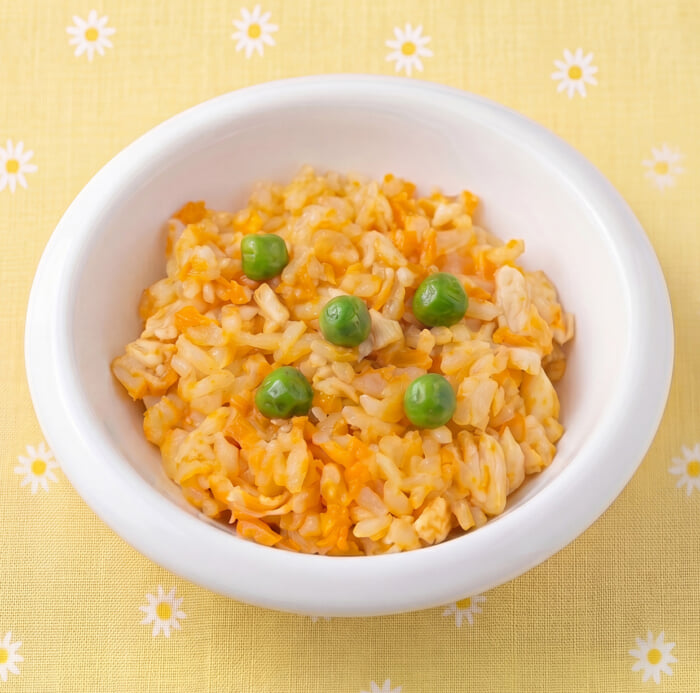
Japanese chicken rice is a yoshoku (Western-style Japanese) classic: rice tinted orange with ketchup and studded with small pieces of chicken, carrot, onion, corn and green peas. It is the same rice you find tucked inside omurice, and its sweet-savory ketchup flavor makes it an easy win with children. In this version most of the rice cooks in the rice cooker, while the vegetables and chicken are sautéed separately so their sweetness really comes through.
Toddlers to adults. The whole family can eat this exactly as written.
Added. Open the recipe helper (bottom right) → ☰ Menu → 🛒 Shopping list to see the ingredients for your family size.
Printing uses the number of adults and children set under Ingredients, so set those first.
Ingredients
Amounts for 1 child (1 serving). An adult counts as 2 servings.
One serving here is 1.5× the portion served to a child in a Japanese preschool, sized for Western appetites. An adult counts as two servings. Tap an ingredient to check it off.
Ingredients
- 90 griceJapanese short-grain white rice (japonica), which cooks up soft and slightly sticky. The amount listed is for uncooked rice. Substitute: Sushi rice, or another short-grain or medium-grain rice such as Calrose.
- 15 gcarrot
- 45 gonion
- 30 gwhole kernel corn (canned or frozen)
- 51 gchicken thigh
- 3.6 gvegetable oil
- 9 gfrozen green peas
Seasonings (A)
- 18 gketchup
- 0.5 gconsommé bouillon (granules or cube)Japanese-style Western soup stock powder or cubes, similar to chicken or vegetable bouillon. Substitute: Chicken or vegetable bouillon granules or a bouillon cube.
- 1.1 gsalt
- a pinchpepper
About the Japanese ingredients in this recipe
- rice (米)
- Japanese short-grain white rice (japonica), which cooks up soft and slightly sticky. The amount listed is for uncooked rice. Substitute: Sushi rice, or another short-grain or medium-grain rice such as Calrose.
- consommé bouillon (granules or cube) (コンソメ)
- Japanese-style Western soup stock powder or cubes, similar to chicken or vegetable bouillon. Substitute: Chicken or vegetable bouillon granules or a bouillon cube.
Directions
Video is in Japanese and may show a different version of this dish (other ingredients or steps). Follow the ingredients and steps on this page, especially when cooking for allergies.
- 1
Rinse the rice and drain it in a sieve. Put it in the rice cooker, add water to the marked line, and let it soak for at least 30 minutes. Mix the Seasonings (A) together, add 1/3 of the mixture to the rice, stir lightly, and start the rice cooker.
- 2
Coarsely chop the carrot and onion. Put them in a heat-safe bowl, cover loosely with plastic wrap, and microwave at 1200W for about 2 to 2 1/2 minutes.
- 3
Cut the chicken into 1 cm cubes. Drain the corn in a sieve.
- 4
Heat the oil in a frying pan over medium heat and stir-fry the vegetables from step 2 for about 3 minutes to cook off their moisture. Add the chicken, reduce to low heat, and stir-fry for about 1 1/2 to 2 minutes until the chicken changes color.
- 5
Add the remaining 2/3 of the Seasonings (A) and cook over low heat for about 5 minutes, stirring as the sauce reduces. Note: If you have time, simmering for about 10 minutes gives a richer, deeper flavor.
- 6
Put the frozen green peas in a large heat-safe container, add enough boiling water to just cover them, and microwave at 1200W for about 1 minute 30 seconds. Drain in a sieve. Note: Use a large container so the water does not boil over.
- 7
When the rice from step 1 is cooked, add the chicken mixture from step 5 and the peas from step 6 and mix well.
Tips for the Best Flavor
- Sautéing the vegetables brings out their sweetness. Cooking them separately instead of adding them raw to the rice cooker is the key to a tasty result.
- Adding 1/3 of the ketchup mixture before cooking the rice keeps the color and flavor even, with no patchy spots.
Freezing Instructions
Wrap individual portions in plastic wrap and freeze. To eat, reheat in the microwave still in the wrap.
Keeps for about 2 weeks (best eaten as soon as possible).
Nutrition
Nutrition values include the rice.
| Per | 1 serving | 1 adult serving | Your total |
|---|---|---|---|
| Energy | 375 kcal | 750 kcal | 375 kcal |
| Protein | 11.9 g | 23.7 g | 11.9 g |
| Fat | 8.8 g | 17.5 g | 8.8 g |
| Carbohydrates | 64 g | 128 g | 64 g |
| Fiber | 2.7 g | 5.4 g | 2.7 g |
| Salt equivalent | 1.7 g | 3.3 g | 1.7 g |
| Calcium | 18.8 mg | 37.5 mg | 18.8 mg |
| Iron | 1.2 mg | 2.4 mg | 1.2 mg |
| Potassium | 347.3 mg | 694.5 mg | 347.3 mg |
| Phosphorus | 159.8 mg | 319.5 mg | 159.8 mg |
| Energy | Protein | Fat | Carbs | Fiber | Salt equiv. | Calcium | Iron | Potassium | Phosphorus | |
|---|---|---|---|---|---|---|---|---|---|---|
| 1 serving | 375 kcal | 11.9 g | 8.8 g | 64 g | 2.7 g | 1.7 g | 18.8 mg | 1.2 mg | 347.3 mg | 159.8 mg |
| 1 adult serving | 750 kcal | 23.7 g | 17.5 g | 128 g | 5.4 g | 3.3 g | 37.5 mg | 2.4 mg | 694.5 mg | 319.5 mg |
Values are per serving (1.5× the Japanese preschool portion); an adult serving is double. They were calculated by a licensed Japanese nutritionist using the Standard Tables of Food Composition in Japan. "Salt equivalent" is sodium × 2.54, the standard Japanese measure. Allergen flags cover egg, milk and wheat only and come from the nutritionist's records. Soy sauce and miso are made with wheat but are usually allowed on Japanese wheat-free school menus, so check with your doctor.