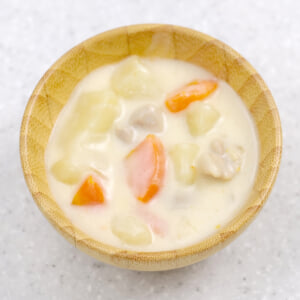
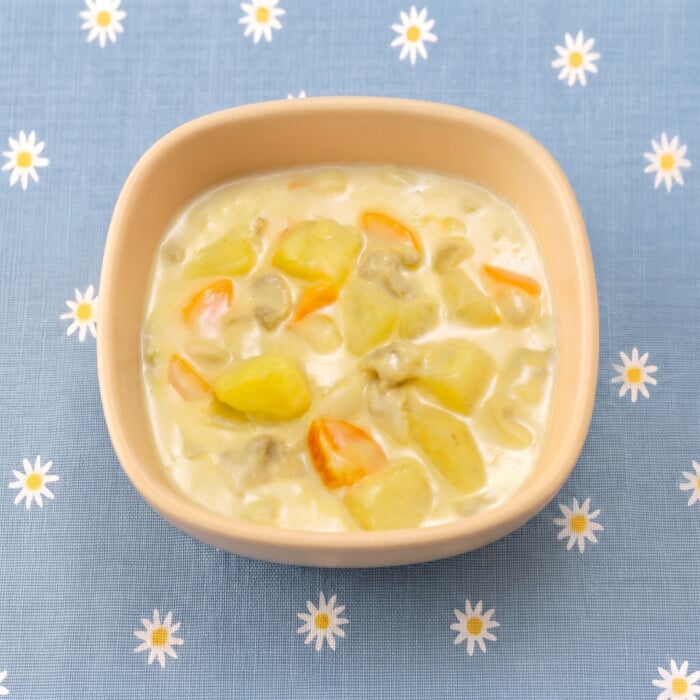
Curry Stew
カレーシチュー
 By Aoi, licensed nutritionist · From a Japanese preschool lunch menu
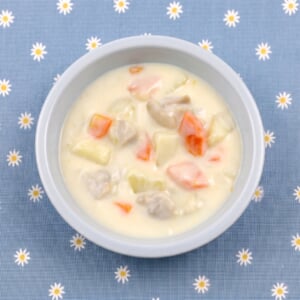
Curry stew is a school-lunch classic in Japan: a creamy white stew gently flavored with curry powder, somewhere between a Japanese curry and a cream stew. The milk base keeps the spice mild, so even small children who shy away from regular curry take to it happily. A little processed cheese stirred in at the end is Aoi's quiet trick for a rich, glossy sauce. It is made without egg, and because it is thickened with flour rather than a roux block, you can control exactly what goes in.
Toddlers to adults. The whole family can eat this exactly as written.
Added. Open the recipe helper (bottom right) → ☰ Menu → 🛒 Shopping list to see the ingredients for your family size.
Printing uses the number of adults and children set under Ingredients, so set those first.
Ingredients
Amounts for 1 child (1 serving). An adult counts as 2 servings.
One serving here is 1.5× the portion served to a child in a Japanese preschool, sized for Western appetites. An adult counts as two servings. Tap an ingredient to check it off.
- 36 gthinly sliced pork (komagire)Small, thin offcuts of pork sold in Japan for quick stir-fries and simmered dishes. Substitute: Thinly sliced pork shoulder or loin cut into bite-size pieces.
- 45 gonion
- 30 gcarrot
- 75 gpotato
- 6 gbutter
- 6 gvegetable oil
- 12 gflour
- 0.9 gcurry powder
- 165 mlwater
- 75 mlmilk
- 1.8 gconsommé bouillon (granules or cube)Japanese-style Western soup stock powder or cubes, similar to chicken or vegetable bouillon. Substitute: Chicken or vegetable bouillon granules or a bouillon cube.
- 6 gprocessed cheese
- 0.9 gsalt
- to tastepepper
About the Japanese ingredients in this recipe
- thinly sliced pork (komagire) (豚こま切れ肉)
- Small, thin offcuts of pork sold in Japan for quick stir-fries and simmered dishes. Substitute: Thinly sliced pork shoulder or loin cut into bite-size pieces.
- consommé bouillon (granules or cube) (コンソメ)
- Japanese-style Western soup stock powder or cubes, similar to chicken or vegetable bouillon. Substitute: Chicken or vegetable bouillon granules or a bouillon cube.
Directions
Video is in Japanese — the steps below are synced to it, so tap ▶ on a step to jump to that moment.
- 1
Cut the onion into 1.5 cm pieces, the carrot into quarter-rounds, the potato into 2 cm cubes, and the pork into 2 cm wide strips.
- 2
Put the onion, carrot and 1 tbsp of water (not included in the ingredient list) in a heatproof container and mix. Cover loosely with plastic wrap, leaving a gap for steam, and microwave at 1200W for about 3 minutes 30 seconds (7 minutes at 600W). Add the potato, stir, and microwave for about 1 more minute (2 minutes at 600W). (The stew turns out best when the carrot and onion are soft and wilted at this point.)
- 3
Heat the butter and oil in a pot, add the microwaved vegetables from step 2, and stir-fry over medium heat for about 3 minutes. Add the pork and cook until it changes color.
- 4
Turn off the heat, sprinkle in the flour and curry powder, and stir to coat everything. Once no dry flour remains, turn the heat to low, add half of the water and stir until smooth.
- 5
Once it thickens slightly, add the remaining water, the milk and the consommé and stir. Add the cheese and simmer over low heat for about 15 minutes, stirring occasionally, then season with salt and pepper. (If the stew is not thick enough, simmer it a little longer.)
Tips for Best Results
- The cheese is the secret ingredient: it adds depth and makes the stew rich and creamy. It is done when it has thickened nicely and turned glossy.
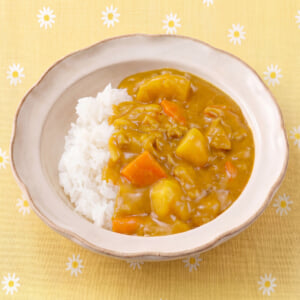
- Because it is a curry-flavored stew, it goes with both rice and bread. It is also delicious spooned over spaghetti.
How to Freeze
Remove the potatoes first, since their texture changes in the freezer. Let the stew cool, then divide into single portions in freezer bags and freeze. To serve, reheat in the microwave and stir well.
Keeps for about 2 weeks (but eat it as soon as you can).
Nutrition
| Per | 1 serving | 1 adult serving | Your total |
|---|---|---|---|
| Energy | 342 kcal | 684 kcal | 342 kcal |
| Protein | 14.7 g | 29.4 g | 14.7 g |
| Fat | 19.7 g | 39.3 g | 19.7 g |
| Carbohydrates | 33.8 g | 67.5 g | 33.8 g |
| Fiber | 8.9 g | 17.7 g | 8.9 g |
| Salt equivalent | 2.1 g | 4.2 g | 2.1 g |
| Calcium | 150 mg | 300 mg | 150 mg |
| Iron | 1 mg | 2.1 mg | 1 mg |
| Potassium | 750 mg | 1500 mg | 750 mg |
| Phosphorus | 259.5 mg | 519 mg | 259.5 mg |
| Energy | Protein | Fat | Carbs | Fiber | Salt equiv. | Calcium | Iron | Potassium | Phosphorus | |
|---|---|---|---|---|---|---|---|---|---|---|
| 1 serving | 342 kcal | 14.7 g | 19.7 g | 33.8 g | 8.9 g | 2.1 g | 150 mg | 1 mg | 750 mg | 259.5 mg |
| 1 adult serving | 684 kcal | 29.4 g | 39.3 g | 67.5 g | 17.7 g | 4.2 g | 300 mg | 2.1 mg | 1500 mg | 519 mg |
Values are per serving (1.5× the Japanese preschool portion); an adult serving is double. They were calculated by a licensed Japanese nutritionist using the Standard Tables of Food Composition in Japan. "Salt equivalent" is sodium × 2.54, the standard Japanese measure. Allergen flags cover egg, milk and wheat only and come from the nutritionist's records. Soy sauce and miso are made with wheat but are usually allowed on Japanese wheat-free school menus, so check with your doctor.
Cooking for bigger kids? See the elementary-school portion of this recipe.