Watermelon
すいか
 By Aoi, licensed nutritionist · From a Japanese preschool lunch menu
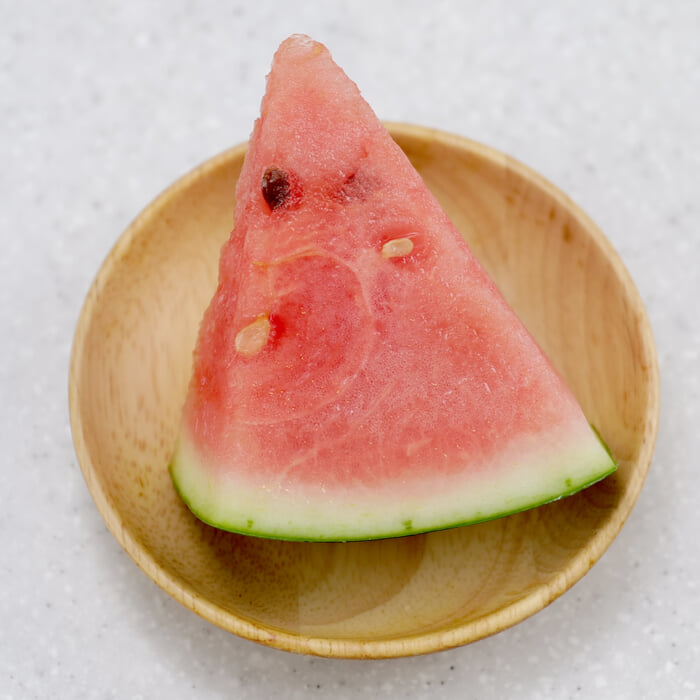
Watermelon (suika) is the taste of summer in Japan, and at nursery school it appears on the afternoon snack menu as soon as the weather turns hot. Children love holding a wedge by the rind and biting straight in, so in preschool kitchens we serve it that way for the older kids. For toddlers still finishing the weaning stage, we take off the rind and seeds and cut the flesh into small cubes so it is safe and easy to manage with a spoon or little fingers. Summer in Japan also brings suika-wari, the beach game of splitting a watermelon blindfolded with a stick, so this simple fruit carries plenty of happy seasonal memories.
Added. Open the recipe helper (bottom right) → ☰ Menu → 🛒 Shopping list to see the ingredients for your family size.
Printing uses the number of adults and children set under Ingredients, so set those first.
Ingredients
Amounts for 1 child (1 serving). An adult counts as 2 servings.
One serving here is 1.5× the portion served to a child in a Japanese preschool, sized for Western appetites. An adult counts as two servings. Tap an ingredient to check it off.
- 90 gwatermelon
Directions
- 1
Cut a small watermelon into about 32 wedges and serve the wedges with the rind left on. For toddlers in the weaning-completion stage (around 12 to 18 months), remove the rind and seeds and cut the flesh into small cubes.
Nutrition
| Per | 1 serving | 1 adult serving | Your total |
|---|---|---|---|
| Energy | 37.5 kcal | 75 kcal | 37.5 kcal |
| Protein | 0.6 g | 1.2 g | 0.6 g |
| Fat | 0.2 g | 0.3 g | 0.2 g |
| Carbohydrates | 8.6 g | 17.1 g | 8.6 g |
| Fiber | 0.3 g | 0.6 g | 0.3 g |
| Salt equivalent | 0 g | 0 g | 0 g |
| Calcium | 3 mg | 6 mg | 3 mg |
| Iron | 0.2 mg | 0.3 mg | 0.2 mg |
| Potassium | 108 mg | 216 mg | 108 mg |
| Energy | Protein | Fat | Carbs | Fiber | Salt equiv. | Calcium | Iron | Potassium | |
|---|---|---|---|---|---|---|---|---|---|
| 1 serving | 37.5 kcal | 0.6 g | 0.2 g | 8.6 g | 0.3 g | 0 g | 3 mg | 0.2 mg | 108 mg |
| 1 adult serving | 75 kcal | 1.2 g | 0.3 g | 17.1 g | 0.6 g | 0 g | 6 mg | 0.3 mg | 216 mg |
Values are per serving (1.5× the Japanese preschool portion); an adult serving is double. They were calculated by a licensed Japanese nutritionist using the Standard Tables of Food Composition in Japan. "Salt equivalent" is sodium × 2.54, the standard Japanese measure. Allergen flags cover egg, milk and wheat only and come from the nutritionist's records. Soy sauce and miso are made with wheat but are usually allowed on Japanese wheat-free school menus, so check with your doctor.