Ume Gohan (Pickled Plum Rice)
梅ごはん · Ume Gohan
 By Aoi, licensed nutritionist · From a Japanese preschool lunch menu
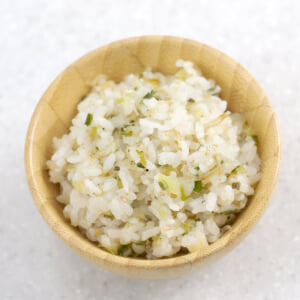
Ume gohan is rice cooked with umeboshi, the salty-sour pickled plums that Japanese families have long eaten with rice. Chopping the plum finely and cooking it right in the pot spreads its flavor and pale pink flecks through every grain, so the taste is mild and gentle rather than sharp. The soft tang wakes up the appetite and makes plain rice a little more interesting for children, and with only two ingredients it is one of the simplest rice dishes you can make.
Added. Open the recipe helper (bottom right) → ☰ Menu → 🛒 Shopping list to see the ingredients for your family size.
Printing uses the number of adults and children set under Ingredients, so set those first.
Ingredients
Amounts for 1 child (1 serving). An adult counts as 2 servings.
One serving here is 1.5× the portion served to a child in a Japanese preschool, sized for Western appetites. An adult counts as two servings. Tap an ingredient to check it off.
- 75 griceJapanese short-grain white rice (japonica), which cooks up soft and slightly sticky. The amount listed is for uncooked rice. Substitute: Sushi rice, or another short-grain or medium-grain rice such as Calrose.
- 9 gumeboshi (pickled plum)Japanese ume plums pickled in salt, very sour and salty, used as a seasoning. Substitute: No close substitute - look for it at a Japanese or Asian grocery, or online.
About the Japanese ingredients in this recipe
- rice (米)
- Japanese short-grain white rice (japonica), which cooks up soft and slightly sticky. The amount listed is for uncooked rice. Substitute: Sushi rice, or another short-grain or medium-grain rice such as Calrose.
- umeboshi (pickled plum) (うめ干し)
- Japanese ume plums pickled in salt, very sour and salty, used as a seasoning. Substitute: No close substitute - look for it at a Japanese or Asian grocery, or online.
Directions
- 1
Rinse the rice and let it soak in water for at least 30 minutes.
- 2
Remove the pits from the umeboshi and mince the flesh finely.
- 3
Add the minced umeboshi to the soaked rice, stir gently, and cook the rice as usual.
- 4
When the rice is done, mix it well so the plum is evenly distributed throughout.
Nutrition
| Per | 1 serving | 1 adult serving | Your total |
|---|---|---|---|
| Energy | 259.5 kcal | 519 kcal | 259.5 kcal |
| Protein | 4.7 g | 9.3 g | 4.7 g |
| Fat | 0.8 g | 1.5 g | 0.8 g |
| Carbohydrates | 64.2 g | 128.4 g | 64.2 g |
| Salt equivalent | 1.7 g | 3.3 g | 1.7 g |
| Calcium | 7.5 mg | 15 mg | 7.5 mg |
| Iron | 0.6 mg | 1.2 mg | 0.6 mg |
| Energy | Protein | Fat | Carbs | Salt equiv. | Calcium | Iron | |
|---|---|---|---|---|---|---|---|
| 1 serving | 259.5 kcal | 4.7 g | 0.8 g | 64.2 g | 1.7 g | 7.5 mg | 0.6 mg |
| 1 adult serving | 519 kcal | 9.3 g | 1.5 g | 128.4 g | 3.3 g | 15 mg | 1.2 mg |
Values are per serving (1.5× the Japanese preschool portion); an adult serving is double. They were calculated by a licensed Japanese nutritionist using the Standard Tables of Food Composition in Japan. "Salt equivalent" is sodium × 2.54, the standard Japanese measure. Allergen flags cover egg, milk and wheat only and come from the nutritionist's records. Soy sauce and miso are made with wheat but are usually allowed on Japanese wheat-free school menus, so check with your doctor.