Spaghetti with Mild Meat Sauce
ミートソーススパゲティ(甘口)
 By Aoi, licensed nutritionist · From a Japanese preschool lunch menu
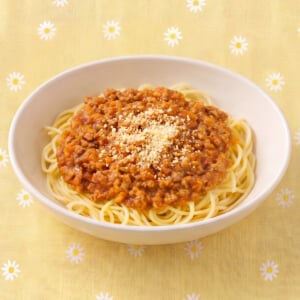
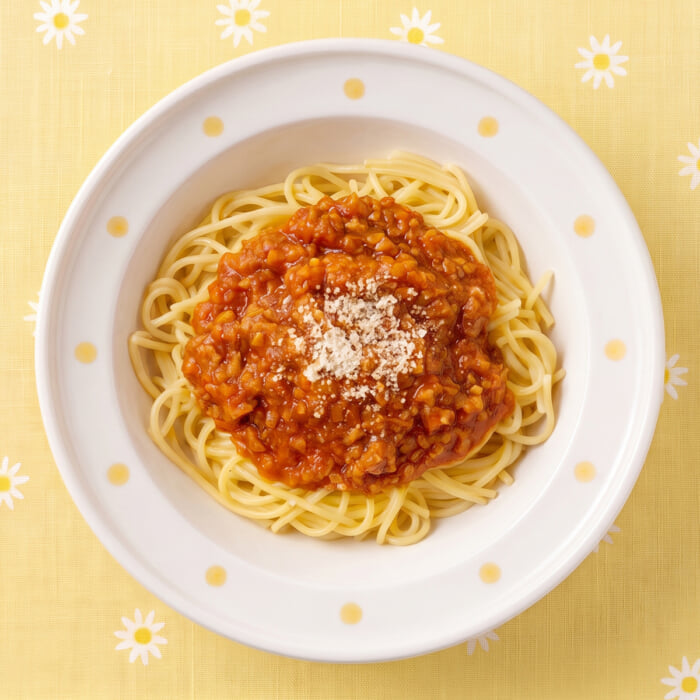
Meat sauce spaghetti is a long-standing favorite on Japanese school lunch menus, and this is the mild version we make for little ones. The sauce is built on ketchup and chuno sauce rather than wine or herbs, and it uses twice as much vegetable as meat: onion and carrot are cooked down slowly until their sweetness and umami are concentrated, so the sauce tastes rich without being sharp. Because the seasoning is gentle, there is no need to cook a separate batch for the grown-ups; the whole family can share the same pot.
Toddlers to adults. The whole family can eat this exactly as written.
Added. Open the recipe helper (bottom right) → ☰ Menu → 🛒 Shopping list to see the ingredients for your family size.
Printing uses the number of adults and children set under Ingredients, so set those first.
Ingredients
Amounts for 1 child (1 serving). An adult counts as 2 servings.
One serving here is 1.5× the portion served to a child in a Japanese preschool, sized for Western appetites. An adult counts as two servings. Tap an ingredient to check it off.
Ingredients
- 90 gspaghetti
- 45 gground pork
- 24 gcarrot
- 45 gonion
- 2.3 gvegetable oil
- 4.8 gflour
- 84 mlwater
- 4.5 ggrated Parmesan cheese
Seasonings (A)
- 45 gketchup
- 6.6 gchuno sauce (Japanese medium-thick brown sauce)A sweet, tangy, fruit-and-vegetable-based brown sauce that sits between thin Worcestershire and thick tonkatsu sauce. Substitute: Tonkatsu sauce, or Worcestershire sauce mixed with a little ketchup.
- 0.5 gsalt
- a pinchpepper
About the Japanese ingredients in this recipe
- chuno sauce (Japanese medium-thick brown sauce) (中濃ソース)
- A sweet, tangy, fruit-and-vegetable-based brown sauce that sits between thin Worcestershire and thick tonkatsu sauce. Substitute: Tonkatsu sauce, or Worcestershire sauce mixed with a little ketchup.
Directions
Video is in Japanese — the steps below are synced to it, so tap ▶ on a step to jump to that moment.
- 1
Finely chop the onion and carrot. Put them in a heatproof bowl, cover loosely with plastic wrap so there is a gap for steam to escape, and microwave at 1200W for about 5 minutes.
- 2
Heat the vegetable oil in a frying pan and sauté the vegetables from step 1 over medium heat for about 3 minutes. Note: Cooking the vegetables down until they are about one-third of their raw volume gives the sauce a rich, deep flavor.
- 3
Add the ground pork and stir-fry over medium heat, breaking it up, until it changes color. Turn off the heat, add the flour and stir until no dry flour remains, then return to low heat, add the water and cook until it thickens. Note: It will come together as it simmers later, so it does not need to be fully thickened at this point. Note: For children with a wheat allergy, use joshinko (Japanese rice flour) in place of the flour.
- 4
Add the Seasonings (A), stir, and simmer over low heat for about 15 minutes, stirring from time to time so it does not scorch. Let it cool slightly so the flavors meld.
- 5
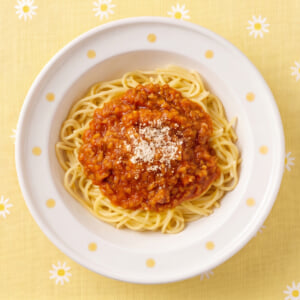
Cook the spaghetti in boiling water, without adding salt, following the package directions. Once cooked, toss with a little vegetable oil (not included in the ingredient amounts), then plate, spoon the sauce over the top and sprinkle with grated Parmesan cheese. Note: For toddlers, cook the spaghetti about 3 minutes longer than the package says so it is nice and soft.
Tips for Best Results
・There is twice as much vegetable as ground pork in this sauce! Sautéing the vegetables slowly to drive off their moisture concentrates their sweetness and umami and makes the sauce taste even better.
・No need to set aside a separate portion for the little ones. From toddlers to adults, the whole family can eat the same thing.
Freezing Instructions
Spread the sauce in a thin layer in freezer bags, one meal's worth per bag, and freeze. To serve, reheat in the microwave and pour over freshly cooked spaghetti.
Keeps for: about 2 weeks (best eaten as soon as possible).
Nutrition
Nutrition values do not include the noodles.
| Per | 1 serving | 1 adult serving | Your total |
|---|---|---|---|
| Energy | 229.5 kcal | 459 kcal | 229.5 kcal |
| Protein | 11.6 g | 23.3 g | 11.6 g |
| Fat | 11.6 g | 23.1 g | 11.6 g |
| Carbohydrates | 24.2 g | 48.4 g | 24.2 g |
| Fiber | 2.2 g | 4.4 g | 2.2 g |
| Salt equivalent | 2.3 g | 4.5 g | 2.3 g |
| Calcium | 88.5 mg | 177 mg | 88.5 mg |
| Iron | 1 mg | 2 mg | 1 mg |
| Potassium | 466.5 mg | 933 mg | 466.5 mg |
| Phosphorus | 133.5 mg | 267 mg | 133.5 mg |
| Energy | Protein | Fat | Carbs | Fiber | Salt equiv. | Calcium | Iron | Potassium | Phosphorus | |
|---|---|---|---|---|---|---|---|---|---|---|
| 1 serving | 229.5 kcal | 11.6 g | 11.6 g | 24.2 g | 2.2 g | 2.3 g | 88.5 mg | 1 mg | 466.5 mg | 133.5 mg |
| 1 adult serving | 459 kcal | 23.3 g | 23.1 g | 48.4 g | 4.4 g | 4.5 g | 177 mg | 2 mg | 933 mg | 267 mg |
Values are per serving (1.5× the Japanese preschool portion); an adult serving is double. They were calculated by a licensed Japanese nutritionist using the Standard Tables of Food Composition in Japan. "Salt equivalent" is sodium × 2.54, the standard Japanese measure. Allergen flags cover egg, milk and wheat only and come from the nutritionist's records. Soy sauce and miso are made with wheat but are usually allowed on Japanese wheat-free school menus, so check with your doctor.