Snack-Time Spaghetti with Meat Sauce
おやつミートソーススパゲティ
 By Aoi, licensed nutritionist · From a Japanese preschool lunch menu
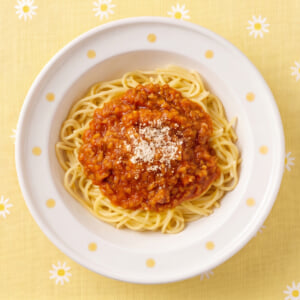
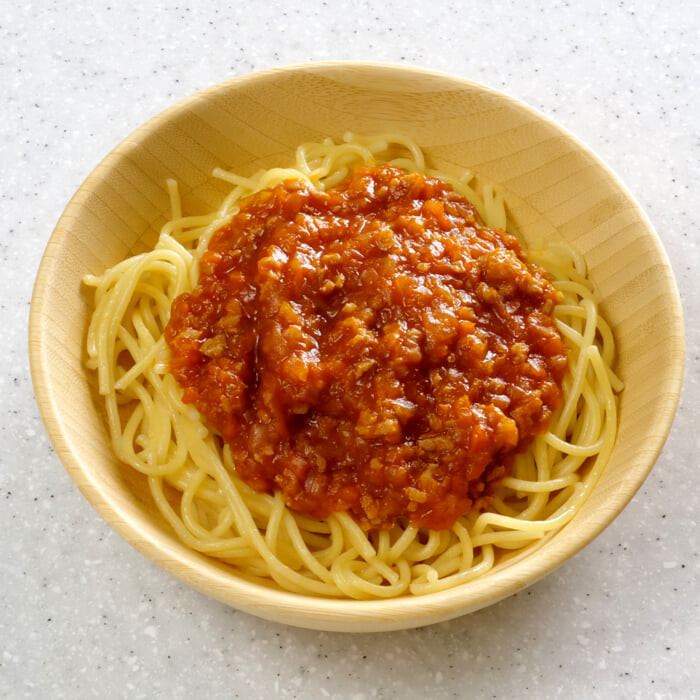
In Japanese preschools, the afternoon snack (oyatsu) is often a small savory dish rather than something sweet, and this spaghetti with meat sauce is a favorite. The sauce is built on ketchup and chuno sauce instead of canned tomatoes, so it comes out gentle and slightly sweet rather than sharp, which is exactly what little ones like. Breaking the spaghetti into thirds before boiling makes it far easier to manage with a fork or spoon, and cooking the carrot and onion until completely soft brings out their natural sweetness so the finished sauce is rich without heavy seasoning.
Added. Open the recipe helper (bottom right) → ☰ Menu → 🛒 Shopping list to see the ingredients for your family size.
Printing uses the number of adults and children set under Ingredients, so set those first.
Ingredients
Amounts for 1 child (1 serving). An adult counts as 2 servings.
One serving here is 1.5× the portion served to a child in a Japanese preschool, sized for Western appetites. An adult counts as two servings. Tap an ingredient to check it off.
Ingredients
- 37.5 gspaghetti
- 18 gground pork
- 9 gcarrot
- 18 gonion
Seasonings
- 2.3 gvegetable oil
- 1.8 gflour
- 27 gwater
- 15 gketchup
- 2.3 gchuno sauce (Japanese medium-thick brown sauce)A sweet, tangy, fruit-and-vegetable-based brown sauce that sits between thin Worcestershire and thick tonkatsu sauce. Substitute: Tonkatsu sauce, or Worcestershire sauce mixed with a little ketchup.
- 0.2 gsalt
- to tastepepper
About the Japanese ingredients in this recipe
- chuno sauce (Japanese medium-thick brown sauce) (中濃ソース)
- A sweet, tangy, fruit-and-vegetable-based brown sauce that sits between thin Worcestershire and thick tonkatsu sauce. Substitute: Tonkatsu sauce, or Worcestershire sauce mixed with a little ketchup.
Directions
- 1
Break the spaghetti into thirds and boil it. Toss the cooked spaghetti with a little oil (not included in the ingredient amounts) so the strands don't stick together.
- 2
Finely chop the carrot and onion. Heat the oil in a frying pan and sauté the carrot and onion thoroughly. Once they are soft, add the ground pork and cook, stirring.
- 3
Turn off the heat and sprinkle the flour over the mixture. Once no dry flour remains, add the water and the seasonings, then simmer to cook off the acidity.
- 4
Put the spaghetti from step 1 in bowls and spoon the sauce from step 3 over the top.
Sauté the carrot and onion well until fully softened, and take the time in step 3 to cook off the acidity properly. That is what gives you a sweet, rich meat sauce.
Nutrition
| Per | 1 serving | 1 adult serving | Your total |
|---|---|---|---|
| Energy | 220.5 kcal | 441 kcal | 220.5 kcal |
| Protein | 8.6 g | 17.1 g | 8.6 g |
| Fat | 6.1 g | 12.3 g | 6.1 g |
| Carbohydrates | 36.2 g | 72.3 g | 36.2 g |
| Fiber | 3 g | 6 g | 3 g |
| Salt equivalent | 0.8 g | 1.5 g | 0.8 g |
| Calcium | 19.5 mg | 39 mg | 19.5 mg |
| Iron | 0.9 mg | 1.8 mg | 0.9 mg |
| Potassium | 244.5 mg | 489 mg | 244.5 mg |
| Energy | Protein | Fat | Carbs | Fiber | Salt equiv. | Calcium | Iron | Potassium | |
|---|---|---|---|---|---|---|---|---|---|
| 1 serving | 220.5 kcal | 8.6 g | 6.1 g | 36.2 g | 3 g | 0.8 g | 19.5 mg | 0.9 mg | 244.5 mg |
| 1 adult serving | 441 kcal | 17.1 g | 12.3 g | 72.3 g | 6 g | 1.5 g | 39 mg | 1.8 mg | 489 mg |
Values are per serving (1.5× the Japanese preschool portion); an adult serving is double. They were calculated by a licensed Japanese nutritionist using the Standard Tables of Food Composition in Japan. "Salt equivalent" is sodium × 2.54, the standard Japanese measure. Allergen flags cover egg, milk and wheat only and come from the nutritionist's records. Soy sauce and miso are made with wheat but are usually allowed on Japanese wheat-free school menus, so check with your doctor.