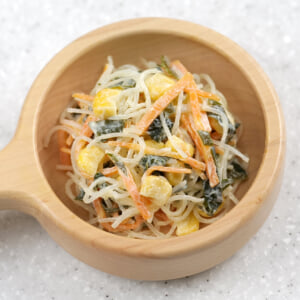
Silver Salad (Glass Noodle Salad)
シルバーサラダ
 By Aoi, licensed nutritionist · From a Japanese elementary school lunch menu
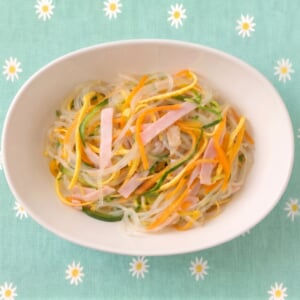
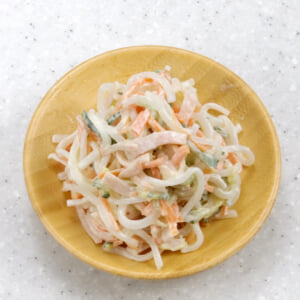
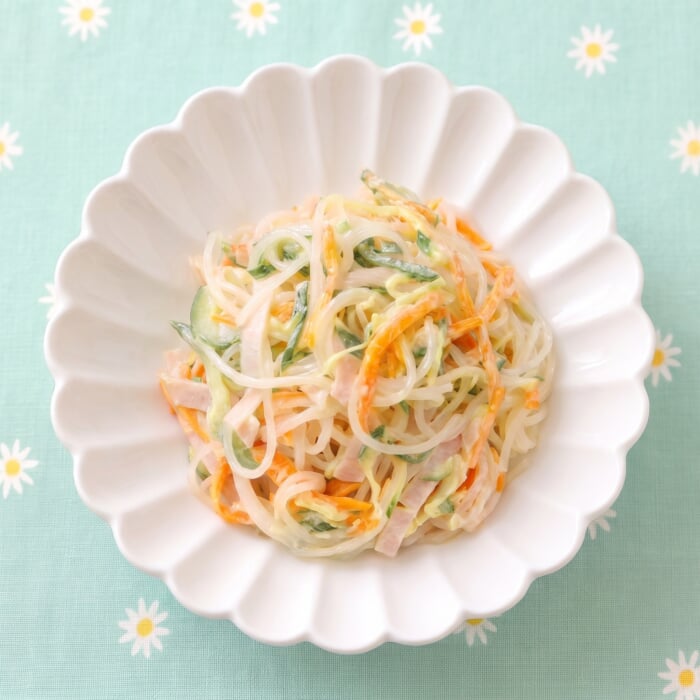
Silver Salad is a longtime favorite on Japanese school lunch menus, named for the silvery sheen of the glass noodles that make up most of the dish. Slippery noodles, crisp carrot and cucumber, and strips of ham all come together in a mild mayonnaise dressing that children happily slurp up. Everything is boiled a little longer than usual so it stays soft and easy to chew, and a rest in the fridge lets the flavors settle in. It uses no wheat, and it pairs well with just about any main dish.
Toddlers to adults. The whole family can eat this exactly as written.
Added. Open the recipe helper (bottom right) → ☰ Menu → 🛒 Shopping list to see the ingredients for your family size.
Printing uses the number of adults and children set under Ingredients, so set those first.
Ingredients
Amounts for 1 child (1 serving). An adult counts as 2 servings.
One serving here is 1.5× the portion served to a child in a Japanese elementary school, sized for Western appetites. An adult counts as two servings. Tap an ingredient to check it off.
Ingredients
- to tasteharusame (glass noodles)Thin, translucent noodles made from potato or mung bean starch that soften quickly in hot water. Substitute: Mung bean glass noodles or thin rice vermicelli.
- 12 gcarrot
- 24 gcucumber
- 12 gham
Sauce Mixture (A)
- 13.5 gmayonnaise
- 0.3 gsalt
- to tastepepper
About the Japanese ingredients in this recipe
- harusame (glass noodles) (春雨)
- Thin, translucent noodles made from potato or mung bean starch that soften quickly in hot water. Substitute: Mung bean glass noodles or thin rice vermicelli.
Directions
Video is in Japanese — the steps below are synced to it, so tap ▶ on a step to jump to that moment.
- 1
Cut the carrot and cucumber into thin matchsticks. Peel the ham slices apart, cut them in half so they are half as long, then cut into thin strips.
- 2
Put the water and carrot in a pot and bring to a boil, then boil for about 1 minute. Add the cucumber and ham, and once the water returns to a boil, drain in a colander and cool under running water. (For children of elementary-school age and younger, boil about 1 to 2 minutes longer so the vegetables are softer and easier to eat.)
- 3
Boil the harusame in boiling water for about 3 minutes longer than the package directions say, then drain in a colander and cool under running water. (For 1- to 2-year-olds, snip the harusame into short lengths with kitchen scissors.)
- 4
Squeeze the water out of the vegetables and ham from step 2 and the harusame from step 3 very well, then toss with A. Chill in the refrigerator to let the flavors meld.
Tips for Making It Well
- If you plan to make this ahead, mung bean glass noodles are best: they are less likely to stick together the next day. If you prefer a chewier, bouncier texture, use Japanese-made harusame (usually potato or sweet potato starch).
- The key is to squeeze the boiled vegetables and harusame really well to remove the water. Chilling the salad in the refrigerator makes it taste even better.
Freezing and Storage
This salad does not freeze well. Keep it in the refrigerator and finish it by the next day.
Nutrition
| Per | 1 serving | 1 adult serving | Your total |
|---|---|---|---|
| Energy | 154.5 kcal | 309 kcal | 154.5 kcal |
| Protein | 2.7 g | 5.4 g | 2.7 g |
| Fat | 12 g | 24 g | 12 g |
| Carbohydrates | 10.4 g | 20.7 g | 10.4 g |
| Fiber | 0.8 g | 1.5 g | 0.8 g |
| Salt equivalent | 0.9 g | 1.8 g | 0.9 g |
| Calcium | 15 mg | 30 mg | 15 mg |
| Iron | 0.3 mg | 0.6 mg | 0.3 mg |
| Potassium | 118.5 mg | 237 mg | 118.5 mg |
| Phosphorus | 52.5 mg | 105 mg | 52.5 mg |
| Energy | Protein | Fat | Carbs | Fiber | Salt equiv. | Calcium | Iron | Potassium | Phosphorus | |
|---|---|---|---|---|---|---|---|---|---|---|
| 1 serving | 154.5 kcal | 2.7 g | 12 g | 10.4 g | 0.8 g | 0.9 g | 15 mg | 0.3 mg | 118.5 mg | 52.5 mg |
| 1 adult serving | 309 kcal | 5.4 g | 24 g | 20.7 g | 1.5 g | 1.8 g | 30 mg | 0.6 mg | 237 mg | 105 mg |
Values are per serving (1.5× the Japanese elementary-school portion); an adult serving is double. They were calculated by a licensed Japanese nutritionist using the Standard Tables of Food Composition in Japan. "Salt equivalent" is sodium × 2.54, the standard Japanese measure. Allergen flags cover egg, milk and wheat only and come from the nutritionist's records. Soy sauce and miso are made with wheat but are usually allowed on Japanese wheat-free school menus, so check with your doctor.