Bansansu (Chinese-Style Glass Noodle Salad)
バンサンスー · Bansansu
 By Aoi, licensed nutritionist · From a Japanese preschool lunch menu
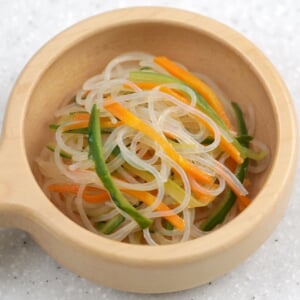
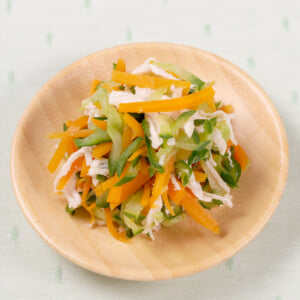
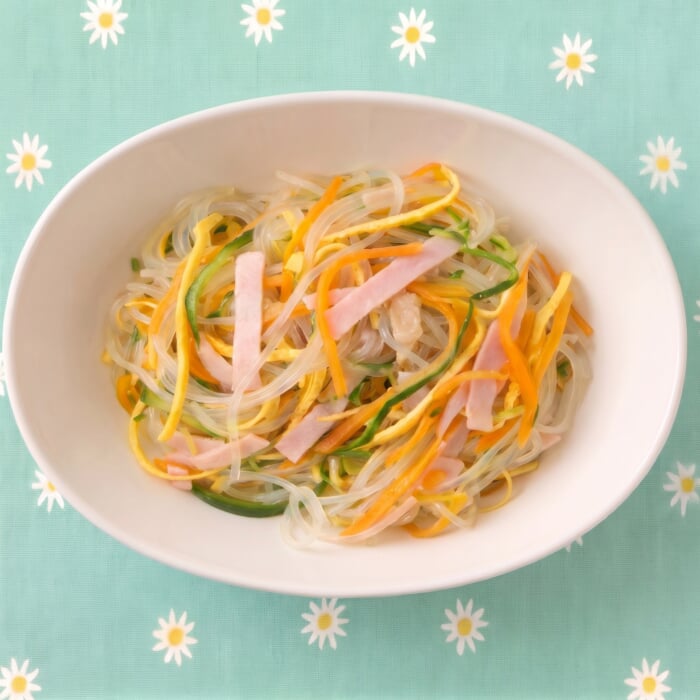
Bansansu takes its name from the Chinese 拌三絲, "three shredded things tossed together," and in Japan it has become one of the best-known school lunch side dishes. Thin strips of carrot, cucumber, ham and egg are mixed with slippery glass noodles and a gently sweet-and-sour sesame dressing, then chilled. Children love the slurpy noodles and the mild tang, and because every ingredient is cut into fine strips it is easy for small mouths to manage. In preschool kitchens we even give the cucumber and ham a quick dip in boiling water so the salad is softer and less salty for little ones.
Toddlers to adults. The whole family can eat this exactly as written.
Wheat-free, but uses soy sauce (made with wheat). Japanese school-lunch allergy menus usually allow it, so check with your doctor. How to read the labels
Added. Open the recipe helper (bottom right) → ☰ Menu → 🛒 Shopping list to see the ingredients for your family size.
Printing uses the number of adults and children set under Ingredients, so set those first.
Ingredients
Amounts for 1 child (1 serving). An adult counts as 2 servings.
One serving here is 1.5× the portion served to a child in a Japanese preschool, sized for Western appetites. An adult counts as two servings. Tap an ingredient to check it off.
Ingredients
- 12 gcarrot
- 24 gcucumber
- 11.4 gham
- to tasteharusame (glass noodles)Thin, translucent noodles made from potato or mung bean starch that soften quickly in hot water. Substitute: Mung bean glass noodles or thin rice vermicelli.
- 19.5 gegg
Sauce Mixture (A)
- 2.7 gsugar
- 0.5 gsalt
- 2.3 gsoy sauce
- 6.6 gvinegar
- 2.3 gsesame oil
About the Japanese ingredients in this recipe
- harusame (glass noodles) (春雨)
- Thin, translucent noodles made from potato or mung bean starch that soften quickly in hot water. Substitute: Mung bean glass noodles or thin rice vermicelli.
Directions
Video is in Japanese — the steps below are synced to it, so tap ▶ on a step to jump to that moment.
- 1
Cut the carrot and cucumber into 4 cm long matchsticks. Cut the ham slices in half, then slice them into thin strips.
- 2
Put the water and carrot in a pot and bring to a boil, then boil for about 1 minute. Add the cucumber and ham, and once the water returns to a boil, drain in a colander and cool under running water. (For 1- to 2-year-olds, boil the carrot for about 3 minutes so it is soft and easy to eat.)
- 3
Boil the harusame in plenty of hot water according to the package directions, then drain in a colander and cool under running water. (For elementary-school-age children and younger, boil the harusame for about 10 minutes and cut it into 3 cm lengths.)
- 4
Put the ingredients for A in a microwave-safe container and mix well. Microwave at 1200W for about 15 seconds (30 seconds at 600W), then let cool slightly. (Heating the dressing mellows the sourness and helps the flavors blend in.)
- 5
Beat the egg, cutting through the whites as you go. Warm a frying pan lined with nonstick cooking foil over low heat, pour in the egg and spread it into a thin round. When it is no longer runny, turn off the heat, cover with a lid and let the residual heat finish cooking it. Cut the sheet in half, stack the halves and slice into thin strips.
- 6
Squeeze the cooled vegetables and ham, and the harusame, firmly to remove excess water, then toss them with the dressing and the egg strips. Chill in the refrigerator to let the flavors blend.
Tips for Making It Well
- The key is to squeeze the water out of the vegetables and harusame thoroughly. The dressing will coat everything well and the salad won't turn watery.
- Giving the cucumber and ham a quick boil, too, tones down the saltiness of the ham and makes the vegetables easier for children to eat. The colder it is served, the better it tastes.
Freezing and Storage
This salad does not freeze well. Keep it in the refrigerator and finish it by the next day.
Nutrition
| Per | 1 serving | 1 adult serving | Your total |
|---|---|---|---|
| Energy | 123 kcal | 246 kcal | 123 kcal |
| Protein | 4.9 g | 9.9 g | 4.9 g |
| Fat | 6 g | 12 g | 6 g |
| Carbohydrates | 12.9 g | 25.8 g | 12.9 g |
| Fiber | 0.8 g | 1.5 g | 0.8 g |
| Salt equivalent | 1 g | 2.1 g | 1 g |
| Calcium | 22.5 mg | 45 mg | 22.5 mg |
| Iron | 0.5 mg | 0.9 mg | 0.5 mg |
| Potassium | 148.5 mg | 297 mg | 148.5 mg |
| Phosphorus | 84 mg | 168 mg | 84 mg |
| Energy | Protein | Fat | Carbs | Fiber | Salt equiv. | Calcium | Iron | Potassium | Phosphorus | |
|---|---|---|---|---|---|---|---|---|---|---|
| 1 serving | 123 kcal | 4.9 g | 6 g | 12.9 g | 0.8 g | 1 g | 22.5 mg | 0.5 mg | 148.5 mg | 84 mg |
| 1 adult serving | 246 kcal | 9.9 g | 12 g | 25.8 g | 1.5 g | 2.1 g | 45 mg | 0.9 mg | 297 mg | 168 mg |
Values are per serving (1.5× the Japanese preschool portion); an adult serving is double. They were calculated by a licensed Japanese nutritionist using the Standard Tables of Food Composition in Japan. "Salt equivalent" is sodium × 2.54, the standard Japanese measure. Allergen flags cover egg, milk and wheat only and come from the nutritionist's records. Soy sauce and miso are made with wheat but are usually allowed on Japanese wheat-free school menus, so check with your doctor.
Cooking for bigger kids? See the elementary-school portion of this recipe.