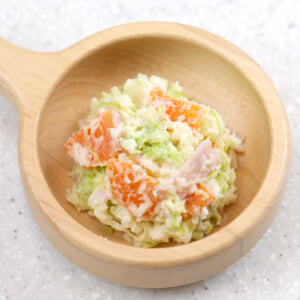
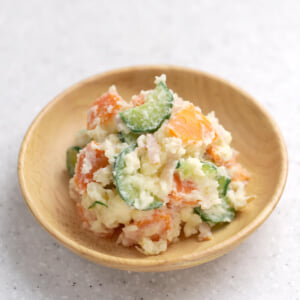
Potato Salad
ポテトサラダ
 By Aoi, licensed nutritionist · From a Japanese preschool lunch menu
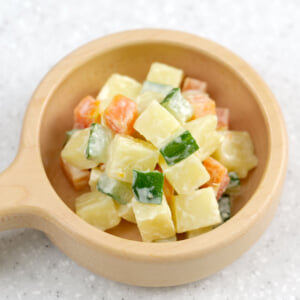
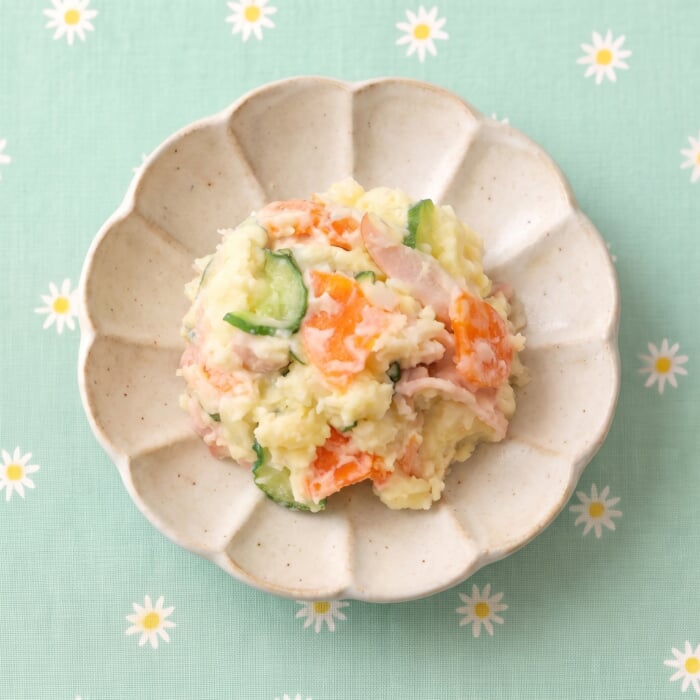
Japanese potato salad is a little different from the chunky Western kind: the potatoes are mashed until just a few pieces remain, then folded together with thin slices of carrot, cucumber and ham and a modest amount of mayonnaise. It is one of the most familiar side dishes on school lunch trays in Japan, and children love its soft, creamy texture. The trick here is to season the potatoes with vinegar and salt while they are still hot, so the salad tastes full-flavored even with less mayonnaise and a light hand on the salt. Even the cucumber and ham get a quick dip in boiling water, which softens their flavor and helps everything blend together for small eaters. This recipe uses no wheat.
Toddlers to adults. The whole family can eat this exactly as written.
Added. Open the recipe helper (bottom right) → ☰ Menu → 🛒 Shopping list to see the ingredients for your family size.
Printing uses the number of adults and children set under Ingredients, so set those first.
Ingredients
Amounts for 1 child (1 serving). An adult counts as 2 servings.
One serving here is 1.5× the portion served to a child in a Japanese preschool, sized for Western appetites. An adult counts as two servings. Tap an ingredient to check it off.
Ingredients
- 75 gpotato
- 18 gcarrot
- 24 gcucumber
- 15 gham
Sauce Mixture (A)
- 2.3 gvinegar
- 0.2 gsalt
Mixed Seasonings (B)
- 13.5 gmayonnaise
- 0.3 gsalt
- to tastepepper
Directions
Video is in Japanese — the steps below are synced to it, so tap ▶ on a step to jump to that moment.
- 1
Cut the potatoes into 1 cm thick quarter-rounds. Put the potatoes in a pot with water, bring to a boil, and boil for about 10 minutes from the time it comes to a boil. Drain in a colander, return the potatoes to the empty pot, and stir over medium heat for about 2 minutes to drive off the moisture. (Drying them out this way gives you a fluffy potato salad.)
- 2
Transfer to a bowl and mash, leaving a few small pieces. Mix in A while the potatoes are still hot, then let cool slightly. (Leaving some pieces softens the dry, fluffy texture and makes it easier for children to swallow.)
- 3
Cut the carrot into 2 mm thick quarter-rounds and the cucumber into 2 mm thick half-moons. Separate the ham slices one by one, cut each in half, then cut into 5 mm wide strips.
- 4
Put the carrot in a pot with water, bring to a boil, and boil for about 2 minutes from the time it comes to a boil. Add the cucumber and ham, boil for about 1 minute more, then drain in a colander and cool under running water. (Boiling the cucumber and ham too mellows the grassy taste and saltiness and helps them blend with the other ingredients.)
- 5
Squeeze the vegetables and ham from step 4 well to remove excess water, add them to the potatoes from step 2, and toss with B. Chill in the refrigerator to let the flavors come together.
Tips for Best Results
- Mixing the vinegar and salt into the potatoes while they are still hot lets the flavor come through clearly even with less mayonnaise, so the salad tastes good even with light seasoning.
- Be sure to squeeze the boiled vegetables well. This keeps the salad from turning watery and the flavor from going flat.
Freezing and Storage
This salad does not freeze well. Keep it in the refrigerator and finish it by the next day.
Nutrition
| Per | 1 serving | 1 adult serving | Your total |
|---|---|---|---|
| Energy | 175.5 kcal | 351 kcal | 175.5 kcal |
| Protein | 4.7 g | 9.3 g | 4.7 g |
| Fat | 12.6 g | 25.2 g | 12.6 g |
| Carbohydrates | 16 g | 32.1 g | 16 g |
| Fiber | 7.4 g | 14.7 g | 7.4 g |
| Salt equivalent | 1 g | 2.1 g | 1 g |
| Calcium | 15 mg | 30 mg | 15 mg |
| Iron | 0.5 mg | 0.9 mg | 0.5 mg |
| Potassium | 448.5 mg | 897 mg | 448.5 mg |
| Phosphorus | 93 mg | 186 mg | 93 mg |
| Energy | Protein | Fat | Carbs | Fiber | Salt equiv. | Calcium | Iron | Potassium | Phosphorus | |
|---|---|---|---|---|---|---|---|---|---|---|
| 1 serving | 175.5 kcal | 4.7 g | 12.6 g | 16 g | 7.4 g | 1 g | 15 mg | 0.5 mg | 448.5 mg | 93 mg |
| 1 adult serving | 351 kcal | 9.3 g | 25.2 g | 32.1 g | 14.7 g | 2.1 g | 30 mg | 0.9 mg | 897 mg | 186 mg |
Values are per serving (1.5× the Japanese preschool portion); an adult serving is double. They were calculated by a licensed Japanese nutritionist using the Standard Tables of Food Composition in Japan. "Salt equivalent" is sodium × 2.54, the standard Japanese measure. Allergen flags cover egg, milk and wheat only and come from the nutritionist's records. Soy sauce and miso are made with wheat but are usually allowed on Japanese wheat-free school menus, so check with your doctor.
Cooking for bigger kids? See the elementary-school portion of this recipe.