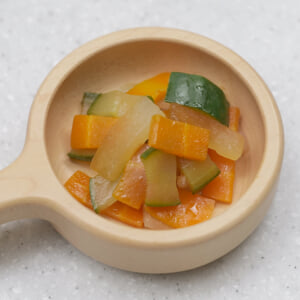
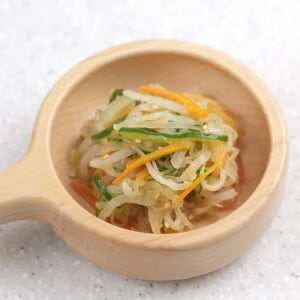
Bansansu (Glass Noodle Salad) (Elementary School Portion)
【小学校】バンサンスー · Bansansu
 By Aoi, licensed nutritionist · From a Japanese elementary school lunch menu
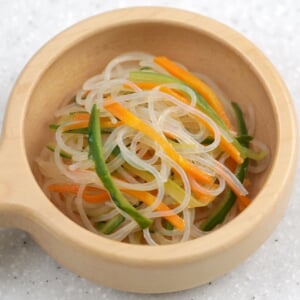
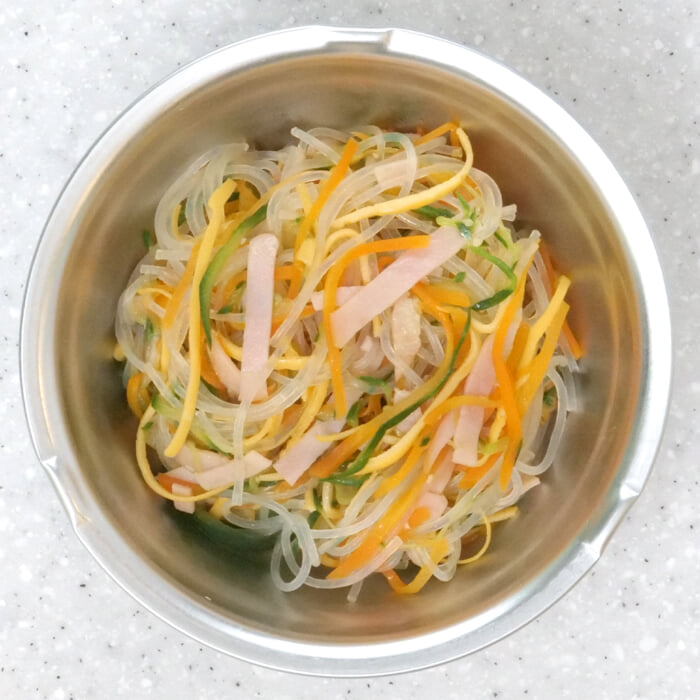
Bansansu is a chilled glass noodle salad that almost every child in Japan knows from school lunch. The name comes from the Chinese dish 拌三絲 (ban san si), meaning "three shredded things tossed together" - here that is carrot, cucumber and ham, with slippery harusame noodles and ribbons of thin egg omelet folded in. A light sweet-and-sour dressing with a little sesame oil makes it refreshing and easy to eat, and the noodles slurp right up, so even children who are wary of salads tend to finish it. This is the elementary school version of our preschool recipe.
Wheat-free, but uses soy sauce (made with wheat). Japanese school-lunch allergy menus usually allow it, so check with your doctor. How to read the labels
Added. Open the recipe helper (bottom right) → ☰ Menu → 🛒 Shopping list to see the ingredients for your family size.
Printing uses the number of adults and children set under Ingredients, so set those first.
Ingredients
Amounts for 1 child (1 serving). An adult counts as 2 servings.
One serving here is 1.5× the portion served to a child in a Japanese elementary school, sized for Western appetites. An adult counts as two servings. Tap an ingredient to check it off.
Ingredients
- 8.9 gharusame (glass noodles)Thin, translucent noodles made from potato or mung bean starch that soften quickly in hot water. Substitute: Mung bean glass noodles or thin rice vermicelli.
- 11.4 gcarrot
- 22.2 gcucumber
- 11.1 gham
- 19.2 gegg
Seasonings
- 2.6 gsugar
- 0.3 gsalt
- 2.1 gsoy sauce
- 6.6 gvinegar
- 2.1 gsesame oil
About the Japanese ingredients in this recipe
- harusame (glass noodles) (春雨)
- Thin, translucent noodles made from potato or mung bean starch that soften quickly in hot water. Substitute: Mung bean glass noodles or thin rice vermicelli.
Directions
- 1
Cut the carrot and cucumber into 4 cm matchsticks. Cut the ham in half to shorten it, then cut into thin strips.
- 2
Put the carrot in a pan of cold water, bring to a boil, and boil for 1 minute. Add the cucumber and ham; once the water returns to a boil, drain in a colander and rinse under running water to cool.
- 3
Cook the harusame in boiling water for the time given on the package. Drain in a colander and rinse under running water to cool.
- 4
In a heatproof container, combine the sugar, salt, soy sauce, vinegar and sesame oil, and microwave at 1200W for about 15 seconds. Let cool slightly.
- 5
Beat the egg, using the chopsticks or fork to cut through the whites. Line a frying pan with a generous sheet of nonstick frying-pan foil and warm it over low heat. Pour in the egg; as soon as it begins to set, tilt and swirl the pan to spread it into a thin round. When the egg no longer runs, cover with a lid and let the residual heat finish cooking it. Cut the omelet in half, stack the halves, and cut into thin strips.
- 6
Squeeze the vegetables and harusame to remove excess water, then toss with the dressing and the shredded egg. Chill in the refrigerator to let the flavors meld.
The shredded egg is optional - add it if you like.
Nutrition
| Per | 1 serving | 1 adult serving | Your total |
|---|---|---|---|
| Energy | 124.2 kcal | 248.4 kcal | 124.2 kcal |
| Protein | 4.9 g | 9.9 g | 4.9 g |
| Fat | 5.9 g | 11.7 g | 5.9 g |
| Carbohydrates | 12.8 g | 25.5 g | 12.8 g |
| Fiber | 0.8 g | 1.5 g | 0.8 g |
| Salt equivalent | 1 g | 2.1 g | 1 g |
| Calcium | 21 mg | 42 mg | 21 mg |
| Iron | 0.5 mg | 0.9 mg | 0.5 mg |
| Potassium | 145.4 mg | 290.7 mg | 145.4 mg |
| Energy | Protein | Fat | Carbs | Fiber | Salt equiv. | Calcium | Iron | Potassium | |
|---|---|---|---|---|---|---|---|---|---|
| 1 serving | 124.2 kcal | 4.9 g | 5.9 g | 12.8 g | 0.8 g | 1 g | 21 mg | 0.5 mg | 145.4 mg |
| 1 adult serving | 248.4 kcal | 9.9 g | 11.7 g | 25.5 g | 1.5 g | 2.1 g | 42 mg | 0.9 mg | 290.7 mg |
Values are per serving (1.5× the Japanese elementary-school portion); an adult serving is double. They were calculated by a licensed Japanese nutritionist using the Standard Tables of Food Composition in Japan. "Salt equivalent" is sodium × 2.54, the standard Japanese measure. Allergen flags cover egg, milk and wheat only and come from the nutritionist's records. Soy sauce and miso are made with wheat but are usually allowed on Japanese wheat-free school menus, so check with your doctor.
This is the elementary-school portion of Bansansu (Chinese-Style Glass Noodle Salad) (larger quantities, same method).