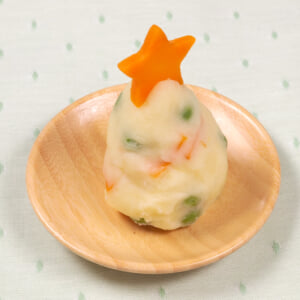
Okahijiki (Saltwort) Salad with Mayonnaise
おかひじきのマヨネーズ和え · Okahijiki no Mayonēzu Ae
 By Aoi, licensed nutritionist · From a Japanese preschool lunch menu
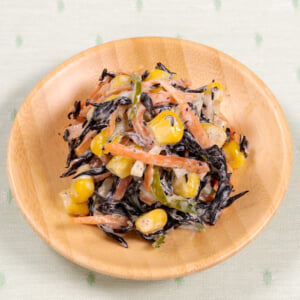
Okahijiki is a succulent green with slender, needle-like leaves; its name means "land hijiki" because it looks so much like the hijiki seaweed. It has a gentle flavor and a pleasant, crisp bite that holds up even after boiling, and it is a well-known specialty of Yamagata Prefecture. Here it is paired with cucumber, carrot and sweet corn and dressed simply with mayonnaise, so the colors are bright and the taste is mild enough that children who are wary of new vegetables will still take to it. Cutting everything short and fine keeps the salad easy to scoop up with a small spoon.
Added. Open the recipe helper (bottom right) → ☰ Menu → 🛒 Shopping list to see the ingredients for your family size.
Printing uses the number of adults and children set under Ingredients, so set those first.
Ingredients
Amounts for 1 child (1 serving). An adult counts as 2 servings.
One serving here is 1.5× the portion served to a child in a Japanese preschool, sized for Western appetites. An adult counts as two servings. Tap an ingredient to check it off.
Ingredients
- 17.1 gokahijiki (saltwort)A crisp, slightly salty green vegetable with needle-like leaves, sometimes called land seaweed. Substitute: Samphire, or thinly sliced green beans.
- 18.9 gcucumber
- 12.9 gcarrot
- 12 gcanned corn
Seasonings
- 7.5 gmayonnaise
- 0.2 gsalt
- to tastepepper
About the Japanese ingredients in this recipe
- okahijiki (saltwort) (おかひじき)
- A crisp, slightly salty green vegetable with needle-like leaves, sometimes called land seaweed. Substitute: Samphire, or thinly sliced green beans.
Directions
- 1
Cut the okahijiki into 3-4 cm lengths (trim off the lower stems, as they are tough), and cut the carrot and cucumber into short, fine matchsticks.
- 2
Boil each of the vegetables from step 1 separately, then rinse under cold running water. Drain the canned corn in a colander.
- 3
Squeeze the vegetables from step 2 well to remove excess water, then toss them with the seasonings.
Nutrition
| Per | 1 serving | 1 adult serving | Your total |
|---|---|---|---|
| Energy | 69 kcal | 138 kcal | 69 kcal |
| Protein | 0.9 g | 1.8 g | 0.9 g |
| Fat | 5.9 g | 11.7 g | 5.9 g |
| Carbohydrates | 3.6 g | 7.2 g | 3.6 g |
| Salt equivalent | 0.5 g | 0.9 g | 0.5 g |
| Calcium | 34.5 mg | 69 mg | 34.5 mg |
| Iron | 0.5 mg | 0.9 mg | 0.5 mg |
| Energy | Protein | Fat | Carbs | Salt equiv. | Calcium | Iron | |
|---|---|---|---|---|---|---|---|
| 1 serving | 69 kcal | 0.9 g | 5.9 g | 3.6 g | 0.5 g | 34.5 mg | 0.5 mg |
| 1 adult serving | 138 kcal | 1.8 g | 11.7 g | 7.2 g | 0.9 g | 69 mg | 0.9 mg |
Values are per serving (1.5× the Japanese preschool portion); an adult serving is double. They were calculated by a licensed Japanese nutritionist using the Standard Tables of Food Composition in Japan. "Salt equivalent" is sodium × 2.54, the standard Japanese measure. Allergen flags cover egg, milk and wheat only and come from the nutritionist's records. Soy sauce and miso are made with wheat but are usually allowed on Japanese wheat-free school menus, so check with your doctor.