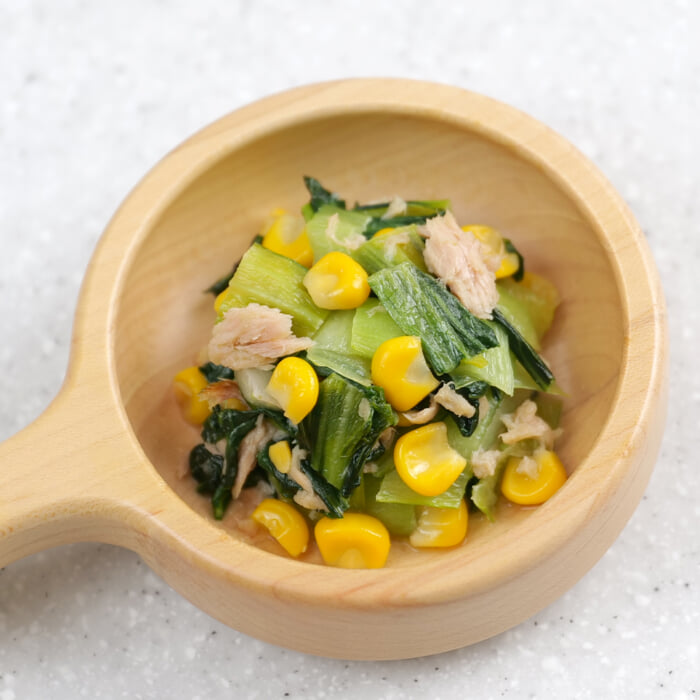
Sautéed Bok Choy with Corn and Tuna
チンゲン菜のソテー · Chingensai no Sauté
 By Aoi, licensed nutritionist · From a Japanese preschool lunch menu
Bok choy (chingensai in Japanese) is a regular on Japanese school lunch menus: it cooks in minutes and keeps its gentle sweetness even for children who are wary of leafy greens. Here it is sautéed with sweet corn and canned tuna and seasoned lightly with chicken stock, salt and pepper, so the corn and tuna do most of the work of winning kids over. The trick is to start the crisp stems first and add the tender leaves only at the end, so everything is soft but not soggy.
Added. Open the recipe helper (bottom right) → ☰ Menu → 🛒 Shopping list to see the ingredients for your family size.
Printing uses the number of adults and children set under Ingredients, so set those first.
Ingredients
Amounts for 1 child (1 serving). An adult counts as 2 servings.
One serving here is 1.5× the portion served to a child in a Japanese preschool, sized for Western appetites. An adult counts as two servings. Tap an ingredient to check it off.
Ingredients
- 63 gbok choy
- 18 gwhole kernel corn (canned or frozen)
- 7.5 gcanned tuna (in oil)
Seasonings
- 1.5 gvegetable oil
- 0.4 gchicken stock powder (Chinese-style)Japanese granulated chicken bone soup base used for Chinese-style soups and stir-fries. Substitute: Chicken bouillon granules or powder.
- 0.1 gsalt
- to tastepepper
About the Japanese ingredients in this recipe
- chicken stock powder (Chinese-style) (鶏ガラスープの素)
- Japanese granulated chicken bone soup base used for Chinese-style soups and stir-fries. Substitute: Chicken bouillon granules or powder.
Directions
- 1
Cut the bok choy into 2 cm pieces. Tip the canned tuna into a sieve and drain off the oil.
- 2
Heat the oil in a frying pan, add the bok choy stems and sauté well over medium heat. Once they are tender, add the leaves and sauté over low heat.
- 3
Add the drained corn, the tuna and the seasonings, and stir-fry briefly to combine.
Nutrition
| Per | 1 serving | 1 adult serving | Your total |
|---|---|---|---|
| Energy | 52.5 kcal | 105 kcal | 52.5 kcal |
| Protein | 2.3 g | 4.5 g | 2.3 g |
| Fat | 3.3 g | 6.6 g | 3.3 g |
| Carbohydrates | 4.4 g | 8.7 g | 4.4 g |
| Fiber | 1.4 g | 2.7 g | 1.4 g |
| Salt equivalent | 0.3 g | 0.6 g | 0.3 g |
| Calcium | 63 mg | 126 mg | 63 mg |
| Iron | 0.8 mg | 1.5 mg | 0.8 mg |
| Potassium | 205.5 mg | 411 mg | 205.5 mg |
| Energy | Protein | Fat | Carbs | Fiber | Salt equiv. | Calcium | Iron | Potassium | |
|---|---|---|---|---|---|---|---|---|---|
| 1 serving | 52.5 kcal | 2.3 g | 3.3 g | 4.4 g | 1.4 g | 0.3 g | 63 mg | 0.8 mg | 205.5 mg |
| 1 adult serving | 105 kcal | 4.5 g | 6.6 g | 8.7 g | 2.7 g | 0.6 g | 126 mg | 1.5 mg | 411 mg |
Values are per serving (1.5× the Japanese preschool portion); an adult serving is double. They were calculated by a licensed Japanese nutritionist using the Standard Tables of Food Composition in Japan. "Salt equivalent" is sodium × 2.54, the standard Japanese measure. Allergen flags cover egg, milk and wheat only and come from the nutritionist's records. Soy sauce and miso are made with wheat but are usually allowed on Japanese wheat-free school menus, so check with your doctor.