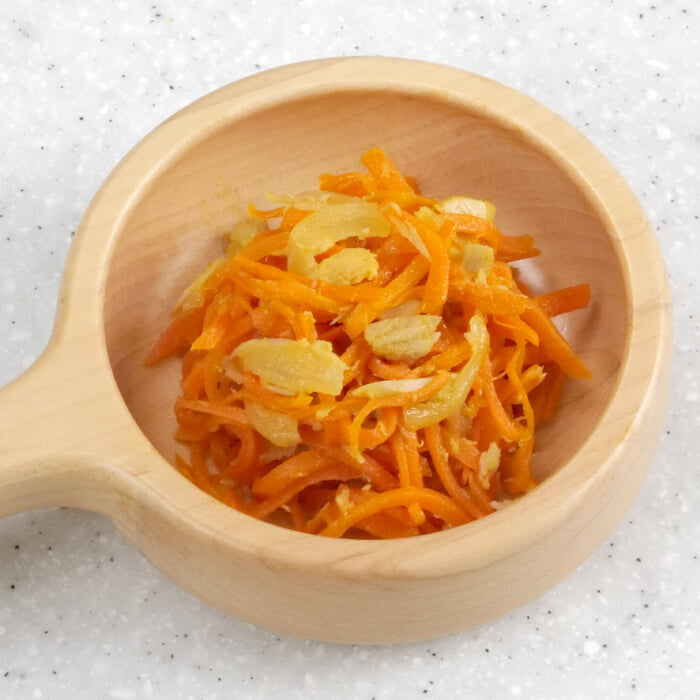
Ninjin Shirishiri (Okinawan Carrot Stir-Fry) (Egg-Free)
にんじんしりしりー(卵なし) · Ninjin Shirishiri
 By Aoi, licensed nutritionist · From a Japanese preschool lunch menu
Ninjin shirishiri is a home-style dish from Okinawa: finely shredded carrot stir-fried until tender and sweet, usually with egg and canned tuna. The name comes from the Okinawan word for the "shiri-shiri" sound of grating carrot against a shredder. This version leaves out the egg, and the tuna adds a savory flavor that makes even carrot-shy kids happy to eat a whole plateful. Cutting the carrot into short, thin strips keeps it soft and easy for small mouths to chew.
Wheat-free, but uses soy sauce (made with wheat). Japanese school-lunch allergy menus usually allow it, so check with your doctor. How to read the labels
Added. Open the recipe helper (bottom right) → ☰ Menu → 🛒 Shopping list to see the ingredients for your family size.
Printing uses the number of adults and children set under Ingredients, so set those first.
Ingredients
Amounts for 1 child (1 serving). An adult counts as 2 servings.
One serving here is 1.5× the portion served to a child in a Japanese preschool, sized for Western appetites. An adult counts as two servings. Tap an ingredient to check it off.
Ingredients
- 45 gcarrot
- 9 gonion
- 9 gcanned tuna (in oil)
Seasonings
- 2.6 gvegetable oil
- 0.2 gsalt
- to tastepepper
- 0.3 gsoy sauce
Directions
- 1
Cut the carrot into short, thin strips. Slice the onion thinly, then cut the slices in half. Drain the oil from the canned tuna.
- 2
Heat the oil in a frying pan, add the carrot and onion, and stir-fry well.
- 3
Once the vegetables are soft, add the seasonings and the tuna and stir-fry briefly.
Nutrition
| Per | 1 serving | 1 adult serving | Your total |
|---|---|---|---|
| Energy | 66 kcal | 132 kcal | 66 kcal |
| Protein | 2.1 g | 4.2 g | 2.1 g |
| Fat | 4.7 g | 9.3 g | 4.7 g |
| Carbohydrates | 4.9 g | 9.9 g | 4.9 g |
| Fiber | 1.4 g | 2.7 g | 1.4 g |
| Salt equivalent | 0.3 g | 0.6 g | 0.3 g |
| Calcium | 13.5 mg | 27 mg | 13.5 mg |
| Iron | 0.2 mg | 0.3 mg | 0.2 mg |
| Potassium | 171 mg | 342 mg | 171 mg |
| Energy | Protein | Fat | Carbs | Fiber | Salt equiv. | Calcium | Iron | Potassium | |
|---|---|---|---|---|---|---|---|---|---|
| 1 serving | 66 kcal | 2.1 g | 4.7 g | 4.9 g | 1.4 g | 0.3 g | 13.5 mg | 0.2 mg | 171 mg |
| 1 adult serving | 132 kcal | 4.2 g | 9.3 g | 9.9 g | 2.7 g | 0.6 g | 27 mg | 0.3 mg | 342 mg |
Values are per serving (1.5× the Japanese preschool portion); an adult serving is double. They were calculated by a licensed Japanese nutritionist using the Standard Tables of Food Composition in Japan. "Salt equivalent" is sodium × 2.54, the standard Japanese measure. Allergen flags cover egg, milk and wheat only and come from the nutritionist's records. Soy sauce and miso are made with wheat but are usually allowed on Japanese wheat-free school menus, so check with your doctor.