Ninjin Shirishiri (Okinawan Carrot Stir-Fry)
にんじんしりしりー · Ninjin Shirishiri
 By Aoi, licensed nutritionist · From a Japanese preschool lunch menu
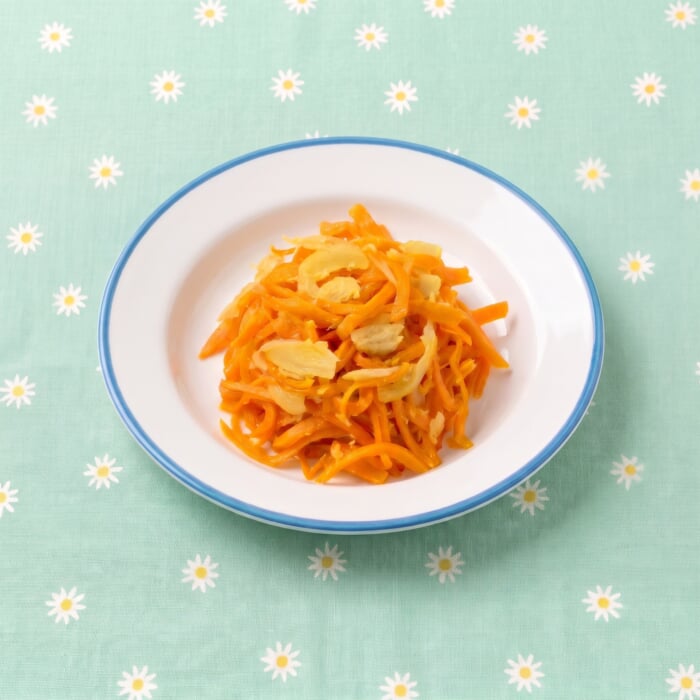
Ninjin shirishiri is a home-cooking staple from Okinawa: finely shredded carrot stir-fried with tuna and egg. The name comes from the Okinawan word for the "shiri shiri" sound of grating the carrots on a special coarse grater, though thin matchsticks cut with a knife work just as well. The carrot cooks down sweet and soft, the tuna adds just enough savoriness that only a touch of seasoning is needed, and the gentle egg makes the whole thing easy for small children to eat. Cooking in the oil from the tuna can means no extra oil, and it helps the body absorb the carrot's beta-carotene, too. This version is made without milk or dairy.
Toddlers to adults. The whole family can eat this exactly as written.
Wheat-free, but uses soy sauce (made with wheat). Japanese school-lunch allergy menus usually allow it, so check with your doctor. How to read the labels
Added. Open the recipe helper (bottom right) → ☰ Menu → 🛒 Shopping list to see the ingredients for your family size.
Printing uses the number of adults and children set under Ingredients, so set those first.
Ingredients
Amounts for 1 child (1 serving). An adult counts as 2 servings.
One serving here is 1.5× the portion served to a child in a Japanese preschool, sized for Western appetites. An adult counts as two servings. Tap an ingredient to check it off.
Ingredients
- 66 gcarrot
- 13.5 gcanned tuna (in oil)
- 13.5 gegg
Sauce Mixture (A)
- 0.5 gsoy sauce
- 0.3 gsalt
- to tastepepper
Directions
Video is in Japanese — the steps below are synced to it, so tap ▶ on a step to jump to that moment.
- 1
Cut the carrot into thin matchsticks. Open the tuna can and separate the oil from the tuna. Beat the egg. (Tip: slice the carrot thinly on the diagonal, lay the slices in a slightly overlapping row, and cut across from one end - you get even-length matchsticks quickly.)
- 2
Heat the oil from the tuna can in a frying pan and stir-fry the carrot over medium heat. Add a splash of water whenever it looks like it might stick or scorch, and cook for about 7 to 10 minutes, until the carrot is as tender as you like. (You can also make this in the microwave: in a heatproof bowl, mix the carrot with the oil from the tuna can, cover loosely with plastic wrap and microwave at 1200W for about 2 minutes (4 minutes at 600W). Add the egg, tuna and A, cover again and microwave at 1200W for about 1 minute 30 seconds (3 minutes at 600W), then stir to break up the egg.)
- 3
Add the beaten egg and stir-fry over low heat for about 40 seconds, coating the carrot with the egg.
- 4
Add the tuna, then add A a little at a time, tasting as you go, and stir-fry over low heat for about 1 minute.
Tips for Best Results
- Tuna canned in oil is recommended. You stir-fry in the oil from the can, so there is no need to add any extra oil, and the beta-carotene in the carrot is absorbed better when eaten with oil.
- With the sweetness of the carrot and the saltiness of the tuna, only a little seasoning is needed. Add it a little at a time, tasting as you go.
Freezing Instructions
Let cool, then pack single portions into freezer bags and freeze. To eat, reheat in the microwave.
Keeps for about 2 weeks (but enjoy it as soon as you can).
Nutrition
| Per | 1 serving | 1 adult serving | Your total |
|---|---|---|---|
| Energy | 79.5 kcal | 159 kcal | 79.5 kcal |
| Protein | 4.5 g | 9 g | 4.5 g |
| Fat | 4.5 g | 9 g | 4.5 g |
| Carbohydrates | 6.5 g | 12.9 g | 6.5 g |
| Fiber | 2 g | 3.9 g | 2 g |
| Salt equivalent | 0.6 g | 1.2 g | 0.6 g |
| Calcium | 25.5 mg | 51 mg | 25.5 mg |
| Iron | 0.5 mg | 0.9 mg | 0.5 mg |
| Potassium | 253.5 mg | 507 mg | 253.5 mg |
| Phosphorus | 63 mg | 126 mg | 63 mg |
| Energy | Protein | Fat | Carbs | Fiber | Salt equiv. | Calcium | Iron | Potassium | Phosphorus | |
|---|---|---|---|---|---|---|---|---|---|---|
| 1 serving | 79.5 kcal | 4.5 g | 4.5 g | 6.5 g | 2 g | 0.6 g | 25.5 mg | 0.5 mg | 253.5 mg | 63 mg |
| 1 adult serving | 159 kcal | 9 g | 9 g | 12.9 g | 3.9 g | 1.2 g | 51 mg | 0.9 mg | 507 mg | 126 mg |
Values are per serving (1.5× the Japanese preschool portion); an adult serving is double. They were calculated by a licensed Japanese nutritionist using the Standard Tables of Food Composition in Japan. "Salt equivalent" is sodium × 2.54, the standard Japanese measure. Allergen flags cover egg, milk and wheat only and come from the nutritionist's records. Soy sauce and miso are made with wheat but are usually allowed on Japanese wheat-free school menus, so check with your doctor.