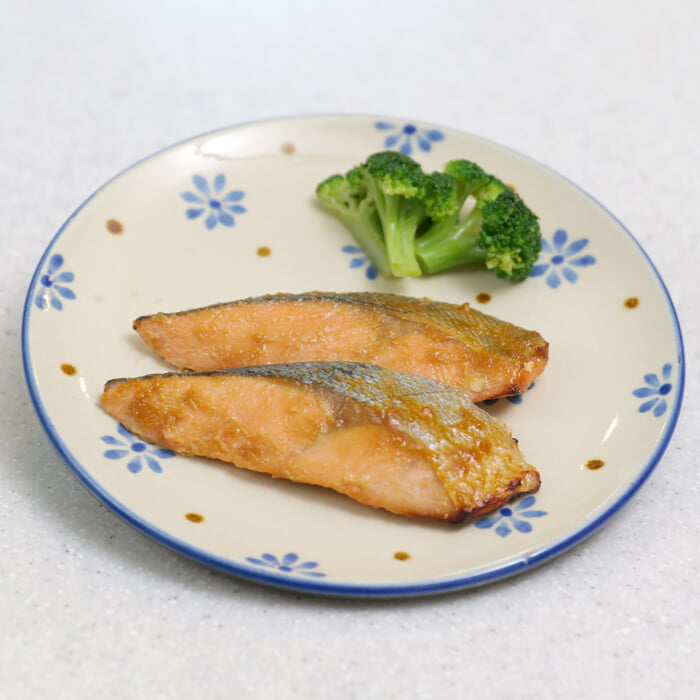
Miso-Glazed Salmon (Cooked from Frozen)
鮭の味噌焼き【オカフーズ版】 · Sake no Misoyaki
 By Aoi, licensed nutritionist · From a Japanese preschool lunch menu
Sake no misoyaki is salmon brushed with a gentle, slightly sweet miso sauce and baked until the glaze just catches at the edges. This version was written for the frozen boneless salmon fillets that many Japanese school kitchens buy from Oka Foods, a frozen-fish supplier, so the fish goes into the oven still frozen with no thawing needed. A splash of oil and a little potato starch in the sauce help it cling to the fish instead of sliding off, and the mild, rounded flavor of miso makes this one of the fish dishes children are happiest to eat. There is also a frying-pan method at the end for kitchens without an oven.
Added. Open the recipe helper (bottom right) → ☰ Menu → 🛒 Shopping list to see the ingredients for your family size.
Printing uses the number of adults and children set under Ingredients, so set those first.
Ingredients
Amounts for 1 child (1 serving). An adult counts as 2 servings.
One serving here is 1.5× the portion served to a child in a Japanese preschool, sized for Western appetites. An adult counts as two servings. Tap an ingredient to check it off.
Ingredients
- 67.5 gfrozen salmon
Seasonings
- 1.8 gmirinMirin is a sweet Japanese rice seasoning that adds gentle sweetness and a glossy finish. Hon-mirin (true mirin) contains about 14% alcohol; "mirin-style seasoning" has little or no alcohol. Some alcohol can remain after short cooking. If you prefer no alcohol for children, use the substitute. Substitute: For each tablespoon of mirin, use 1 tablespoon water plus 1 to 2 teaspoons sugar.
- 1.8 gmisoFermented soybean paste. Salty and savory, it is Japan's everyday seasoning for miso soup and many simmered dishes. Substitute: Any light (white or awase) miso. Misos differ in saltiness, so start with a little less and taste. Some misos are made with barley or wheat, so check the label if you avoid them.
- 0.8 gsugar
- 1 gsoy sauce
- 0.8 gvegetable oil
- 0.2 gpotato starch (katakuriko)Japanese potato starch used for thickening sauces and coating fried foods. Substitute: Cornstarch: start with the same amount and add a little more if it is still thin. It thickens a little less than potato starch and needs a couple of minutes at a gentle bubble to reach full thickness.
- 0.9 gwater
About the Japanese ingredients in this recipe
- mirin (みりん)
- Mirin is a sweet Japanese rice seasoning that adds gentle sweetness and a glossy finish. Hon-mirin (true mirin) contains about 14% alcohol; "mirin-style seasoning" has little or no alcohol. Some alcohol can remain after short cooking. If you prefer no alcohol for children, use the substitute. Substitute: For each tablespoon of mirin, use 1 tablespoon water plus 1 to 2 teaspoons sugar.
- miso (みそ)
- Fermented soybean paste. Salty and savory, it is Japan's everyday seasoning for miso soup and many simmered dishes. Substitute: Any light (white or awase) miso. Misos differ in saltiness, so start with a little less and taste. Some misos are made with barley or wheat, so check the label if you avoid them.
- potato starch (katakuriko) (かたくり粉)
- Japanese potato starch used for thickening sauces and coating fried foods. Substitute: Cornstarch: start with the same amount and add a little more if it is still thin. It thickens a little less than potato starch and needs a couple of minutes at a gentle bubble to reach full thickness. Read the guide: Katakuriko (Japanese Potato Starch) and What to Use Instead → Guide: japanese-school-lunch.com/articles/katakuriko-potato-starch/
Directions
- 1
Put the mirin in a microwave-safe container and microwave it uncovered at 1200W for about 25 to 30 seconds (50 to 60 seconds at 600W) to cook off the alcohol.
- 2
Add the miso, sugar, soy sauce, oil, potato starch and water to the mirin and mix well. Microwave uncovered at 1200W for about 15 to 20 seconds (30 to 40 seconds at 600W) to thicken the sauce. Let it cool (as it cools, the oil and potato starch blend into the sauce).
- 3
Preheat the oven to 230°C (450°F).
- 4
Put the salmon, still frozen, into a tray or bowl, add 2/3 of the sauce and turn the fish to coat.
- 5
Arrange the salmon on a baking sheet lined with parchment paper.
- 6
Place a tray filled with hot water on the lower rack of the oven and bake the salmon at 230°C (450°F) for 10 minutes. Take it out, brush on the remaining sauce and bake at 230°C (450°F) for another 5 minutes. Note: If you are using fresh (unfrozen) salmon, set the oven to 200°C (400°F) and follow the same method otherwise.
- 7
Alternatively, cook the salmon in a frying pan as follows.
- 8
Line a frying pan with nonstick cooking foil (frying-pan foil), arrange the salmon in the pan and cover with a lid.
- 9
Turn on the heat and cook over medium-low heat for 5 minutes. Flip the salmon, cover again and cook over medium-low heat for another 5 minutes.
- 10
Remove the lid, lower the heat to low and brush the sauce onto the salmon. Turn the pieces as you go so every side is coated in sauce. Note: The sauce burns easily, so keep an eye on the pan as it cooks.
Nutrition
| Per | 1 serving | 1 adult serving | Your total |
|---|---|---|---|
| Energy | 103.5 kcal | 207 kcal | 103.5 kcal |
| Protein | 15.5 g | 30.9 g | 15.5 g |
| Fat | 3.9 g | 7.8 g | 3.9 g |
| Carbohydrates | 1.8 g | 3.6 g | 1.8 g |
| Salt equivalent | 0.5 g | 0.9 g | 0.5 g |
| Calcium | 9 mg | 18 mg | 9 mg |
| Iron | 0.5 mg | 0.9 mg | 0.5 mg |
| Energy | Protein | Fat | Carbs | Salt equiv. | Calcium | Iron | |
|---|---|---|---|---|---|---|---|
| 1 serving | 103.5 kcal | 15.5 g | 3.9 g | 1.8 g | 0.5 g | 9 mg | 0.5 mg |
| 1 adult serving | 207 kcal | 30.9 g | 7.8 g | 3.6 g | 0.9 g | 18 mg | 0.9 mg |
Values are per serving (1.5× the Japanese preschool portion); an adult serving is double. They were calculated by a licensed Japanese nutritionist using the Standard Tables of Food Composition in Japan. "Salt equivalent" is sodium × 2.54, the standard Japanese measure. Allergen flags cover egg, milk and wheat only and come from the nutritionist's records. Soy sauce and miso are made with wheat but are usually allowed on Japanese wheat-free school menus, so check with your doctor.
Cooking for bigger kids? See the elementary-school portion of this recipe.