Minestrone
ミネストローネ
 By Aoi, licensed nutritionist · From a Japanese preschool lunch menu
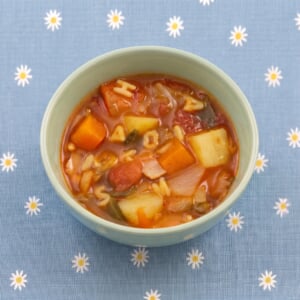
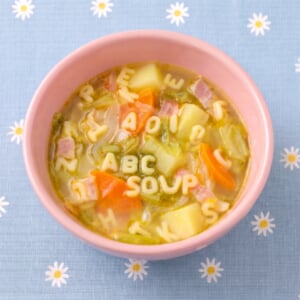
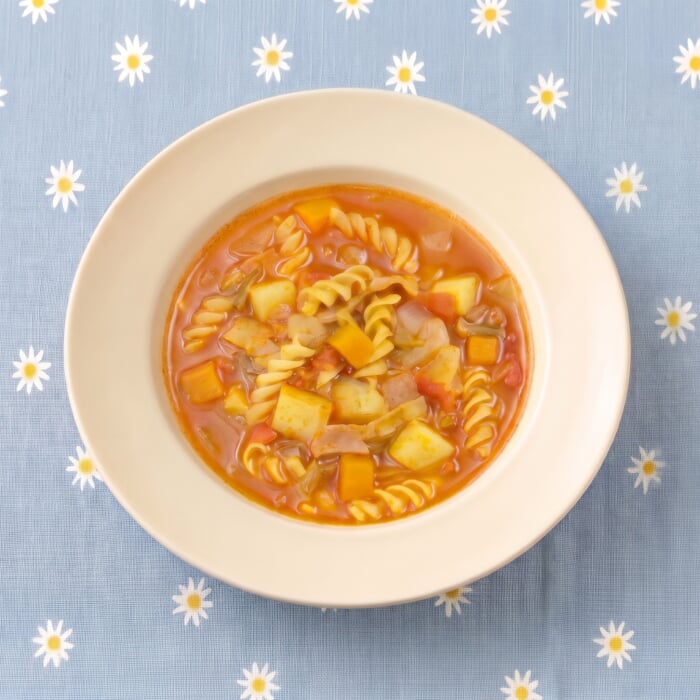
Minestrone, the Italian vegetable soup, is a regular on Japanese school lunch menus, and this is the version from our preschool kitchen. Carrot, onion, cabbage, and potato are cut into small 1 cm dice so they fit easily on a toddler's spoon, and the tomatoes are simmered long enough to cook off their sharpness, leaving a gentle, rounded flavor. A little bacon brings savory depth, and the macaroni goes in at the very end so it stays pleasantly tender rather than soaking up the broth.
Toddlers to adults. The whole family can eat this exactly as written.
Added. Open the recipe helper (bottom right) → ☰ Menu → 🛒 Shopping list to see the ingredients for your family size.
Printing uses the number of adults and children set under Ingredients, so set those first.
Ingredients
Amounts for 1 child (1 serving). An adult counts as 2 servings.
One serving here is 1.5× the portion served to a child in a Japanese preschool, sized for Western appetites. An adult counts as two servings. Tap an ingredient to check it off.
- 12 gbacon
- 18 gcarrot
- 24 gonion
- 24 gcabbage
- 30 gpotato
- 0.8 ggarlic paste (tube)Grated garlic sold ready to use in a squeeze tube, a staple in Japanese kitchens. Japanese school lunch kitchens grate fresh garlic for its aroma, but for cooking at home Aoi says the tube works just fine. Tube pastes often contain added salt, oil and other ingredients, so check the label. Substitute: Use freshly grated garlic in the same amount. 1 teaspoon of paste is about 5 g.
- 1.5 gvegetable oil
- 225 mlwater
- 3 gconsommé bouillon (granules or cube)Japanese-style Western soup stock powder or cubes, similar to chicken or vegetable bouillon. Substitute: Chicken or vegetable bouillon granules or a bouillon cube.
- 54 gcanned diced tomatoes
- 3.6 gketchup
- 10.5 gmacaroni
- 0.5 gsalt
- to tastepepper
About the Japanese ingredients in this recipe
- garlic paste (tube) (にんにくチューブ)
- Grated garlic sold ready to use in a squeeze tube, a staple in Japanese kitchens. Japanese school lunch kitchens grate fresh garlic for its aroma, but for cooking at home Aoi says the tube works just fine. Tube pastes often contain added salt, oil and other ingredients, so check the label. Substitute: Use freshly grated garlic in the same amount. 1 teaspoon of paste is about 5 g.
- consommé bouillon (granules or cube) (コンソメ)
- Japanese-style Western soup stock powder or cubes, similar to chicken or vegetable bouillon. Substitute: Chicken or vegetable bouillon granules or a bouillon cube.
Directions
Video is in Japanese — the steps below are synced to it, so tap ▶ on a step to jump to that moment.
- 1
Cut the carrot, onion, cabbage, and potato into 1 cm dice, and soak the potato in water for about 5 minutes. Cut the bacon into 1 cm wide strips.
- 2
Put the carrot, onion, cabbage, and 1 tbsp water (not included in the ingredient amounts) in a microwave-safe container and stir lightly. Cover loosely with plastic wrap, leaving a gap for steam, and microwave at 1200W for about 2 minutes 30 seconds (5 minutes at 600W). Add the potato, stir, and microwave for about 30 seconds more (1 minute at 600W). (Heating time varies with the amount. The vegetables are ready when a skewer slides easily into the carrot.)
- 3
Heat the oil in a pot, add the microwaved vegetables, the bacon, and the garlic paste, and sauté over medium heat for about 3 minutes. Add the water and consommé and bring to a boil over high heat. Once boiling, add the diced tomatoes and ketchup and simmer over low heat for about 20 minutes. (Cooking off the acidity of the tomatoes is the key here. If you have time, simmering for 30 minutes or more gives an even richer flavor.)
- 4
Add the macaroni and simmer over low heat until cooked through, then season with salt and pepper. (Macaroni soaks up liquid as it sits, so add it just before serving.)
Tips for the Best Flavor
- Sautéing until the bacon smells fragrant makes the soup much tastier. If you have time, frying the bacon on its own first brings out even more savory depth.
- Letting the soup cool to room temperature once and then reheating it lets the flavors settle and improves the taste. If you do this, add the macaroni when you reheat.
Freezing
Remove the potato, since its texture changes when frozen. Before adding the macaroni, let the soup cool to room temperature, then divide into single portions in freezer bags and freeze. To serve, reheat in the microwave and add freshly boiled macaroni.
Keeps for about 2 weeks (enjoy as soon as possible).
Nutrition
| Per | 1 serving | 1 adult serving | Your total |
|---|---|---|---|
| Energy | 139.5 kcal | 279 kcal | 139.5 kcal |
| Protein | 5.1 g | 10.2 g | 5.1 g |
| Fat | 4.4 g | 8.7 g | 4.4 g |
| Carbohydrates | 22.8 g | 45.6 g | 22.8 g |
| Fiber | 5.3 g | 10.5 g | 5.3 g |
| Salt equivalent | 2.3 g | 4.5 g | 2.3 g |
| Calcium | 28.5 mg | 57 mg | 28.5 mg |
| Iron | 0.8 mg | 1.5 mg | 0.8 mg |
| Potassium | 451.5 mg | 903 mg | 451.5 mg |
| Phosphorus | 88.5 mg | 177 mg | 88.5 mg |
| Energy | Protein | Fat | Carbs | Fiber | Salt equiv. | Calcium | Iron | Potassium | Phosphorus | |
|---|---|---|---|---|---|---|---|---|---|---|
| 1 serving | 139.5 kcal | 5.1 g | 4.4 g | 22.8 g | 5.3 g | 2.3 g | 28.5 mg | 0.8 mg | 451.5 mg | 88.5 mg |
| 1 adult serving | 279 kcal | 10.2 g | 8.7 g | 45.6 g | 10.5 g | 4.5 g | 57 mg | 1.5 mg | 903 mg | 177 mg |
Values are per serving (1.5× the Japanese preschool portion); an adult serving is double. They were calculated by a licensed Japanese nutritionist using the Standard Tables of Food Composition in Japan. "Salt equivalent" is sodium × 2.54, the standard Japanese measure. Allergen flags cover egg, milk and wheat only and come from the nutritionist's records. Soy sauce and miso are made with wheat but are usually allowed on Japanese wheat-free school menus, so check with your doctor.
Cooking for bigger kids? See the elementary-school portion of this recipe.