Minestrone (Elementary School Portion)
【小学校】ミネストローネ
 By Aoi, licensed nutritionist · From a Japanese elementary school lunch menu
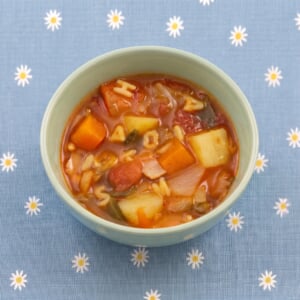
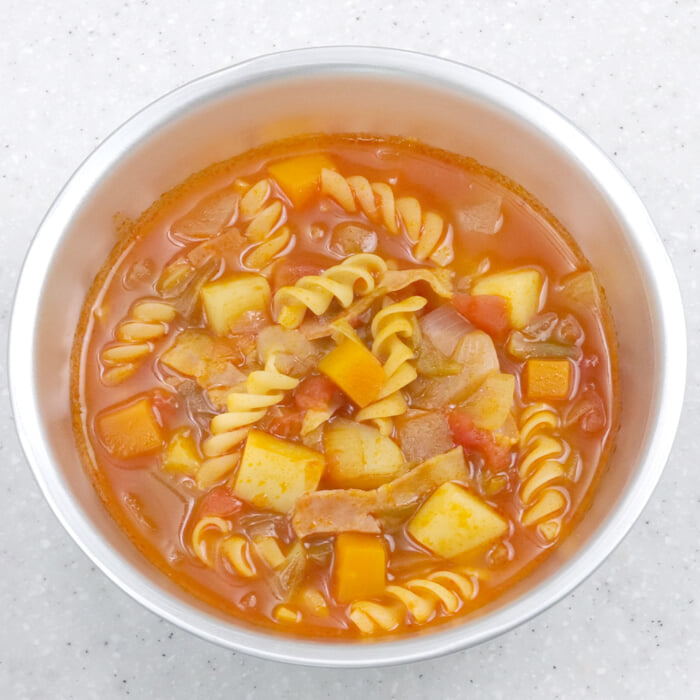
Minestrone, the Italian vegetable soup, is a regular on Japanese school lunch menus, and this is the elementary school version. Carrot, onion, cabbage, and potato are cut into small dice so every spoonful is easy for children to eat, and a little ketchup rounds off the acidity of the tomatoes so the soup tastes mild and sweet. Giving the vegetables a head start in the microwave means they turn soft and tender without a long time at the stove, and a handful of macaroni makes it filling enough to hold its own alongside bread or rice.
Added. Open the recipe helper (bottom right) → ☰ Menu → 🛒 Shopping list to see the ingredients for your family size.
Printing uses the number of adults and children set under Ingredients, so set those first.
Ingredients
Amounts for 1 child (1 serving). An adult counts as 2 servings.
One serving here is 1.5× the portion served to a child in a Japanese elementary school, sized for Western appetites. An adult counts as two servings. Tap an ingredient to check it off.
Ingredients
- 17.7 gcarrot
- 22.2 gonion
- 22.2 gcabbage
- 29.9 gpotato
- 12.1 gbacon
- 222 gwater
- 52.1 gcanned diced tomatoes
- 10.2 gmacaroni
Seasonings
- 0.8 ggarlic paste (tube)Grated garlic sold ready to use in a squeeze tube, a staple in Japanese kitchens. Japanese school lunch kitchens grate fresh garlic for its aroma, but for cooking at home Aoi says the tube works just fine. Tube pastes often contain added salt, oil and other ingredients, so check the label. Substitute: Use freshly grated garlic in the same amount. 1 teaspoon of paste is about 5 g.
- 1.4 gvegetable oil
- 2.8 gconsommé bouillon (granules or cube)Japanese-style Western soup stock powder or cubes, similar to chicken or vegetable bouillon. Substitute: Chicken or vegetable bouillon granules or a bouillon cube.
- 3.6 gketchup
- 0.3 gsalt
- to tastepepper
About the Japanese ingredients in this recipe
- garlic paste (tube) (にんにくチューブ)
- Grated garlic sold ready to use in a squeeze tube, a staple in Japanese kitchens. Japanese school lunch kitchens grate fresh garlic for its aroma, but for cooking at home Aoi says the tube works just fine. Tube pastes often contain added salt, oil and other ingredients, so check the label. Substitute: Use freshly grated garlic in the same amount. 1 teaspoon of paste is about 5 g.
- consommé bouillon (granules or cube) (コンソメ)
- Japanese-style Western soup stock powder or cubes, similar to chicken or vegetable bouillon. Substitute: Chicken or vegetable bouillon granules or a bouillon cube.
Directions
- 1
Cut the carrot, onion, cabbage, and potato into 1 cm dice.
- 2
Put the carrot, onion, and cabbage in a microwave-safe bowl, add 1 tbsp water (not included in the ingredient amounts), toss lightly, cover with plastic wrap, and microwave at 1200W for about 2 minutes 30 seconds. Add the potato and microwave for about 30 seconds more.
- 3
Cut the bacon into 1 cm strips.
- 4
Heat the oil in a pot, add the microwaved vegetables, bacon, and garlic paste, and sauté over medium heat for about 3 minutes. (If you have time, frying the bacon on its own first brings out more savory flavor and makes the soup even tastier.)
- 5
Add the water and consommé and bring to a boil over high heat. Once it comes to a boil, add the diced tomatoes and ketchup and simmer over low heat for about 20 minutes. (If you have time, simmering for 30 minutes or longer cooks off the acidity and makes it even more delicious!)
- 6
Add the macaroni and simmer briefly over low heat until the macaroni is cooked through.
- 7
Finally, add the salt and pepper and adjust the seasoning.
* Microwave times vary with the amount you are making, so keep an eye on the vegetables and adjust as needed.
* Letting the soup cool once lets the flavors settle. If you do this, add the macaroni when you reheat it.
* When making a large batch, 20 minutes of simmering may not be enough to cook off the acidity.
Nutrition
| Per | 1 serving | 1 adult serving | Your total |
|---|---|---|---|
| Energy | 138.8 kcal | 277.5 kcal | 138.8 kcal |
| Protein | 5.1 g | 10.2 g | 5.1 g |
| Fat | 4.2 g | 8.4 g | 4.2 g |
| Carbohydrates | 22.7 g | 45.3 g | 22.7 g |
| Fiber | 5.1 g | 10.2 g | 5.1 g |
| Salt equivalent | 2.1 g | 4.2 g | 2.1 g |
| Calcium | 26.6 mg | 53.1 mg | 26.6 mg |
| Iron | 0.6 mg | 1.2 mg | 0.6 mg |
| Potassium | 449.6 mg | 899.1 mg | 449.6 mg |
| Energy | Protein | Fat | Carbs | Fiber | Salt equiv. | Calcium | Iron | Potassium | |
|---|---|---|---|---|---|---|---|---|---|
| 1 serving | 138.8 kcal | 5.1 g | 4.2 g | 22.7 g | 5.1 g | 2.1 g | 26.6 mg | 0.6 mg | 449.6 mg |
| 1 adult serving | 277.5 kcal | 10.2 g | 8.4 g | 45.3 g | 10.2 g | 4.2 g | 53.1 mg | 1.2 mg | 899.1 mg |
Values are per serving (1.5× the Japanese elementary-school portion); an adult serving is double. They were calculated by a licensed Japanese nutritionist using the Standard Tables of Food Composition in Japan. "Salt equivalent" is sodium × 2.54, the standard Japanese measure. Allergen flags cover egg, milk and wheat only and come from the nutritionist's records. Soy sauce and miso are made with wheat but are usually allowed on Japanese wheat-free school menus, so check with your doctor.
This is the elementary-school portion of Minestrone (larger quantities, same method).