Melon
メロン
 By Aoi, licensed nutritionist · From a Japanese preschool lunch menu
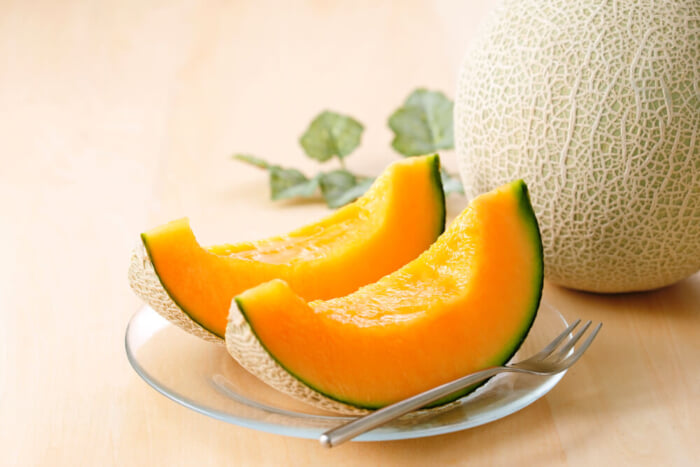
Fresh melon is one of the simplest and most welcomed snacks in a Japanese preschool kitchen; its sweet, juicy flesh needs no seasoning at all. What matters is how it is cut. In preschool kitchens we prepare the same melon differently for each age group, so that the youngest children get soft, bite-sized pieces they can manage on their own, while older children enjoy a wedge they can pick up and eat from the rind.
Added. Open the recipe helper (bottom right) → ☰ Menu → 🛒 Shopping list to see the ingredients for your family size.
Printing uses the number of adults and children set under Ingredients, so set those first.
Ingredients
Amounts for 1 child (1 serving). An adult counts as 2 servings.
One serving here is 1.5× the portion served to a child in a Japanese preschool, sized for Western appetites. An adult counts as two servings. Tap an ingredient to check it off.
- 60 gmelon
Directions
- 1
For children under 3, remove the rind and seeds. For children 3 and over, leave the wedge on the rind and score the rind with a few cuts. For the late weaning stage (around 12 to 18 months), remove the rind and seeds and cut the melon into small cubes.
Nutrition
| Per | 1 serving | 1 adult serving | Your total |
|---|---|---|---|
| Energy | 27 kcal | 54 kcal | 27 kcal |
| Protein | 0.6 g | 1.2 g | 0.6 g |
| Fat | 0 g | 0 g | 0 g |
| Carbohydrates | 6.3 g | 12.6 g | 6.3 g |
| Fiber | 0.3 g | 0.6 g | 0.3 g |
| Salt equivalent | 0 g | 0 g | 0 g |
| Calcium | 3 mg | 6 mg | 3 mg |
| Iron | 0.2 mg | 0.3 mg | 0.2 mg |
| Potassium | 210 mg | 420 mg | 210 mg |
| Energy | Protein | Fat | Carbs | Fiber | Salt equiv. | Calcium | Iron | Potassium | |
|---|---|---|---|---|---|---|---|---|---|
| 1 serving | 27 kcal | 0.6 g | 0 g | 6.3 g | 0.3 g | 0 g | 3 mg | 0.2 mg | 210 mg |
| 1 adult serving | 54 kcal | 1.2 g | 0 g | 12.6 g | 0.6 g | 0 g | 6 mg | 0.3 mg | 420 mg |
Values are per serving (1.5× the Japanese preschool portion); an adult serving is double. They were calculated by a licensed Japanese nutritionist using the Standard Tables of Food Composition in Japan. "Salt equivalent" is sodium × 2.54, the standard Japanese measure. Allergen flags cover egg, milk and wheat only and come from the nutritionist's records. Soy sauce and miso are made with wheat but are usually allowed on Japanese wheat-free school menus, so check with your doctor.